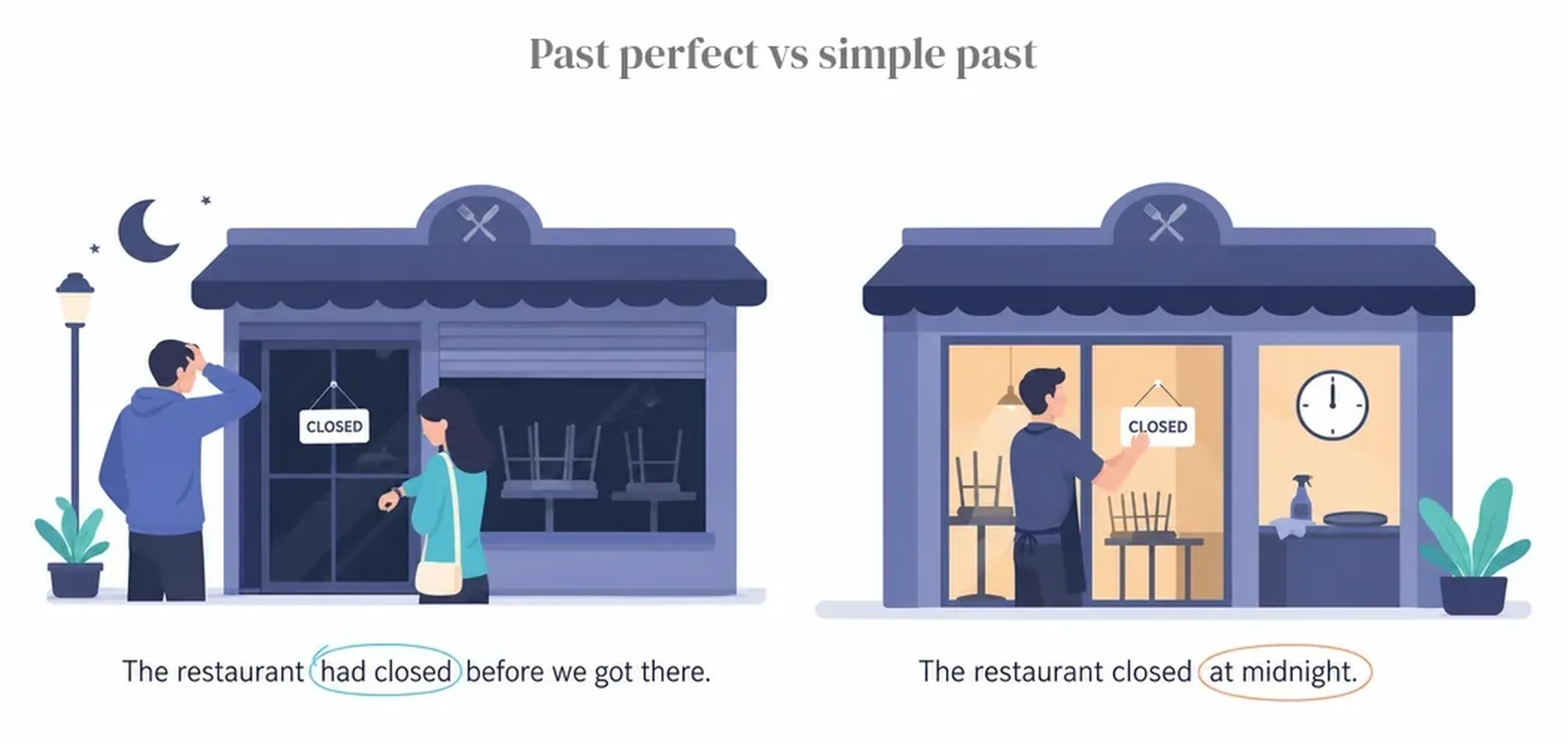
Understanding the Key Difference
Both past perfect and simple past describe actions in the past, but they show different timing relationships. The simple past tells you what happened, while the past perfect tells you what happened before that. Think of the past perfect as the 'earlier past' — it helps you establish a timeline by showing which action came first. When you need to clarify the sequence of past events, the past perfect becomes essential for clear storytelling and context.

Past Perfect vs Simple Past: Side-by-Side Comparison
| Dimension | Past Perfect | Simple Past |
|---|---|---|
| Form | had + past participle (3rd form) e.g., had eaten, had gone, had finished |
Verb in past form (regular: verb + -ed; irregular: 2nd form) e.g., ate, went, finished |
| When to use | To describe an action that was completed before another past action or a specific point in the past. Sets the earlier event in a sequence of two past events. | To describe a completed action at a definite time in the past, a sequence of past events in order, or past habits and states. |
| Positive example | She had already left when I arrived. They had finished dinner before the guests came. |
She left at six o'clock. They finished dinner and then watched a film. |
| Negative example | He hadn't studied before the exam started. We had not met before that evening. |
He didn't study for the exam. We did not meet last week. |
| Question example | Had you ever visited Paris before you moved there? Had she spoken to him before the meeting? |
Did you visit Paris last year? Did she speak to him yesterday? |
| Key signal words | already, just, never, ever, before, after, by the time, once, until, as soon as (used to link two past events) | yesterday, last night / week / year, ago, in 2005, at that moment, then, when, finally, first, next |
| 🔑 Key Difference: The simple past refers to a single completed action or event at a known time in the past, with no reference to another past event. The past perfect is used specifically when you need to make clear that one past action happened before another past action or point in time — it establishes a "further back in the past" relationship. When only one past event is mentioned, the simple past is usually sufficient; the past perfect becomes essential when sequencing or contrasting two past events. | ||
Examples

She had studied French for five years before she moved to Paris.
Past Perfect · Showing earlier action
①She studied French for five years
→
②She moved to Paris

By the time he arrived, we had already eaten dinner.
Past Perfect · Completed before a specific moment
①we ate dinner
→
②he arrived

They had written three letters before the post office closed.
Past Perfect · Sequential action emphasis
①They wrote three letters
→
②Post office closed

She studied French and then moved to Paris.
Simple Past · Straightforward sequence
①She studied French
→
②She moved to Paris

He arrived late, so we started without him.
Simple Past · Two separate past events
①we started without him
→
②he arrived late

They wrote three letters and posted them yesterday.
Simple Past · Completed actions in past
①They wrote three letters
→
②posted them yesterday
When to use it
Storytelling
Use past perfect when recounting a narrative where you need to explain what happened first before moving to the main story.
"Before the accident occurred, he had been driving recklessly for hours."
Explaining Cause & Effect
Use past perfect to show why something happened in the past by referencing an earlier event.
"The report was late because the data had not arrived on time."
Setting Context
Use past perfect to establish background information before introducing a main past event.
"He had never seen snow before he moved to Canada, where it had snowed every winter."
Deadline-Related Situations
Use past perfect with time expressions like 'by the time,' 'before,' or 'when' to emphasize completion before a deadline.
"By midnight, they had completed the entire project."
Signal words
before
after
when
by the time
by then
previously
already
just
earlier
once
Common Mistakes
✕
Wrong
When I arrived at the station, the train left.
✓
Correct
When I arrived at the station, the train had left.
The train's departure happened before arrival, so use past perfect for the earlier action.
✕
Wrong
She had gone to the shop and had bought milk and had made coffee.
✓
Correct
She had gone to the shop and bought milk, then made coffee.
Use past perfect only for the first action; use simple past for subsequent events in order.
✕
Wrong
After he finished his work, he had gone home.
✓
Correct
After he finished his work, he went home.
The word 'after' already shows sequence; both actions can use simple past without past perfect.
KEY TAKEAWAYS
What to Remember
- Use past perfect for the earlier action and simple past for the later action in a sequence.
- Past perfect is formed with 'had' plus the past participle of the main verb.
- The past perfect establishes a clear timeline when describing two past events together.
- Simple past alone can work for chronological narratives, but past perfect clarifies complex sequences.
- Don't use past perfect for single isolated past events—use simple past instead.