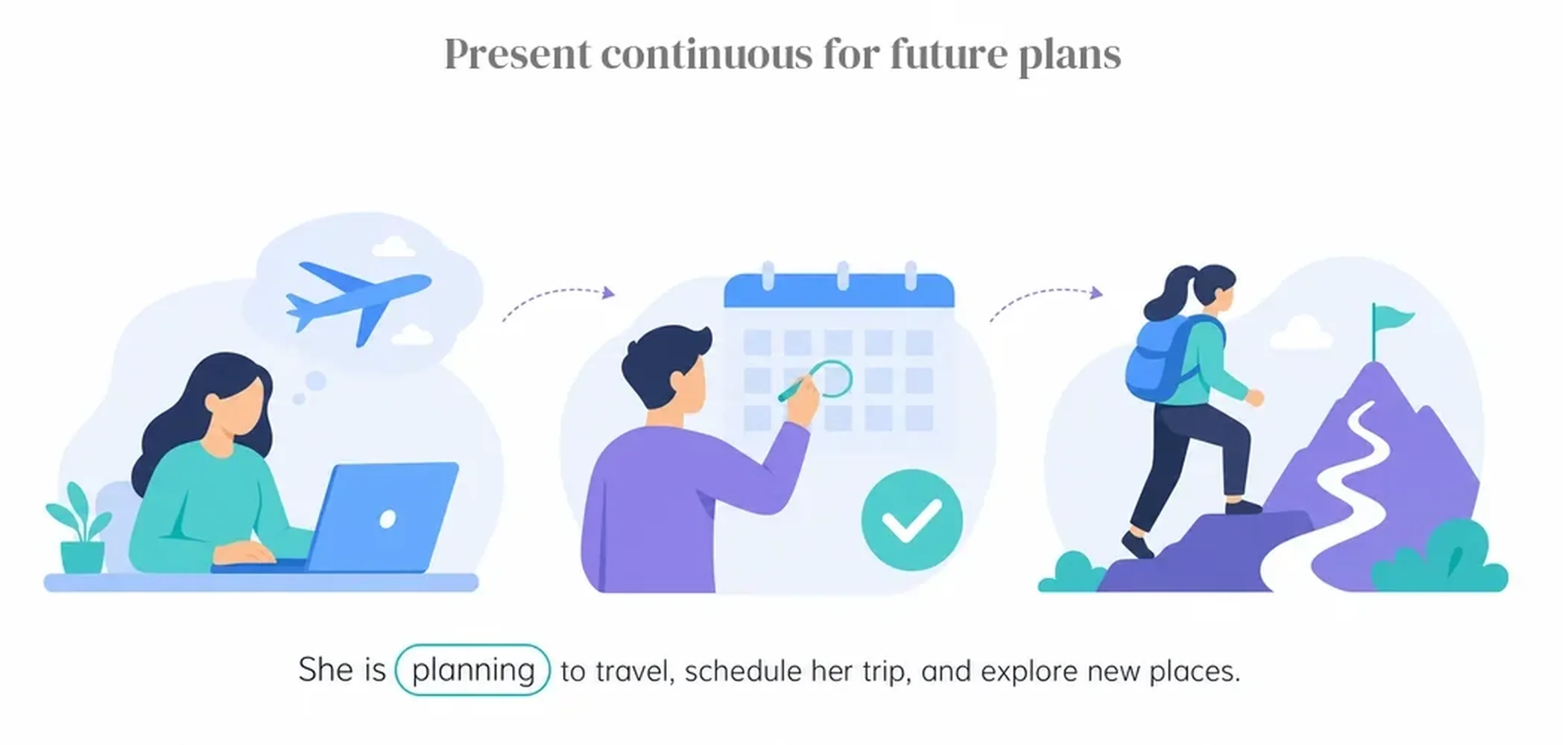
What is Present Continuous for Future?
The present continuous tense can talk about the future. We use it to describe plans or arrangements that we have already decided. The plan is often fixed and definite. For example, if you buy a ticket for a concert next week, you are going to that concert. You can say: "I am going to a concert next week." This is different from just an idea or wish—it is something you have planned.

When to Use Present Continuous for Future Plans
Use present continuous for future when: the arrangement is already decided and definite, you usually have a ticket or confirmation, the event is soon (days or weeks away, not months), and someone else might be involved or you have made a commitment. Common situations include: travel plans, appointments, meetings, events, and activities with friends or family. Do NOT use it for predictions or dreams that are not planned yet.
Present Continuous vs. Going to for Future
Present continuous (is/are + -ing) and "going to" both talk about future plans, but they are used in different contexts. Present continuous is typically used for plans that are already scheduled or arranged with specific details. For example: "I am visiting my grandmother tomorrow" (I have made arrangements; perhaps I have a ticket or a confirmed time). "Going to" is used when you have made a decision about the future but the details may not be finalized yet. For example: "I am going to visit my grandmother soon" (I have decided to do this, but the exact time is not yet arranged). Both are correct, but the present continuous emphasizes that the arrangement is already made, while "going to" emphasizes the decision itself.
Present Continuous for Future Plans: Examples
| Type | Example |
|---|---|
| Affirmative | We are flying to Rome next Friday morning. The tickets have been booked — the arrangement is fixed. |
| Negative | She isn't travelling by train this time — she booked a coach instead. The negative shows a plan that was considered but rejected. |
| Question | Are you staying in a hotel, or are you renting an apartment? Asks about a specific, pre-arranged plan. |
| Type | Example |
|---|---|
| Affirmative | I am seeing the dentist on Thursday at 3 p.m. The appointment is booked and confirmed. |
| Negative | The director isn't attending the conference call tomorrow — she's sent her apologies. A change to a pre-existing arrangement. |
| Question | Is the team meeting on Monday or Tuesday this week? Seeks clarification about a scheduled event. |
| Type | Example |
|---|---|
| Affirmative | They are having a dinner party for twelve guests on Saturday evening. Invitations have been sent — the event is a concrete, arranged plan. |
| Affirmative | Marcus is joining us for the football match after work today. Near-future arrangement — Marcus has agreed and the plan is set. |
| Negative | I am not going to the concert tonight — I gave my ticket to a friend. The speaker had a plan but cancelled it. |
| Question | Are you coming to Lena's birthday brunch on Sunday? Checks whether the listener has committed to an organised event. |
| Type | Example |
|---|---|
| Affirmative | She is starting her new job at the marketing agency on the first of next month. A start date has been agreed — the arrangement is confirmed. |
| Negative | He isn't presenting at the seminar next week — the organisers moved his slot to March. A prior arrangement has been changed by an external party. |
| Question | Are you working from home or from the office on Wednesday? Addresses a scheduled workday choice — implies a decision should have been made. |
Examples






What to Remember
- Use present continuous for future plans that are definite and already decided.
- Present continuous describes arrangements you have made, not just ideas or wishes.
- The plan is usually fixed, often with tickets or confirmed bookings.
- Form: subject + am/is/are + verb + -ing + future time expression.
- Don't use present continuous for spontaneous future decisions or uncertain plans.