What Are Stative Verbs?
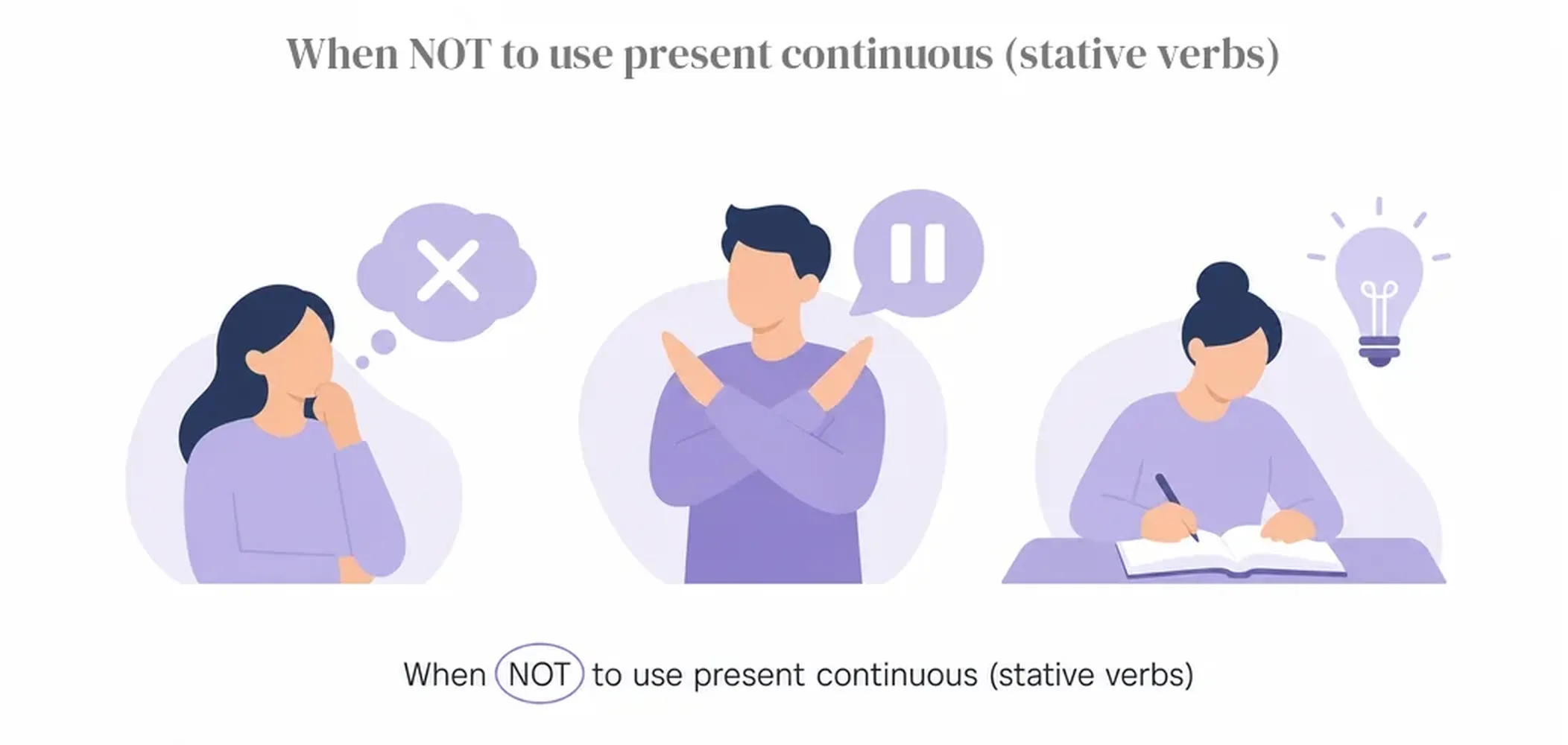
Some verbs describe states or feelings, not actions. These are called stative verbs. We do NOT use the present continuous (-ing form) with stative verbs. Instead, we use the simple present tense. Stative verbs describe things that do not change or happen over time—they just exist or are true.

Correct and Incorrect Examples
| ✗ Incorrect | ✓ Correct |
|---|---|
|
My daughter
"Love" as an emotion is stative — it describes a persistent feeling, not an ongoing activity.
|
My daughter loves chocolate ice cream more than any other flavour.
Simple present is correct. The love is a stable, ongoing state rather than an event.
|
|
He
"Hate" is stative. Even if it's strong and ongoing, it does not take -ing here.
|
He hates early morning meetings at the office.
Simple present shows the emotion as a general, unchanging state.
|
|
She
"Prefer" expresses a personal choice — a state of mind, not an ongoing action.
|
She prefers tea to coffee in the afternoons.
Simple present correctly describes the preference as a stable state.
|
Examples
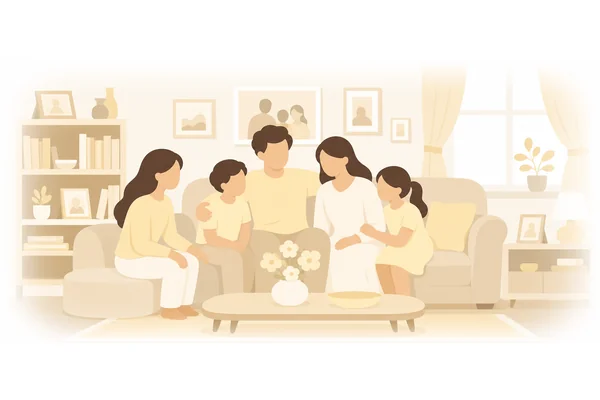
I love my family very much.
Emotion · A2 · Stative
Do you know the answer to this question?
Mental state · A2 · Stative

The flowers smell wonderful in the garden.
Perception · A2 · Stative

My sister owns a small business in the city.
Possession · A2 · Stative
When to use it
Emotions & Feelings
Use simple present for verbs about how you feel or what you like, not present continuous.
I love this song. (NOT: I am loving this song.)
Thinking & Knowing
Mental states and knowledge use simple present, even if you are thinking right now.
I understand the homework. (NOT: I am understanding the homework.)
Perception & Senses
Verbs about seeing, hearing, smelling, tasting, and feeling use simple present, not continuous.
This coffee tastes bitter. (NOT: This coffee is tasting bitter.)
Possession & Ownership
Verbs about having or owning things are stative and use simple present only.
She has two cats. (NOT: She is having two cats.)
Signal words
always
usually
never
often
sometimes
today
in general
right now (with stative verbs)
at the moment (with stative verbs)
normally
generally
every day
Common Mistakes
✕
Wrong
I am loving chocolate ice cream.
✓
Correct
I love chocolate ice cream.
Love is a stative verb about feelings. Use simple present, not continuous.
✕
Wrong
She is understanding the lesson.
✓
Correct
She understands the lesson.
Understand describes a mental state, not an action. Use simple present.
✕
Wrong
The milk is tasting sour.
✓
Correct
The milk tastes sour.
Taste (perception) is stative. Use simple present, not continuous.
✕
Wrong
He is having a car.
✓
Correct
He has a car.
Have (possession) is stative. Use simple present, not continuous.
KEY TAKEAWAYS
What to Remember
- Stative verbs describe states or feelings, not actions, so avoid the present continuous with them.
- Use simple present tense instead of present continuous with verbs like: be, have, like, want, know.
- Common stative verbs include those about emotions, thoughts, possession, and senses—never add -ing to these.
- Do not say "I am liking this" or "She is knowing the answer"—these are incorrect.
- Some verbs can be both stative and action verbs depending on meaning, so consider context carefully.