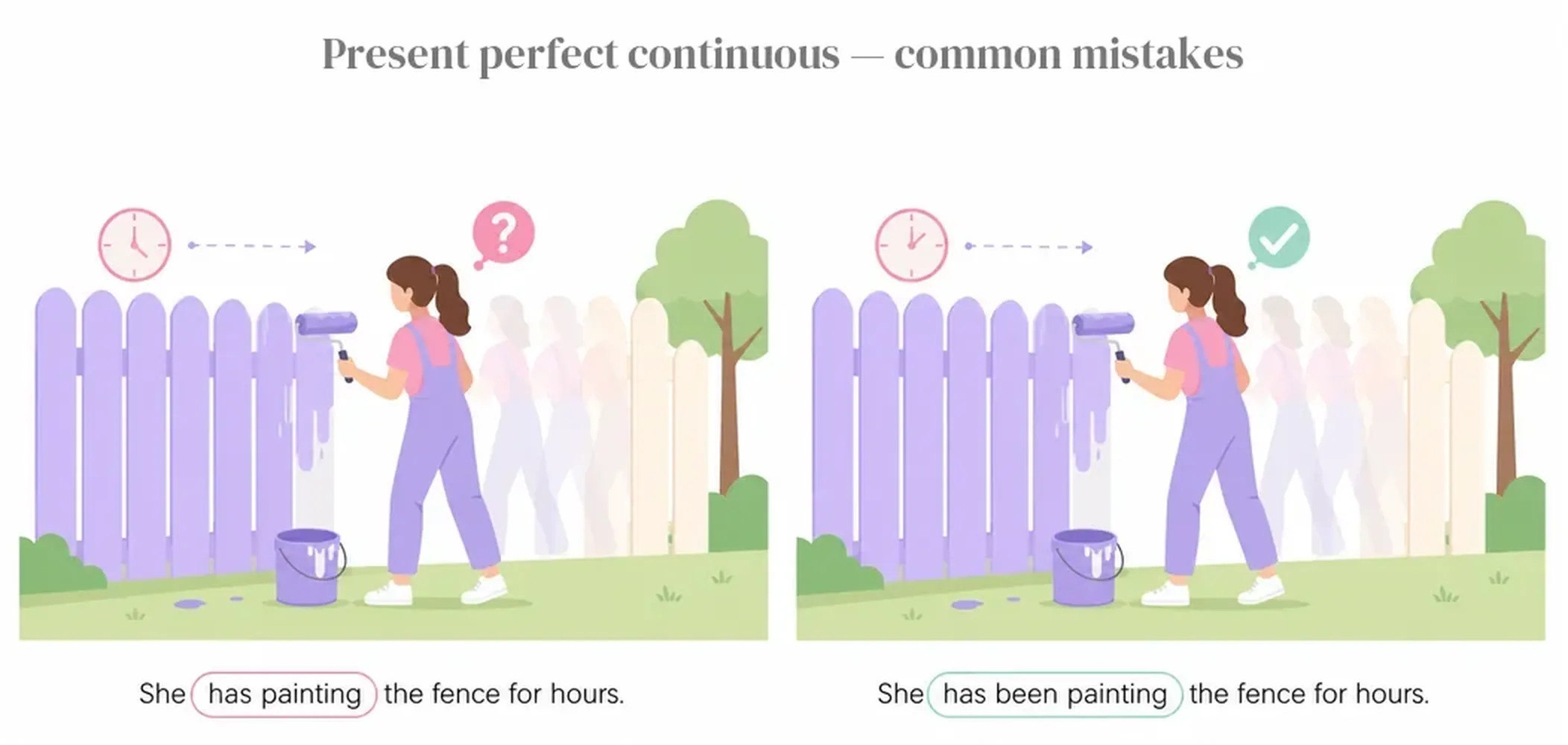
Why Do Learners Struggle with Present Perfect Continuous?
The present perfect continuous can be tricky because it combines the perfect aspect (duration) with continuous action, and learners often confuse it with present perfect simple or present continuous. Common mistakes involve incorrect auxiliary verb combinations, missing 'been', wrong time expressions, and confusion about when to use this tense at all. Understanding these errors will help you use this tense confidently and accurately.

Common Mistakes vs. Correct Usage
| Category | Incorrect (Common Mistake) | Correct Version | Explanation of Error |
|---|---|---|---|
| Form | I have been work here for two years. | I have been working here for two years. | The present perfect continuous requires have/has + been + verb-ing. Learners often forget to add the -ing ending to the main verb after "been". |
| When to Use | I have been knowing him since 2010. (using it with a stative verb) | I have known him since 2010. | Stative verbs (know, believe, love, own, etc.) do not take continuous forms. Learners incorrectly apply the present perfect continuous to verbs that describe states rather than ongoing actions. |
| Positive Example | She has been studying since three hours. | She has been studying for three hours. | Use for with a period or duration of time (for three hours, for two weeks). Use since with a specific point in time (since 3 o'clock, since Monday). Confusing these two prepositions is extremely common. |
| Negative Example | They haven't been not sleeping well lately. | They haven't been sleeping well lately. | Double negation is a frequent error. The negative is formed with have/has + not + been + verb-ing. Adding a second "not" creates an ungrammatical double negative in English. |
| Question Example | How long you have been waiting? | How long have you been waiting? | In English questions, the auxiliary verb have/has must be inverted before the subject. Placing the subject before the auxiliary is a direct translation error from many languages where word order works differently. |
| Key Signal Words | I have been living here since five years. / He has been working there since a long time. | I have been living here for five years. / He has been working there for a long time. | Since must be followed by a specific moment (since 2018, since Tuesday, since I was a child). For must be followed by a duration (for five years, for a long time, for ages). Using "since" with durations is one of the most widespread errors. |
| Key Difference Summary: The present perfect continuous (have/has + been + verb-ing) is used to describe an ongoing action that started in the past and is still happening or has just stopped, with emphasis on the duration or continuity of the activity. The most common mistakes involve: (1) forgetting the -ing form after "been"; (2) using it with stative verbs that don't take continuous forms; (3) confusing "for" (duration) with "since" (point in time); (4) using double negatives; and (5) incorrect question word order. Always ask yourself: Is the verb dynamic? Is the action ongoing? Is the time marker a duration or a point? Answering these will guide you to the correct form every time. | |||
Formula
✔ Positive
Subject
+
have/has
+
been
+
verb + -ing
+
time expression
She has been studying for three hours.
✖ Negative
Subject
+
have/has not
+
been
+
verb + -ing
+
time expression
I haven't been working on this long.
? Question
Have/Has
+
Subject
+
been
+
verb + -ing
+
time expression?
How long have they been living here?
Examples

I have been learning English for two years.
Duration from past to now · B2 Intermediate
①started learning English
→
②two years have passed until now

She has been working on that presentation since 9 a.m.
Ongoing activity, specific start point · Professional
①work on presentation started at 9 a.m.
→
②still working now

They have been playing tennis all afternoon and they're exhausted.
Activity in progress, recent result · Everyday usage
①they started playing tennis this afternoon
→
②now they are exhausted

How long have you been waiting for the bus?
Question form, duration inquiry · Conversational
①you started waiting for the bus
→
②now (at this moment)
When to use it
Unfinished Activities
Use present perfect continuous to show an action that started in the past, continues now, and may continue in the future.
"I have been training for the marathon since January."
Recent Repeated Actions
Describe actions that have happened repeatedly over a recent period leading up to now.
"He has been calling me every day this week."
Explaining Present State
Show why someone is in their current state by linking it to a recent or ongoing activity.
"She looks tired because she has been working night shifts."
Duration Questions
Ask about how long an ongoing action has been happening using 'How long...?'
"How long have you been waiting?"
Signal words
for
since
all day
all morning
all afternoon
recently
lately
how long
the whole time
Common Mistakes
✕
Wrong
I am working here for five years.
✓
Correct
I have been working here for five years.
Present continuous describes ongoing action now, not duration. Present perfect continuous is needed for 'for' + duration expressions.
✕
Wrong
She has been studying since three hours.
✓
Correct
She has been studying for three hours.
'Since' marks a point in time (since 3 o'clock), while 'for' marks a duration (for 3 hours). Don't mix them up.
✕
Wrong
They have studying English all morning.
✓
Correct
They have been studying English all morning.
Present perfect continuous requires 'have/has been + -ing'. The verb 'been' is essential; without it, the sentence is grammatically incomplete.
✕
Wrong
How long are you living in this city?
✓
Correct
How long have you been living in this city?
Present continuous cannot express duration with 'how long'. Use present perfect continuous to show an action that started in the past and continues now.
✕
Wrong
I have been worked on this project for two months.
✓
Correct
I have been working on this project for two months.
After 'have been', use the -ing form (gerund), not the past participle. 'Worked' is incorrect; 'working' is required.
✕
Wrong
She has been write three emails since morning.
✓
Correct
She has been writing three emails since morning.
Use -ing form after 'have been'. Also note: completed actions (three emails) fit better with present perfect simple, but here the -ing form is grammatically required.
✕
Wrong
We have been go to the gym for a month.
✓
Correct
We have been going to the gym for a month.
The base form 'go' is incorrect. After 'have been', always use the continuous form (-ing form), not the base verb.
KEY TAKEAWAYS
What to Remember
- Use have/has + been + verb-ing to show an action that started in the past and continues to now.
- Don't confuse present perfect continuous with present perfect simple—use continuous for emphasis on duration and ongoing activity.
- Include 'been' between the auxiliary and the -ing form; omitting it is one of the most common errors.
- Use time expressions like 'for', 'since', and 'lately' with present perfect continuous, not 'ago' which requires simple past.
- Choose present perfect continuous for activities in progress; use present perfect simple for completed actions with present results.