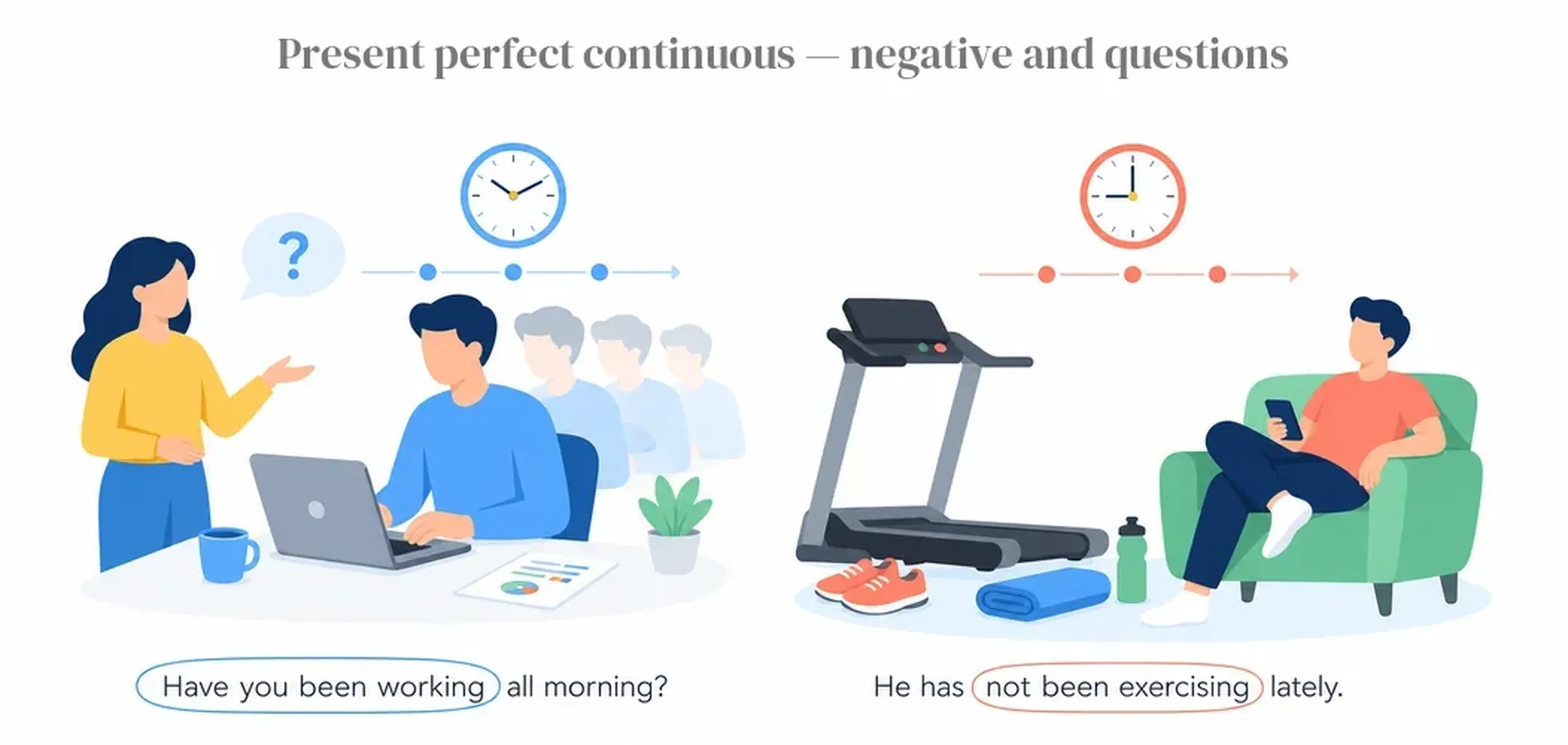
Present Perfect Continuous: Negative & Question Forms
The present perfect continuous describes actions that started in the past and continue to the present moment. To ask about these actions or deny them, you need to know the negative and question structures. Both forms follow predictable patterns based on the auxiliary verb 'have' combined with 'been' and the present participle (-ing form).

Negative Examples
Study these sentences to see the negative form in context.
Negative & Question Formulas
Yes / No Question
| Formula | ||||||
|---|---|---|---|---|---|---|
| have / has | + | subject | + | been | + | verb-ing |
| (object / other) + ? | ||||||
Example:
Have
you
been
studying
all morning?
Wh- Question
| Formula | ||||||||
|---|---|---|---|---|---|---|---|---|
| wh-word | + | have / has | + | subject | + | been | + | verb-ing + ? |
Example:
What
have
they
been
doing
lately?
Examples

I haven't been sleeping well lately.
Negative · Present Perfect Continuous
①sleeping poorly started in the past
→
②continues until now

They haven't been working on the project since Monday.
Duration · Negative
①Monday (when they stopped working)
→
②now (they are still not working)

She hasn't been practicing the violin as much as she should.
Habit/Routine · Negative
①practicing the violin regularly
→
②now (present moment)

Haven't you been living in this city for five years?
Question · Present Perfect Continuous
①started living in this city
→
②now (five years later)

Has he been complaining about the noise?
Question · Singular Subject
①he started complaining about the noise
→
②now (has this been happening?)

How long have you been working at this company?
Question with question word · Duration
①you started working at this company
→
②now (how long until now)
When to use it
Denying an Assumption
Use the negative form to deny something someone thinks is happening or has been happening.
"Haven't you been ignoring my calls?" "No, I haven't been ignoring them. My phone has been broken."
Asking About Duration
Use the question form to ask how long something has been happening or whether it has been happening.
"How long have you been working in this department?"
Stating What Hasn't Happened
Use negative to clarify that an ongoing action has not been taking place.
"I haven't been exercising regularly, so I'm tired all the time."
Signal words
How long
for
since
lately
recently
still
all week
all day
Common Mistakes
✕
Wrong
She is not been studying.
✓
Correct
She has not been studying.
Use 'have/has' not 'is' as the auxiliary verb in present perfect continuous.
✕
Wrong
Been you working here long?
✓
Correct
Have you been working here long?
Questions require the auxiliary 'have/has' before the subject, not just 'been'.
KEY TAKEAWAYS
What to Remember
- Use have/has + been + -ing form for statements about ongoing actions from past to present.
- For negatives, place not after have/has: haven't/hasn't been + -ing (e.g., hasn't been working).
- Form questions by inverting have/has before the subject: Have you been studying? Has she been working?
- Remember that have been + -ing shows duration and continuity, unlike simple perfect which emphasizes completion.
- Avoid using just have + -ing or been + -ing alone; both auxiliary verbs are essential for correct formation.