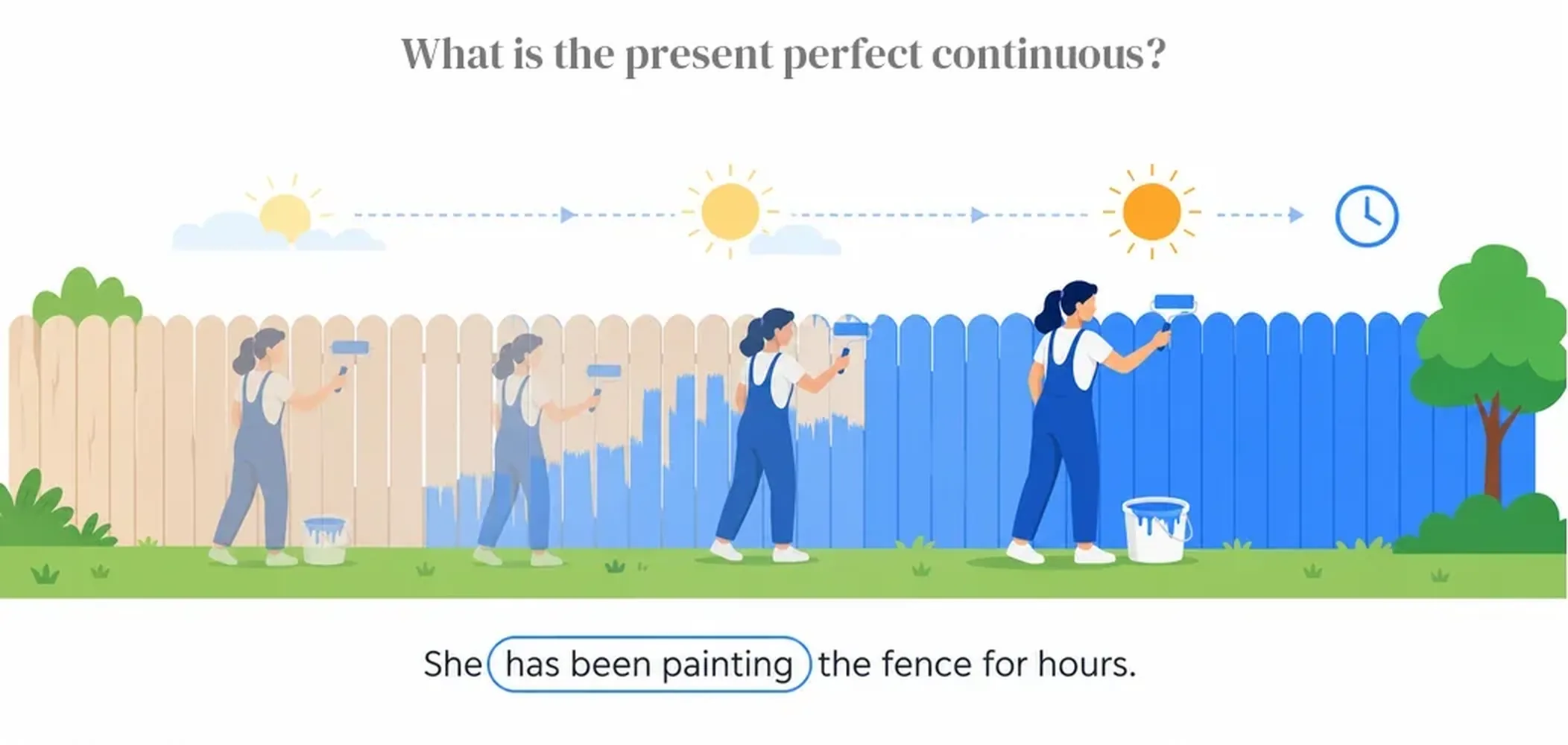
What is the Present Perfect Continuous?
The present perfect continuous is a verb tense that describes an action which began at some point in the past and has continued up to the present moment. It emphasizes the duration or ongoing nature of the action rather than its completion. You form it with the auxiliary verb 'have' or 'has', followed by 'been', and the present participle (verb + -ing). This tense is particularly useful when you want to explain how long something has been happening or to show that an activity is still occurring now.

Key Characteristics
The present perfect continuous connects the past to the present in a meaningful way. Unlike the simple present perfect, which focuses on the result of an action, the present perfect continuous highlights the process and duration. The action may or may not be finished, but what matters is that it has been in progress. Common signal words include 'for', 'since', 'how long', 'all day', and 'recently', which help clarify the timeframe of the ongoing action. This tense is frequently used in conversations and informal writing to discuss recent activities and their effects on the present situation.
Present Perfect Continuous Conjugation
| Pronoun | Affirmative | Negative | Question |
|---|---|---|---|
| I | I have been working | I have not been workingI haven't been working | Have I been working? |
| you (singular) | you have been working | you have not been workingyou haven't been working | Have you been working? |
| he / she / it | he has been workingshe has been workingit has been working | he has not been workingshe hasn't been workingit hasn't been working | Has he been working?Has she been working?Has it been working? |
| we | we have been working | we have not been workingwe haven't been working | Have we been working? |
| you (plural) | you have been working | you have not been workingyou haven't been working | Have you been working? |
| they | they have been working | they have not been workingthey haven't been working | Have they been working? |
- Use has been with he / she / it (third person singular); use have been with all other pronouns.
- The present participle is formed by adding -ing to the base verb: work → working.
- Verbs ending in a silent -e drop the e before -ing: write → writing, make → making.
- Single-syllable verbs ending in consonant-vowel-consonant double the final consonant: run → running, sit → sitting, swim → swimming.
- Irregular auxiliary forms: have not → haven't; has not → hasn't.
- Stative verbs (e.g., know, believe, love, want, own) are not normally used in continuous tenses.
- Common time expressions: for, since, all day / week / morning, lately, recently, how long.
Examples





What to Remember
- The present perfect continuous describes actions that started in the past and continue to the present moment.
- Form it with have/has + been + present participle (verb + -ing) for the complete structure.
- Use this tense to emphasize how long an action has been happening, not just completion.
- Don't confuse it with present perfect simple; continuous focuses on duration and ongoing nature.
- Common mistake: saying "I am been working" instead of "I have been working" with proper auxiliary.