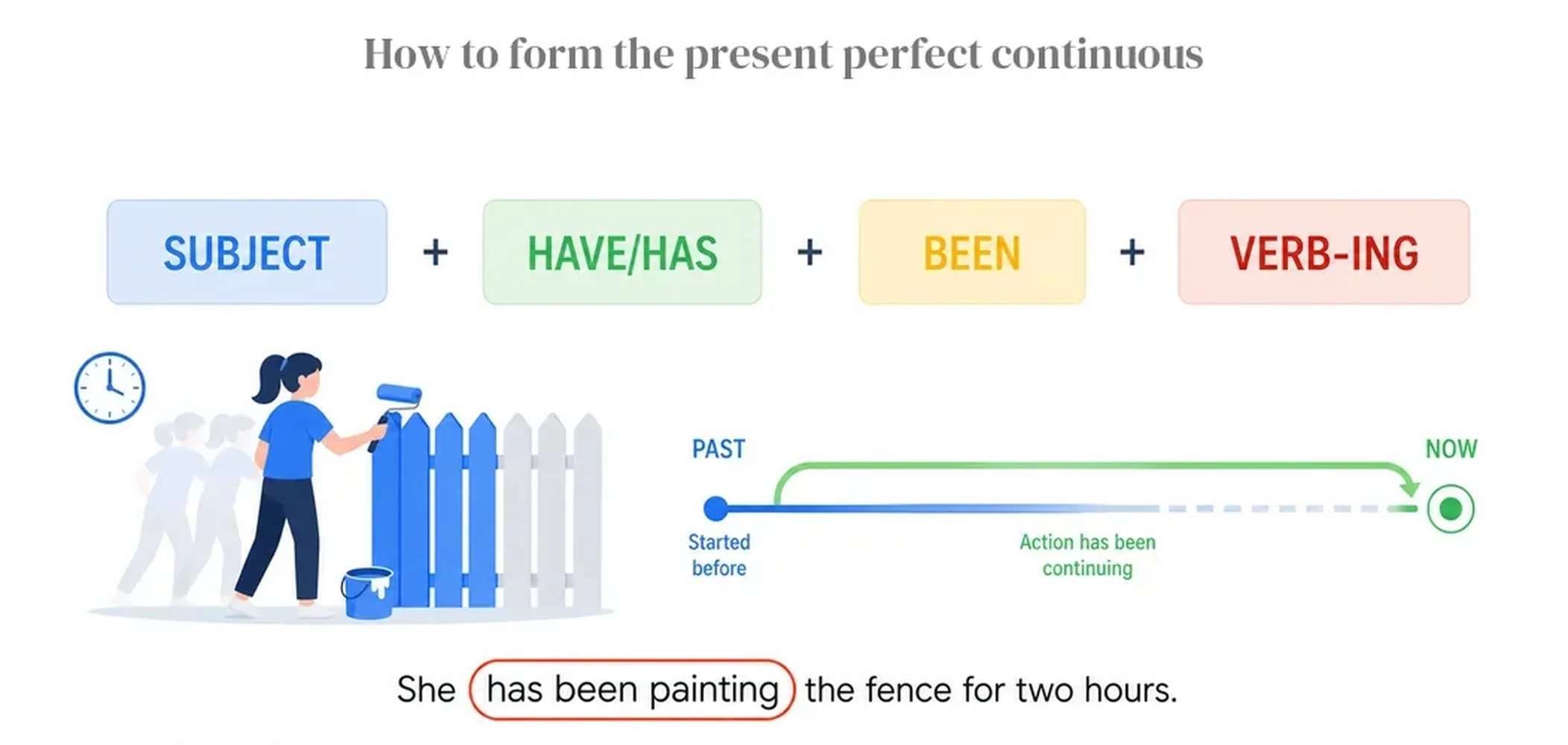
Understanding the Present Perfect Continuous
The present perfect continuous describes actions that started in the past and continue up to the present moment. It emphasises the duration or ongoing nature of an activity. To form this tense, you need three key components: the auxiliary verb 'have' or 'has', the past participle 'been', and the present participle (verb + -ing). This structure allows you to express how long something has been happening without specifying exactly when it started.

Present Perfect Continuous Conjugation by Subject
| Subject | Affirmative | Negative | Question |
|---|---|---|---|
| I | I have been working | I have not been working I haven't been working |
Have I been working? |
| you (singular) | you have been working | you have not been working you haven't been working |
Have you been working? |
| he | he has been working | he has not been working he hasn't been working |
Has he been working? |
| she | she has been working | she has not been working she hasn't been working |
Has she been working? |
| it | it has been working | it has not been working it hasn't been working |
Has it been working? |
| we | we have been working | we have not been working we haven't been working |
Have we been working? |
| you (plural) | you have been working | you have not been working you haven't been working |
Have you been working? |
| they | they have been working | they have not been working they haven't been working |
Have they been working? |
Notes & Special Rules:
|
|||
Formula
✔ Positive
Subject
+
have/has
+
been
+
verb + -ing
I have been studying English for three years.
✖ Negative
Subject
+
have/has not
+
been
+
verb + -ing
She has not been working on this project since Monday.
? Question
Have/Has
+
Subject
+
been
+
verb + -ing
Have you been feeling better lately?
Examples

They have been planning this trip for months.
Positive form · Duration emphasis
①they started planning the trip
→
②now, months later

He hasn't been attending the meetings regularly.
Negative form · Ongoing absence
①meetings started happening regularly
→
②now he is not attending them

Has she been learning to drive?
Question form · Present state inquiry
①she started learning to drive
→
②now (still learning)

We have been waiting here since 10 o'clock.
Duration specification · Time marker
①Started waiting at 10 o'clock
→
②Still waiting now

The weather hasn't been improving this week.
Negative form · Recent period
①this week started
→
②now (weather still not improving)

How long have they been living in Berlin?
Question form · Duration inquiry
①they started living in Berlin
→
②now (and still living)
When to use it
Expressing Duration
Use present perfect continuous to show how long an action has been happening from the past until now.
"I have been working here for five years."
Recent Activity
Describe actions that have been happening recently and may still continue, emphasising the process rather than completion.
"The team has been developing new features all week."
Inquiring About Progress
Ask questions about ongoing situations or activities, particularly useful for checking how things are progressing.
"How long have you been waiting for the results?"
Negating Ongoing Actions
Express what someone has not been doing over a period, useful for explaining absences or lack of progress.
"He hasn't been answering his emails all morning."
Signal words
for
since
all day
all week
recently
lately
how long
the whole time
this morning
this afternoon
Common Mistakes
✕
Wrong
I am studying here since 2020.
✓
Correct
I have been studying here since 2020.
Use present perfect continuous, not present continuous, to show duration from past to present.
✕
Wrong
She has been work on the report.
✓
Correct
She has been working on the report.
The verb after 'been' must be in the -ing form (present participle), not the base form.
✕
Wrong
Have you been gone to the gym recently?
✓
Correct
Have you been going to the gym recently?
Use 'going' (verb-ing), not 'gone' (past participle). The structure requires been + -ing, not been + past participle.
KEY TAKEAWAYS
What to Remember
- Use 'have/has' + 'been' + present participle (-ing form) to form present perfect continuous.
- The tense emphasises duration and describes actions that started in the past and continue now.
- Use 'has' with third person singular subjects and 'have' with all other subjects.
- Don't confuse with present perfect simple, which doesn't emphasise the ongoing duration of activity.
- Present perfect continuous works without stating exact start time, only the continuous duration matters.