What is the Present Perfect Continuous?
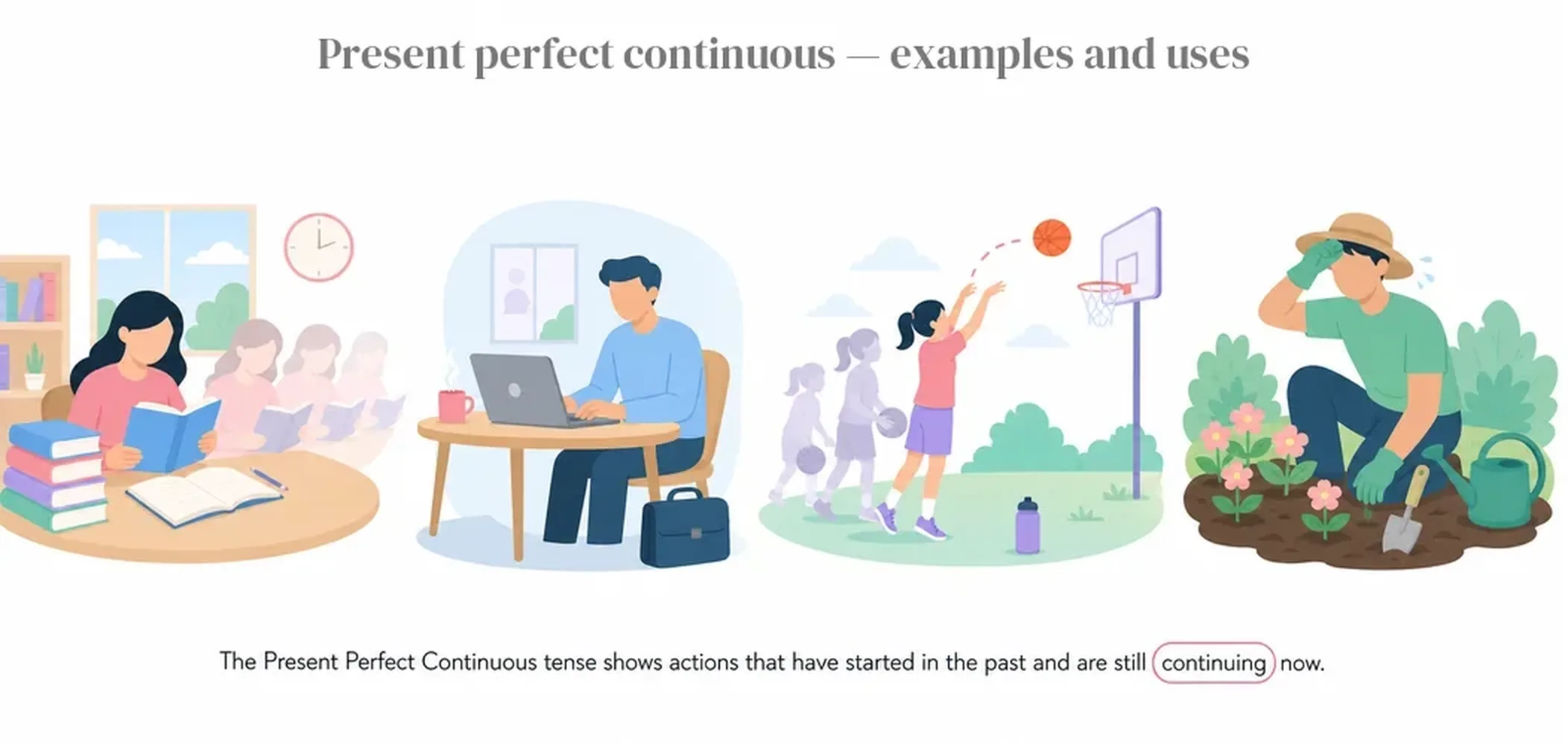
The present perfect continuous (also called present perfect progressive) describes an action that started in the past and continues up to the present moment. It emphasises the duration or ongoing nature of the activity. You form it with have/has + been + verb-ing. The key difference from the simple present perfect is that this tense focuses on the process or duration, not just the completion of the action.

Main Uses of the Present Perfect Continuous
Use this tense when you want to show that an action began in the past and is still happening now, or has only recently stopped. It's especially common when discussing how long something has been happening, or when the duration is more important than the result. For example, if someone looks tired, you might ask 'Have you been working hard?' rather than 'Have you worked hard?' The continuous form suggests ongoing effort, not just completion.
Present Perfect Continuous vs. Simple Present Perfect
Both tenses connect past and present, but they emphasise different aspects. The simple present perfect (have done) focuses on the result or completion: 'I have written three emails.' The present perfect continuous (have been doing) focuses on duration and ongoing activity: 'I have been writing emails for two hours.' Use the continuous form when the duration matters, or when the action may continue. Use the simple form when you're counting completed actions or results.
Present Perfect Continuous vs. Simple Present Perfect: Side-by-Side Comparison
| Dimension | Present Perfect Continuous | Simple Present Perfect |
|---|---|---|
| Form | Subject + have/has been + verb-ing e.g. I have been working |
Subject + have/has + past participle e.g. I have worked |
| Focus | Emphasises the duration or ongoing nature of an activity; the action may still be in progress or has just stopped. | Emphasises the completion or result of an action; whether it happened at some point before now. |
| When to use |
• To show an activity has been ongoing up to now • To explain a present visible result caused by recent activity • To ask how long something has been happening |
• To state that something has happened at least once before now • To announce a completed action with present relevance • To talk about life experiences without specifying when |
| Positive example | "She has been studying for three hours." (activity in progress, duration stressed) |
"She has studied all the chapters." (task completed, result stressed) |
| Negative example | "They haven't been sleeping well lately." (ongoing situation that has not been occurring) |
"They haven't slept more than five hours." (the completed outcome has not been achieved) |
| Question example | "How long have you been waiting?" (asking about the duration of an ongoing action) |
"Have you waited long?" (asking whether the completed action occurred) |
| Key signal words | for, since, all day/week/morning, how long, lately, recently | already, yet, just, ever, never, once, twice, so far, up to now |
| Key Difference: Use the Present Perfect Continuous when you want to highlight how long an activity has been going on or that it is still in progress (e.g. "I've been learning Spanish for two years"). Use the Simple Present Perfect when you want to highlight that something happened or how many times it was completed, without focusing on duration (e.g. "I've learned fifty new words"). Note: stative verbs (know, believe, own, etc.) are not used in continuous forms, so the Simple Present Perfect is always required for them. | ||
Examples






What to Remember
- Use have/has + been + verb-ing to form the present perfect continuous tense.
- This tense shows an action that started in the past and continues to the present.
- It emphasises duration and ongoing process, unlike simple present perfect which focuses on completion.
- Use present perfect continuous when the continuing activity is more important than the result.
- Common mistake: don't use simple present perfect when you want to stress how long.