Grammar B2 Present Perfect Continuous

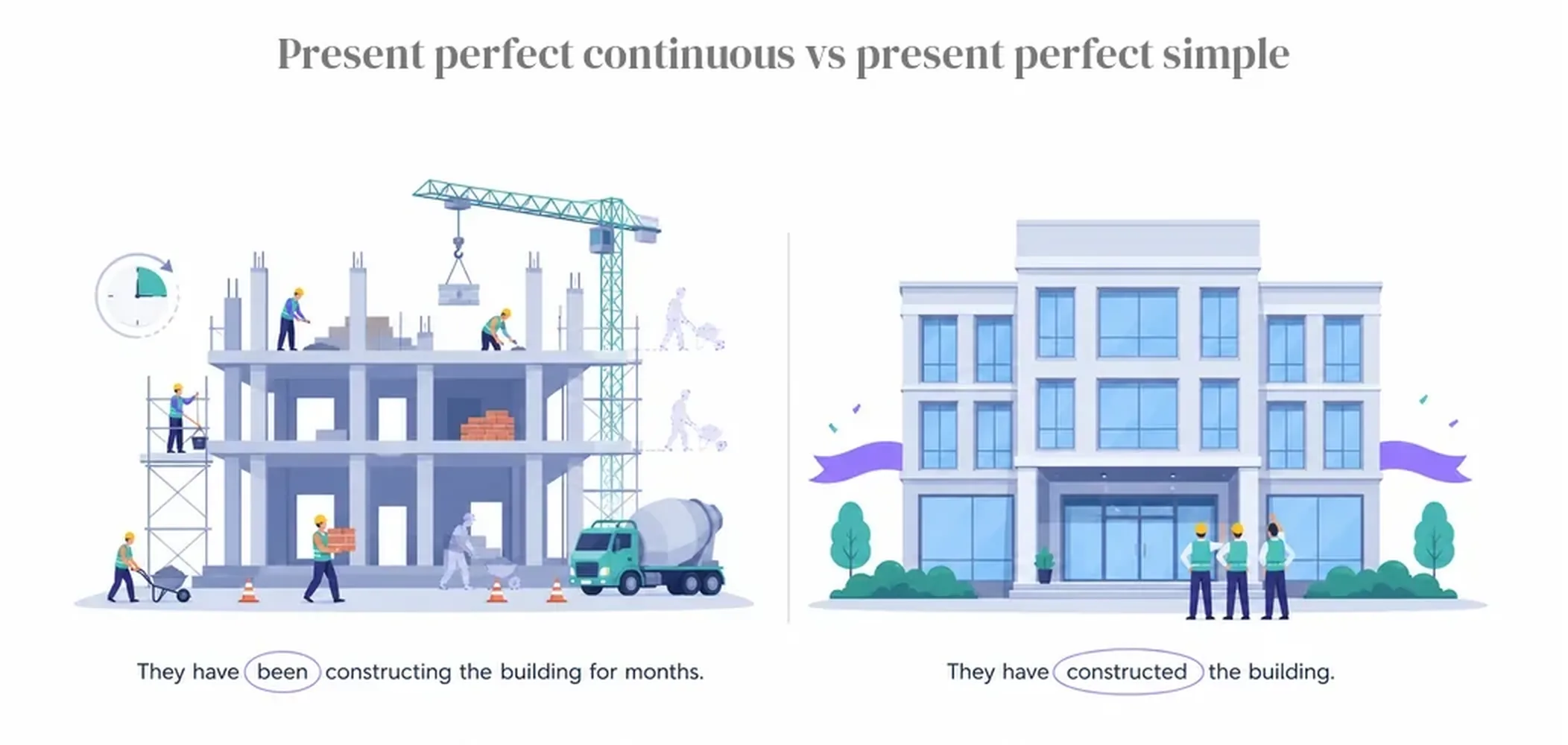
Present perfect continuous vs present perfect simple

Present perfect continuous vs present perfect simple

Key Difference: Duration vs. Completion

Both present perfect continuous and present perfect simple connect the past to the present, but they emphasize different things. The present perfect continuous focuses on the duration and ongoing nature of an action up to now, while the present perfect simple focuses on the completion of an action or its result. Choosing between them depends on whether you want to highlight how long something has been happening or what has been accomplished.

Where the Present Perfect Continuous sits on the English tense timeline

Where the Present Perfect Continuous sits on the English tense timeline

Direct Comparison: Same Action, Different Emphasis

Consider the same real-world situation: a student studying for an exam. With present perfect continuous, you say 'I have been studying for three hours'—the emphasis is on the activity itself and how long it has taken. With present perfect simple, you say 'I have studied five chapters'—the emphasis is on what has been completed. Both are grammatically correct; the choice depends on your communicative intention.

Quick Memory Tip

Ask yourself: 'Am I interested in how long?' (use continuous) or 'Am I interested in what was done?' (use simple). For example: 'How long have you lived here?' suggests continuous thinking, but 'Have you finished your homework?' suggests simple thinking because we care about completion, not duration.

How to Form Each Tense

Present Perfect Continuous
Affirmative
Subject + have / has + been + verb-ing
She has been studying for two hours.
Negative
Subject + have / has + not + been + verb-ing
They have not been waiting long.
Question
Have / Has + Subject + been + verb-ing?
Has he been working all day?
Present Perfect Simple
Affirmative
Subject + have / has + past participle
She has studied three chapters.
Negative
Subject + have / has + not + past participle
They have not finished the project.
Question
Have / Has + Subject + past participle?
Has he completed his homework?

Examples

I have been working on this project since Monday.
Duration emphasis · Ongoing activity
Monday when work on project started now, still working
She has been training for the marathon for six months.
Time period · Continuous process
She started training for the marathon Now, six months later
They have been waiting for the results all week.
Activity in progress · Extended timeframe
they started waiting for the results now, at the end of the week
I have completed all the tasks on my list.
Completion emphasis · Result visible
started completing tasks on list all tasks now finished
She has written three articles this month.
Quantity focus · Finished actions
writing three articles now, this month
They have found a solution to the problem.
Achievement · End result
problem occurred solution found now
When to use it
Highlighting Duration
Use present perfect continuous when you want to emphasize how long an activity has been happening.
"We have been waiting for 20 minutes. When will the train arrive?"
Stating Results
Use present perfect simple when the outcome or completion matters more than the time spent.
"I have finished my homework, so I can go out now."
Counting Achievements
Use present perfect simple with numbers, quantities, or specific accomplishments.
"He has visited 15 countries and plans to see more."
Recent Activity Effects
Use present perfect continuous when something just happened and its effects are visible now.
"You look tired. Have you been running?"
Signal words
for (duration) since (starting point) how long all day/week/month recently (often simple) just (often simple) already (often simple) yet (often simple)
Common Mistakes
Wrong
I have worked here for five years.
Correct
I have been working here for five years.
With a time duration ('for five years'), use continuous to emphasize the ongoing nature of the work.
Wrong
She has been writing ten emails today.
Correct
She has written ten emails today.
When counting completed items or actions, use simple. Continuous doesn't work well with specific quantities.
Wrong
How long have you been lived in London?
Correct
How long have you lived in London?
With 'live' in the sense of permanent residence, use simple. Continuous suggests the action is still unfinished or emphasizes effort, which is unsuitable here.
KEY TAKEAWAYS

What to Remember

  • Use present perfect continuous to emphasize how long an action has been happening up to now.
  • Present perfect continuous requires "have/has been" plus the present participle form of the verb.
  • Choose present perfect simple when focusing on completion or result rather than duration of action.
  • Present perfect continuous suggests the action may continue, while simple suggests it has finished.
  • Avoid present perfect continuous with stative verbs like "know," "want," or "understand" that don't show duration.
← Previous
Present perfect continuous — examples and uses
Next →
Present perfect continuous with how long