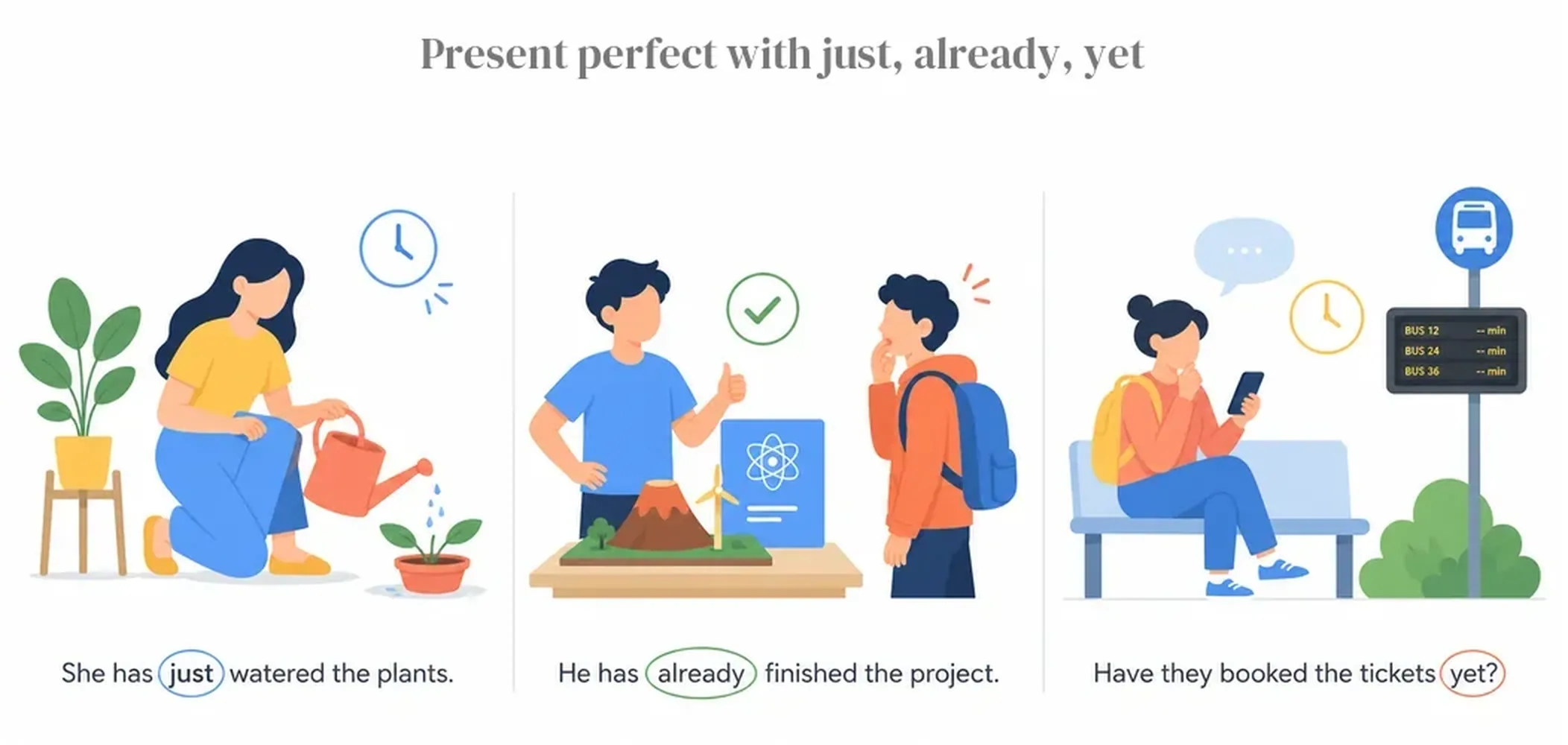
Understanding Present Perfect with Time Adverbs
The present perfect connects the past with the present. We use it to talk about actions that happened at an unspecified time or whose effects are still relevant now. When we add the adverbs just, already, and yet, we make the timing more precise. These adverbs help us show exactly when something happened or whether it has happened at all. They are especially useful for talking about recent events and things that we expected to happen.

Just: Something Happened a Moment Ago
Just means a short time ago, very recently. It emphasises that something happened moments before now. In the present perfect, just typically appears between the auxiliary verb (have/has) and the past participle. Use just when you want to show that an action is fresh and immediate. This is common in conversations when you want to share news or explain why something is happening right now.
Already and Yet: Expected Actions
Already and yet both relate to expectations and timing, but they have opposite meanings. Already means something happened sooner than expected or before now—it suggests completion. Yet is used in questions and negative sentences to ask if something has happened or to say it has not happened when we expected it to. Already usually appears in the middle of the verb phrase (have/has + already + past participle), while yet appears at the end of the sentence. These adverbs are essential for talking about progress and unfinished situations.
Just, Already, and Yet: Side-by-Side Comparison
| Feature | Just | Already | Yet |
|---|---|---|---|
| Form | have/has + just + past participle | have/has + already + past participle | have/has + not + past participle + yet / past participle + yet? |
| When to use | To say that something happened a very short time ago — the action is very recent. | To say that something happened sooner than expected or before a reference point. | To talk about something expected but not done so far (negatives) or to ask whether something has happened (questions). |
| Sentence position | Between the auxiliary verb and the past participle (mid-position). He has just arrived. |
Between the auxiliary verb and the past participle (mid-position). She has already left. |
At the end of the sentence (end-position). They haven't called yet. / Has he finished yet? |
| Positive example | I have just finished my homework. (It happened moments ago.) |
She has already eaten dinner. (Earlier than expected.) |
— (Yet is rarely used in standard affirmative sentences.) |
| Negative example | — (Just is not typically used in negatives.) | — (Already is not typically used in standard negatives.) | He hasn't called yet. (Expected but not done so far.) |
| Question example | Has the bus just left? (Checking if it left seconds ago.) |
Have you already seen this film? (Surprised it may have happened early.) |
Have you finished yet? (Asking if an expected action has happened.) |
| Key signal words / context | a moment ago, a second ago, right now, very recently | sooner than expected, before the time mentioned, surprisingly early | up to now, so far, by now, not so far, still waiting |
| Typical grammar forms | ✅ Affirmatives ✅ Questions (less common) ❌ Negatives |
✅ Affirmatives ✅ Questions (expresses surprise) ❌ Standard negatives |
❌ Standard affirmatives ✅ Negatives ✅ Questions |
| 🔑 Key Difference: Use just to emphasise how recently something happened (seconds or minutes ago). Use already to show that something happened sooner than expected — often expressing surprise. Use yet only in negative sentences and questions to talk about something that is expected to happen but has not happened so far. In short: just = very recent; already = earlier than expected; yet = not happened up to now (but expected). | |||
Examples






What to Remember
- Use present perfect with just to show something happened very recently.
- Use present perfect with already to show something happened before expected or before now.
- Use present perfect with yet in questions and negatives to ask if something has happened.
- Place just and already before the past participle; place yet at the end of the sentence.
- Present perfect connects past actions to the present, so use have/has plus past participle with these adverbs.