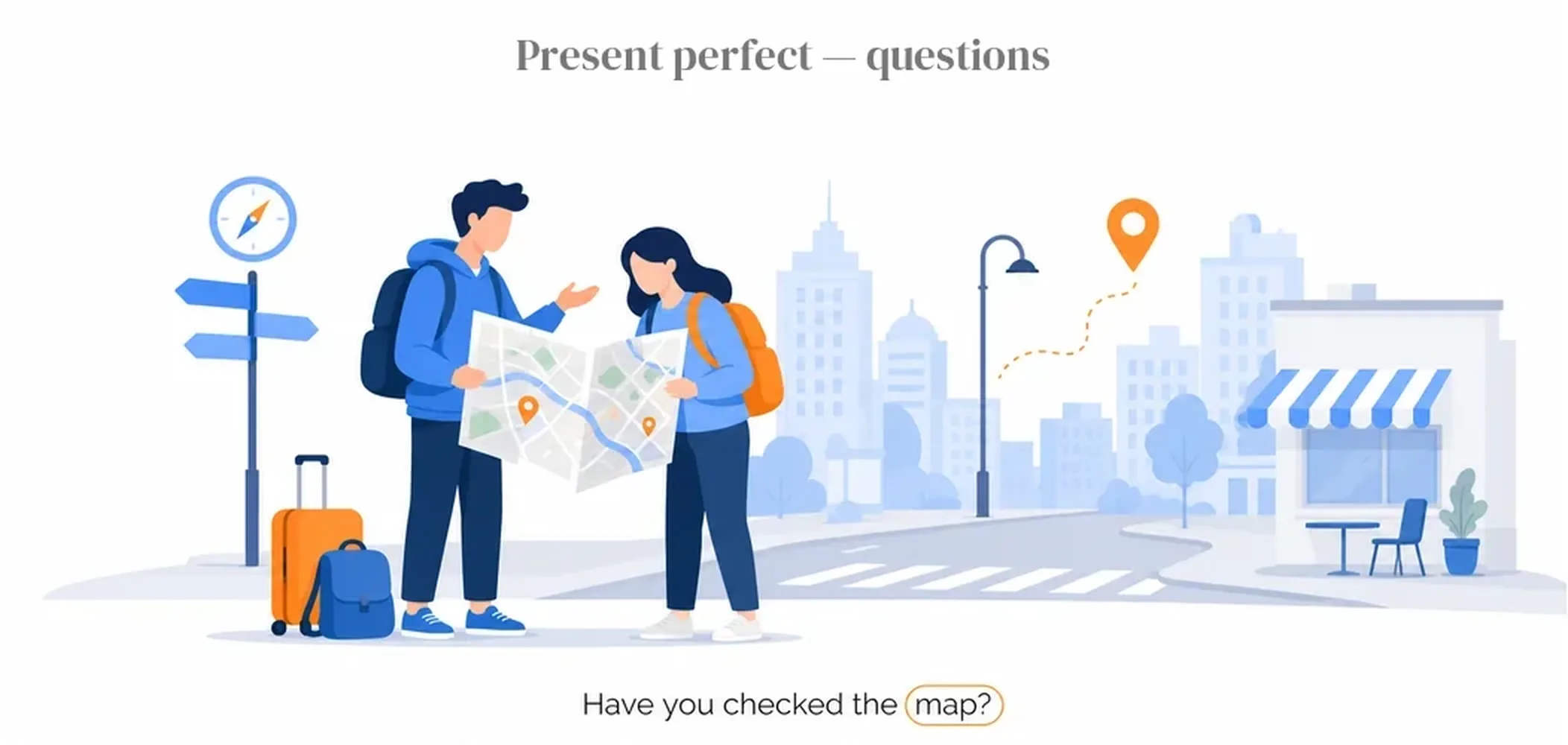
Present Perfect Questions
The present perfect is used to ask about experiences, changes, and recent actions. To form questions, we invert the auxiliary verb 'have' with the subject. This is essential for daily conversations and asking about someone's life or activities. Understanding the word order is key to asking correct present perfect questions.

Yes/No Questions
For simple yes/no questions, place the auxiliary verb before the subject, followed by the past participle.
Question Word Questions
When asking with question words (what, where, how, why), place the question word first, then the auxiliary verb, then the subject.
Example Questions
Here are real present perfect questions you'll hear and use every day:
Present Perfect Question Forms by Subject
| Pronoun | Yes/No Question | Negative Question | Wh- Question (e.g. What) |
|---|---|---|---|
| I | Have I finished? | Haven't I finished? Have I not finished? |
What have I done? |
| you (singular) | Have you finished? | Haven't you finished? Have you not finished? |
What have you done? |
| he | Has he finished? | Hasn't he finished? Has he not finished? |
What has he done? |
| she | Has she finished? | Hasn't she finished? Has she not finished? |
What has she done? |
| it | Has it happened? | Hasn't it happened? Has it not happened? |
What has it done? |
| we | Have we finished? | Haven't we finished? Have we not finished? |
What have we done? |
| you (plural) | Have you finished? | Haven't you finished? Have you not finished? |
What have you done? |
| they | Have they finished? | Haven't they finished? Have they not finished? |
What have they done? |
Notes:
|
|||
Formula
? Question
Have
+
you
+
finished
+
?
Have you finished your work?
Examples

Have you ever been to Paris?
Yes/no question · Experience
①visiting Paris at any time in your life
→
②now, asking about your experience

What has she accomplished this year?
Question word question · Achievement
①she accomplishing things
→
②now, at the end of this year

How long have you lived in this city?
Duration question · Lifestyle
①you started living in this city
→
②now

Has he finished the project yet?
Yes/no question · Recent completion
①he started working on the project
→
②now / at this moment

Why have they left without telling anyone?
Question word question · Unexpected action
①they left without telling anyone
→
②now (we notice they are gone)

Have you visited the new museum in the city centre?
Yes/no question · Recent experience
①new film was released and people started talking about it
→
②now (present moment)
When to use it
Casual Conversation
Ask friends and family about their recent activities and experiences.
Have you eaten lunch yet? What have you been doing lately?
Work Meetings
Check on project progress and employee accomplishments professionally.
Has the team completed the report? How many clients have we contacted?
Educational Settings
Teachers ask about homework and learning experiences.
Have you finished the chapter? What have you learned about this topic?
Travel & Culture
Ask people about their travel experiences and places visited.
Have you ever travelled to Asia? Where have you been this summer?
Signal words
ever
yet
just
already
how long
recently
before
many times
Common Mistakes
✕
Wrong
You have finished the work?
✓
Correct
Have you finished the work?
The auxiliary verb must come before the subject to form a question, not after it.
✕
Wrong
Where has you been?
✓
Correct
Where have you been?
Use 'have' with 'you', not 'has'. 'Has' is only for third-person singular (he, she, it).
KEY TAKEAWAYS
What to Remember
- Invert the auxiliary verb 'have' with the subject to form present perfect questions correctly.
- Use 'Have you ever...?' to ask about experiences and past events with present relevance.
- The word order is: Have/Has + subject + past participle, never subject + have + participle.
- Don't forget the past participle form after 'have'—irregular verbs require correct past participle forms.
- Use 'have' with I, you, we, they and 'has' with he, she, it.