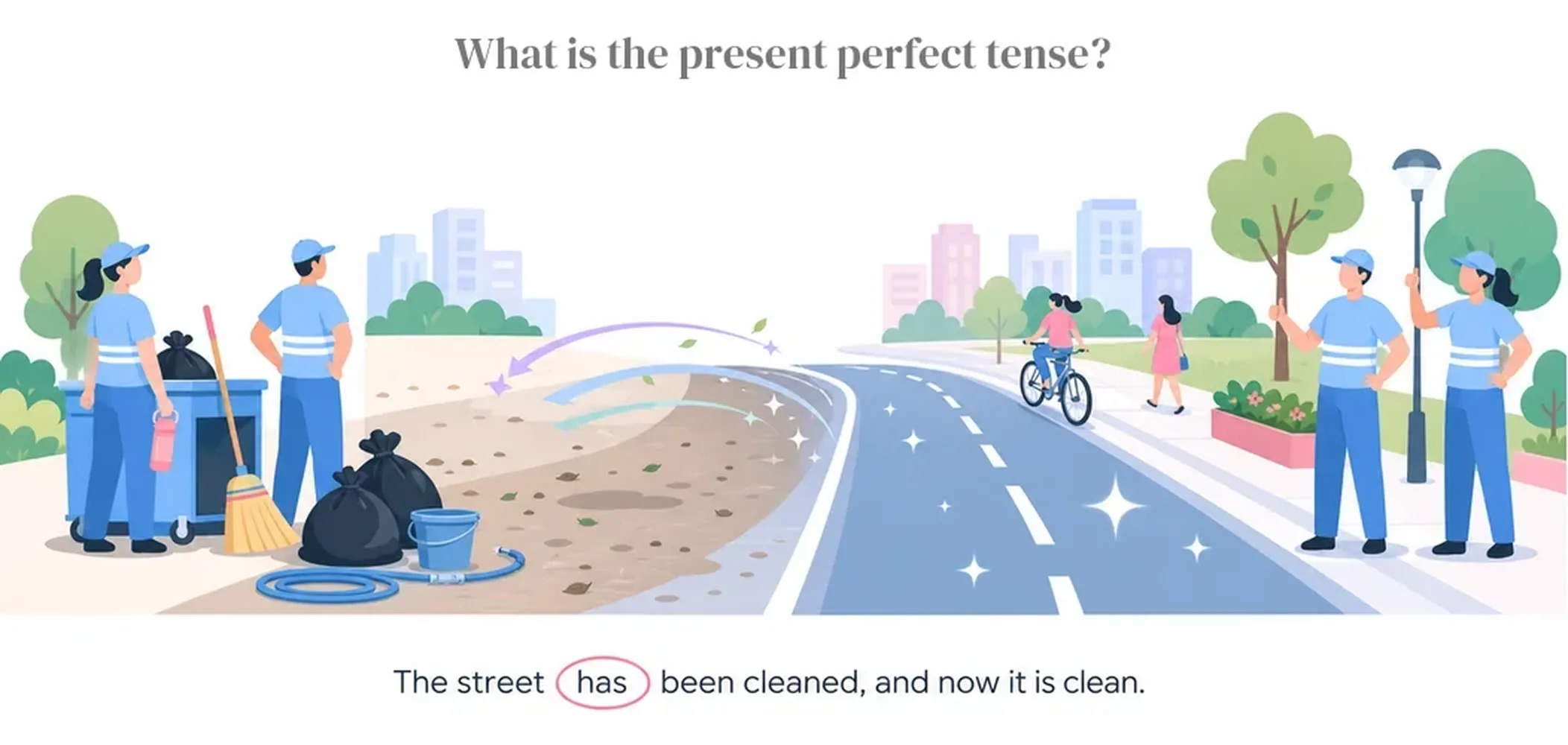
What is the Present Perfect Tense?
The present perfect tense is used to talk about actions or situations that started in the past but are still relevant to the present moment. It connects the past with the present. You form the present perfect with the auxiliary verb 'have' or 'has' plus the past participle of the main verb. For example: 'I have finished my homework' or 'She has lived in London for five years.' The action happened before now, but we focus on the result or connection to the present, not the exact time when it happened.

Key Characteristics
The present perfect is different from the simple past because it emphasizes the connection between the past action and the present situation. You don't usually say when the action happened (no specific past time is mentioned). Common reasons to use the present perfect include: describing recent experiences you want to share, talking about changes over time, discussing actions that are still true or relevant, and explaining how many times something has happened in your life. Understanding when to use it requires practice, but thinking about whether the past action is still connected to 'now' is the key.
Present Perfect Conjugation Table
| Pronoun | Affirmative | Negative | Question |
|---|---|---|---|
| I | I have worked I have gone (irreg.) | I have not worked I haven't worked | Have I worked? Have I gone? (irreg.) |
| You (singular) | You have worked You have seen (irreg.) | You have not worked You haven't worked | Have you worked? Have you seen? (irreg.) |
| He / She / It | He has worked She has eaten (irreg.) It has broken (irreg.) | He has not worked She hasn't eaten It hasn't broken | Has he worked? Has she eaten? (irreg.) Has it broken? (irreg.) |
| We | We have worked We have been (irreg.) | We have not worked We haven't been | Have we worked? Have we been? (irreg.) |
| You (plural) | You have worked You have done (irreg.) | You have not worked You haven't done | Have you worked? Have you done? (irreg.) |
| They | They have worked They have known (irreg.) | They have not worked They haven't known | Have they worked? Have they known? (irreg.) |
|
Key Notes
|
|||
Examples






What to Remember
- Use the present perfect to describe past actions that are still relevant to the present moment.
- Form it with 'have' or 'has' plus the past participle of the main verb.
- Use 'has' with third person singular subjects (he, she, it) and 'have' with all others.
- Focus on the result or connection to the present, not the exact time the action happened.
- Don't use the present perfect when you mention a specific past time; use simple past instead.