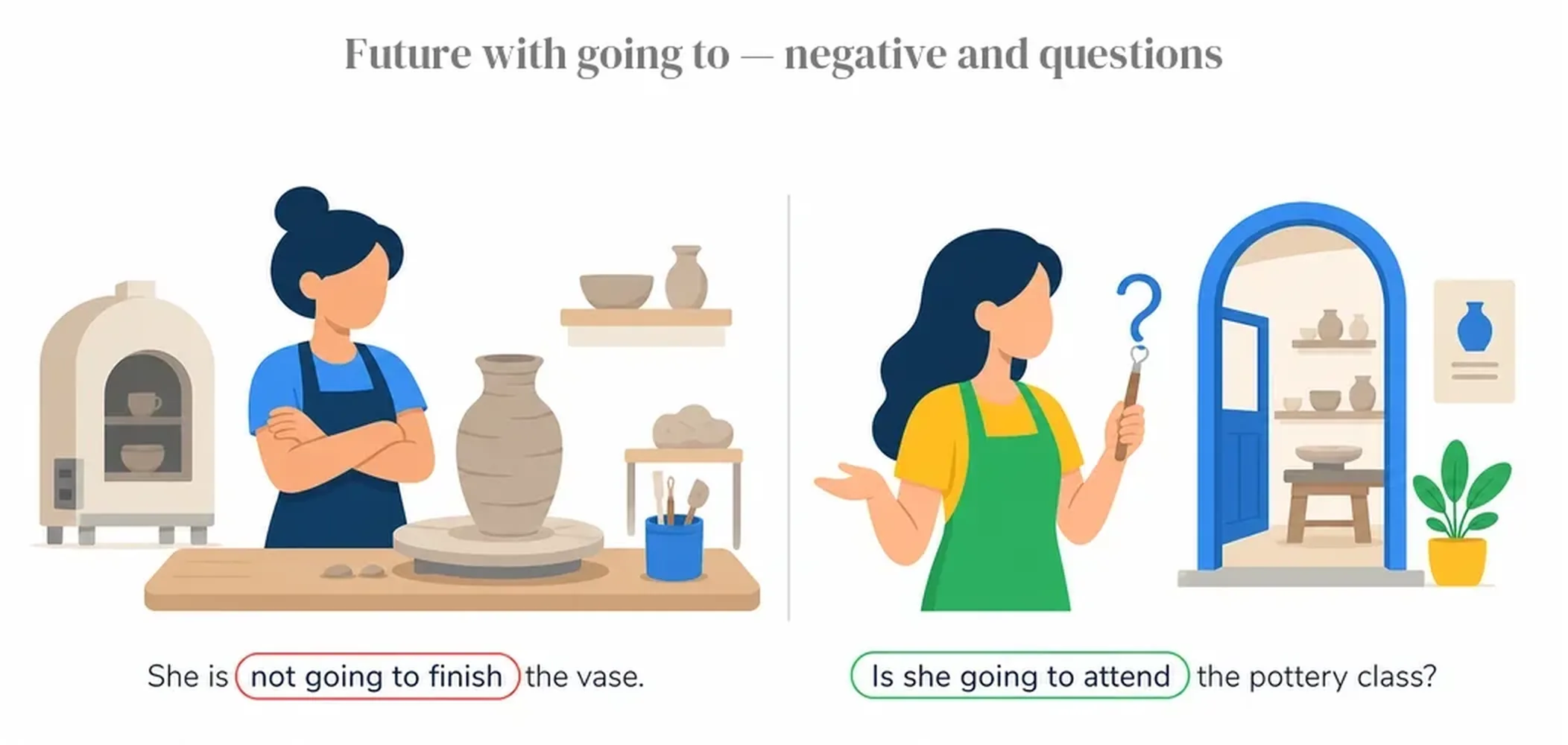
Going to: Negative and Question Forms
You already know how to say positive plans with 'going to' (I am going to study). Now learn how to make negative sentences and ask questions. These forms are very useful for talking about future plans, saying what will NOT happen, and asking about other people's plans.

Negative Form
Add 'not' after the verb 'be'. Use the contracted form 'not' (isn't, aren't) to sound more natural in speech and informal writing.
Going To — Negative and Question Forms by Subject
| Pronoun | Positive | Negative | Question |
|---|---|---|---|
| I | I am going to work I'm going to work | I am not going to work I'm not going to work | Am I going to work? |
| you | you are going to work you're going to work | you are not going to work you aren't going to work you're not going to work | Are you going to work? |
| he / she / it | he is going to work he's going to work | he is not going to work he isn't going to work he's not going to work | Is he going to work? |
| we | we are going to work we're going to work | we are not going to work we aren't going to work we're not going to work | Are we going to work? |
| you (plural) | you are going to work you're going to work | you are not going to work you aren't going to work you're not going to work | Are you going to work? |
| they | they are going to work they're going to work | they are not going to work they aren't going to work they're not going to work | Are they going to work? |
| Notes: (1) I uses am / am not — there is no contracted negative amn't in standard English; use I'm not instead. (2) he / she / it uses is / is not / isn't; all other pronouns except I use are / are not / aren't. (3) In questions, the auxiliary verb be moves to the front: Am / Is / Are + subject + going to + base verb? (4) going to is often pronounced and written informally as gonna in speech, but avoid it in formal writing. | |||
Formula
✖ Negative
Subject
+
am/is/are
+
not
+
going to
+
base verb
I am not going to eat breakfast tomorrow.
? Question
Am/Is/Are
+
subject
+
going to
+
base verb
Are you going to watch the football match tonight?
Examples

She is not going to attend the meeting on Friday.
Negative statement about future plans

They aren't going to buy a new car this year.
Negative with contraction — more natural

Is he going to call you this evening?
Yes/No question form

What are you going to do after school?
Wh-question (question word + going to)

We are not going to travel abroad next summer.
Plural negative statement

Aren't they going to finish the project by next week?
Negative question form
When to use it
Saying What Will NOT Happen
Use the negative form to tell someone about plans you are cancelling or things that won't occur.
"I'm not going to eat meat anymore. I'm becoming vegetarian."
Asking About Someone's Plans
Use the question form to ask what others will do or whether they will do something.
"Are you going to come to my birthday party next month?"
Making Offers or Refusing
Use questions and negatives to make social offers and polite refusals.
"Aren't you going to have dessert? No, I'm not going to eat any more."
Signal words
not
isn't
aren't
am not
tomorrow
next week
next month
later
in the future
Will
Are
Is
Am
Common Mistakes
✕
Wrong
I not going to come tomorrow.
✓
Correct
I am not going to come tomorrow.
Always include the correct form of 'be' (am/is/are) before 'not'. 'Not' alone is not enough.
✕
Wrong
Is she going to comes home early?
✓
Correct
Is she going to come home early?
Use the base form of the verb after 'going to', not the -s form. 'Come' not 'comes'.
KEY TAKEAWAYS
What to Remember
- To make negative 'going to' sentences, add 'not' after the verb 'to be'.
- The question form puts 'to be' before the subject: Are you going to study?
- Use 'going to' for plans you have decided or arranged for the future.
- Common mistake: don't say "I going to" — always use the correct form of 'be'.
- Both negative and question forms keep 'going to' together — never separate the words.