Will vs Going To: What's the Difference?
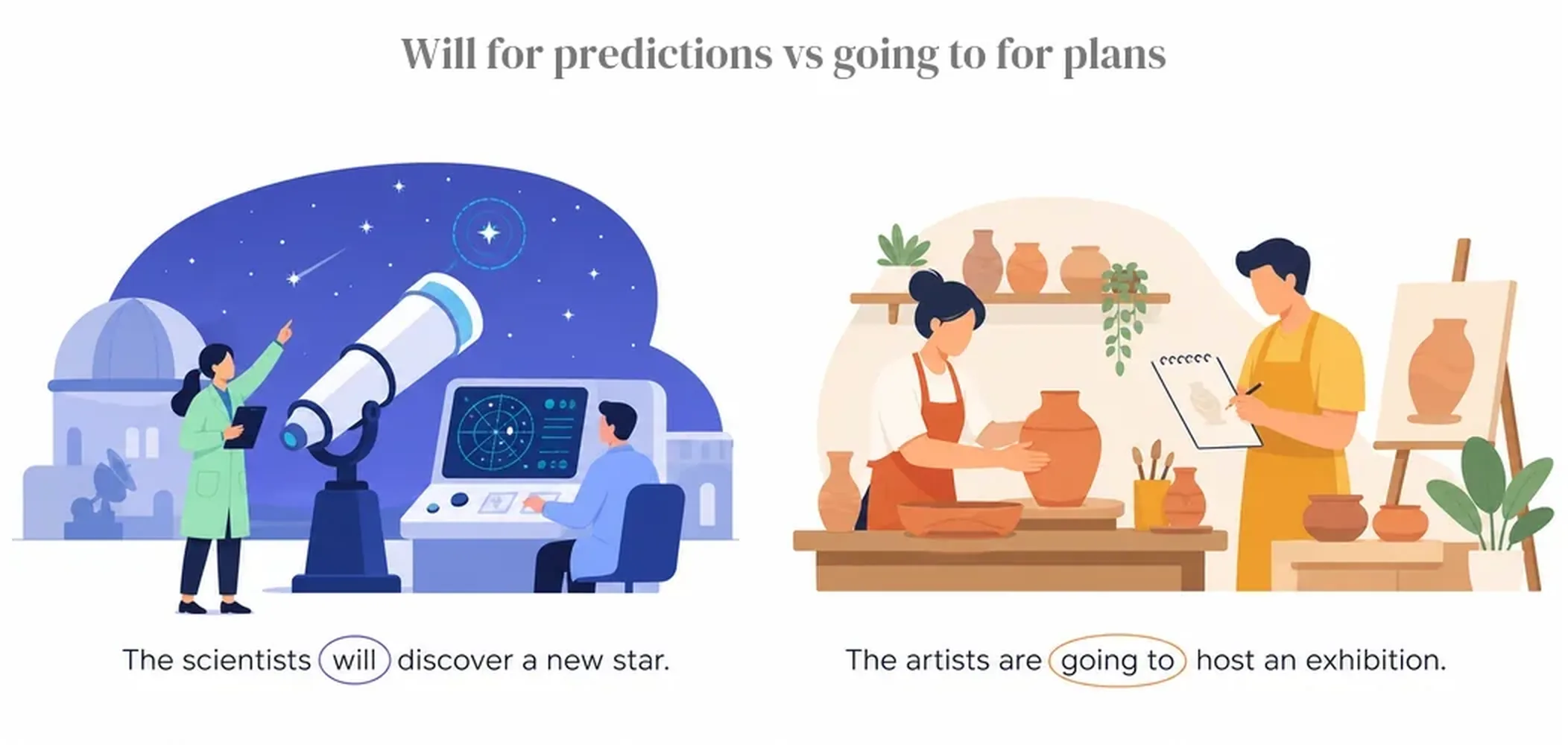
Both 'will' and 'going to' talk about the future, but we use them differently. Use 'will' when you make a sudden decision or prediction at the moment of speaking. Use 'going to' when you have already planned something or when you can see something will happen. Understanding this difference will help you speak more naturally.

Will: Sudden Predictions & Decisions
Use 'will' for predictions you make in the moment, sudden decisions, or things you cannot control. This is unplanned. You decide or realize something right now. The form is: subject + will + verb.
Going To: Plans & Obvious Predictions
Use 'going to' for plans you made before speaking, and for predictions based on what you see now. This is planned or certain. You already decided, or the evidence is clear. The form is: subject + am/is/are + going to + verb.
Quick Tip to Remember
Think of 'will' as a lightning bolt — sudden and unplanned. Think of 'going to' as a map you already drew — planned and predictable. If you made a plan yesterday, use 'going to'. If you decide right now in the conversation, use 'will'.
Will vs Going To: Side-by-Side Comparison
| Category | Will (Predictions) | Going To (Plans) |
|---|---|---|
| Form | Subject + will + base verb e.g. he will go, they will arrive |
Subject + am/is/are going to + base verb e.g. he is going to go, they are going to arrive |
| When to Use | Use for spontaneous predictions, opinions about the future, or decisions made at the moment of speaking. There is no prior plan — you are simply guessing or reacting. | Use for pre-planned intentions or decisions already made before the moment of speaking. Also used when there is clear present evidence that something will happen soon. |
| Timing of Decision | Decision or prediction is made at the moment of speaking. | Decision or plan was made before the moment of speaking. |
| Certainty Level | Often based on personal belief or general expectation; can be less certain. Commonly paired with expressions like I think or I believe. | Generally more certain because a plan or visible evidence exists. The speaker has concrete reason to believe the event will occur. |
| Positive Example | I think it will rain tomorrow. (a spontaneous prediction based on opinion) |
We are going to visit my grandmother this weekend. (a pre-arranged plan) |
| Negative Example | She won't pass the exam if she doesn't study. (a predicted negative outcome) |
They are not going to move to a new house this year. (a planned action that has been cancelled or decided against) |
| Question Example | Will robots replace humans in the future? (asking for a prediction or opinion) |
Are you going to attend the meeting tomorrow? (asking about a pre-made plan or intention) |
| Key Signal Words | I think, I believe, I expect, probably, perhaps, maybe, I'm sure, I doubt | tonight, tomorrow, next week, soon, this weekend, already decided, look (as evidence), watch out |
| 🔑 Key Difference: Use will when you are making a spontaneous prediction or expressing an opinion about the future — there is no prior plan involved. Use going to when a decision or plan was already made before the conversation, or when there is visible present evidence pointing to an imminent outcome (e.g., "Look at those clouds — it's going to rain!"). The core distinction is spontaneity vs. prior intention. | ||
Examples






What to Remember
- Use 'will' for sudden decisions or predictions made at the moment of speaking.
- Use 'going to' for plans you made before or situations you can see coming.
- 'Will' is for spontaneous thoughts; 'going to' is for prepared intentions or obvious future events.
- Both forms talk about the future, but they describe different types of future situations.
- Don't use 'going to' for sudden decisions or 'will' for pre-made plans.