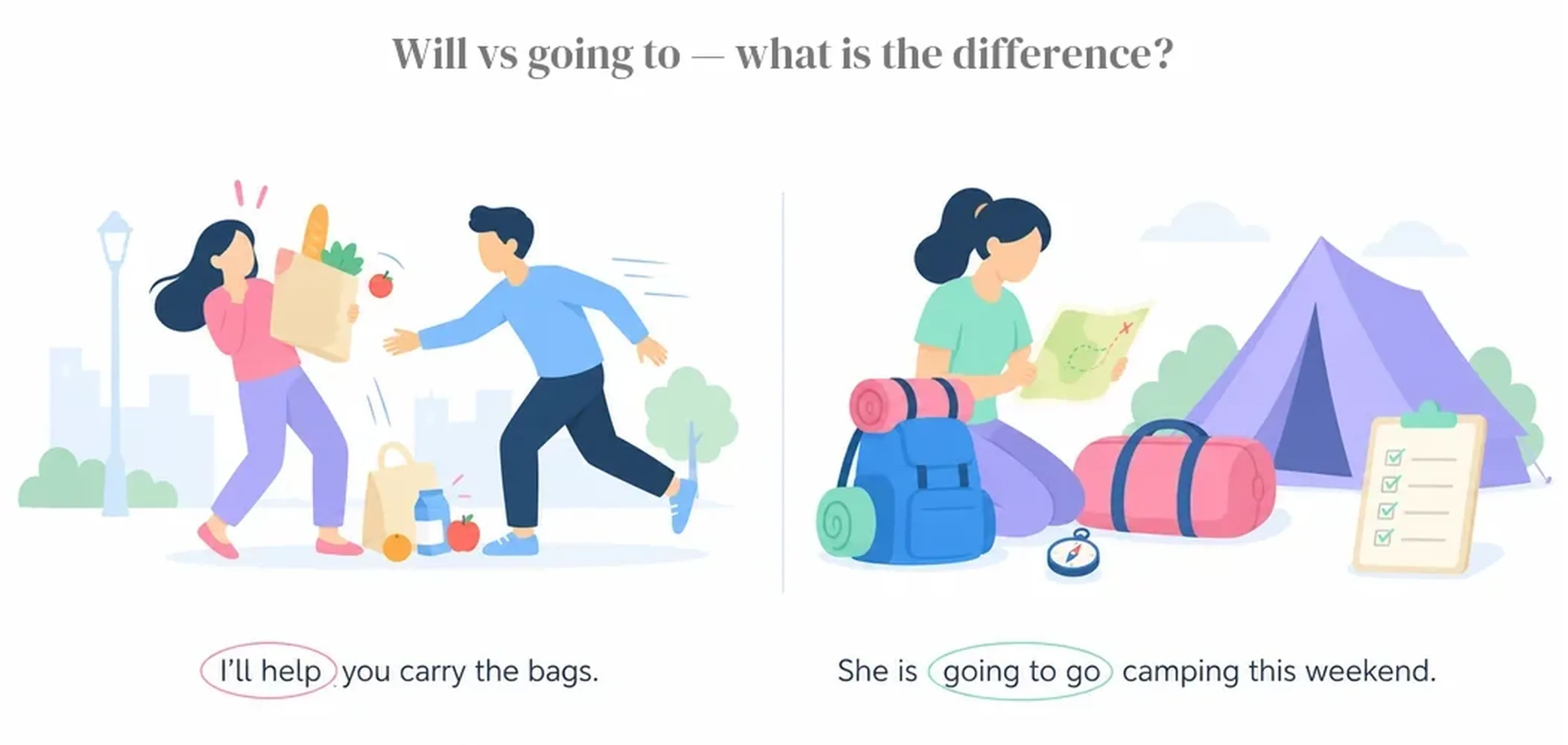
Will vs Going To: The Key Difference
Both 'will' and 'going to' talk about the future, but we use them differently. Use 'will' for sudden decisions, predictions, and offers. Use 'going to' for plans you have already decided, and things that will probably happen because of what you see now. Understanding this difference will help you speak more naturally.

Examples with Will
Use 'will' for quick decisions you make at the moment, predictions about the future, and offers to help.
Examples with Going To
Use 'going to' for plans you already made, things you decided before now, and things that will probably happen because you can see signs of it.
Quick Memory Tip
Think of 'going to' as a plan in your head (you decided it already). Think of 'will' as a choice you make right now, or something you predict without a plan.
Will vs Going To — Side-by-Side Comparison
| Category | Will | Going To |
|---|---|---|
| Form | Subject + will + base verb e.g. I will call |
Subject + am/is/are going to + base verb e.g. I am going to call |
| When to Use |
• Spontaneous decisions made at the moment of speaking • Predictions based on opinion or belief • Offers, promises, and requests • Future facts |
• Pre-planned decisions or intentions decided before speaking • Predictions based on present evidence or signs • Fixed personal plans |
| When Decision Is Made | At the moment of speaking — unplanned | Before the moment of speaking — already planned |
| Positive Example | "The phone is ringing. I'll answer it." "I think it will rain tomorrow." |
"I've already bought the tickets. We're going to see the show." "Look at those clouds — it's going to rain." |
| Negative Example | "Don't worry, I won't tell anyone your secret." | "She's not going to apply for that job after all." |
| Question Example | "Will you help me move this table?" "Will she pass the exam?" |
"Are you going to visit your parents this weekend?" "Is he going to resign?" |
| Key Signal Words | I think, I believe, probably, maybe, perhaps, I'm sure, I promise, I bet | Look!, I've already decided, next week, this summer, soon, I've planned, I've booked |
| Sentence Feel | Spontaneous, uncertain, opinion-based, or offering help in the moment | Deliberate, intentional, evidence-based, or announcing a known plan |
| 🔑 Key Difference: Use will when you decide something spontaneously at the moment of speaking, or when making predictions based on personal opinion. Use going to when the decision or plan was already made before speaking, or when there is clear present evidence pointing to a future outcome. | ||
Formula
✔ Positive
Subject
+
will
+
base verb
I will help you with your homework.
✖ Negative
Subject
+
will not
+
base verb
She won't forget your birthday.
? Question
Will
+
Subject
+
base verb
Will you come to my party?
✔ Positive
Subject
+
am/is/are
+
going to
+
base verb
They are going to move to London next year.
✖ Negative
Subject
+
am/is/are not
+
going to
+
base verb
He is not going to attend the meeting.
? Question
Am/Is/Are
+
Subject
+
going to
+
base verb
Are you going to watch the game tonight?
Examples

I will call you tomorrow.
Sudden promise or offer — Made right now

It will rain this evening.
Prediction — You think it might happen

Don't worry, I will fix your computer.
Offer or promise — Decision at the moment

I am going to buy a new car next month.
Plan — You decided this before

Look at those clouds! It is going to rain.
Certain future — You can see signs now

We are going to have a test next week.
Arrangement — Already decided and planned
When to use it
Sudden Decisions
Use 'will' when you decide to do something at the exact moment you speak.
"The phone is ringing." "I will answer it."
Plans Already Made
Use 'going to' when you made a plan before now. You decided earlier.
"I am going to visit my grandmother on Sunday." (You planned this yesterday.)
Predictions
Use 'will' for guesses about the future with no plan or reason you can see.
"I think the exam will be difficult."
Signs of Future
Use 'going to' when you see signs or reasons something will happen soon.
"Look! The ice cream is melting. It is going to be a hot day."
Offers & Promises
Use 'will' when you offer help or make a promise at the moment.
"Don't worry. I will take care of your cat while you are away."
Arrangements
Use 'going to' for plans or arrangements you already made with other people.
"We are going to have lunch with Sarah tomorrow. We planned it last week."
Signal words
tomorrow
next week
next month
later
tonight
this afternoon
in the future
soon
probably
I think
I bet
definitely
already planned
arranged
Common Mistakes
✕
Wrong
I am going to help you move the furniture. Wait, I will help you instead.
✓
Correct
I will help you move the furniture. (sudden offer at that moment)
'Going to' means you planned it before. 'Will' is better for a new offer you make right now.
✕
Wrong
The weather forecast says it will be sunny, but look at those dark clouds! It will rain.
✓
Correct
The weather forecast says it will be sunny, but look at those dark clouds! It is going to rain.
When you see clear signs or reasons, use 'going to'. You can see the clouds now.
✕
Wrong
She is going to call me. I am sure because she always does.
✓
Correct
I think she will call me. I am sure because she always does.
'Going to' is for plans decided earlier. A prediction about her behaviour needs 'will'.
KEY TAKEAWAYS
What to Remember
- Use 'will' for sudden decisions, predictions, and spontaneous offers about the future.
- Use 'going to' for plans you've already decided and intentions before speaking.
- Use 'going to' when something will probably happen based on what you see now.
- 'Will' is used when you decide at the moment of speaking without previous plans.
- Both express future time, but 'will' shows spontaneity while 'going to' shows prior decision.