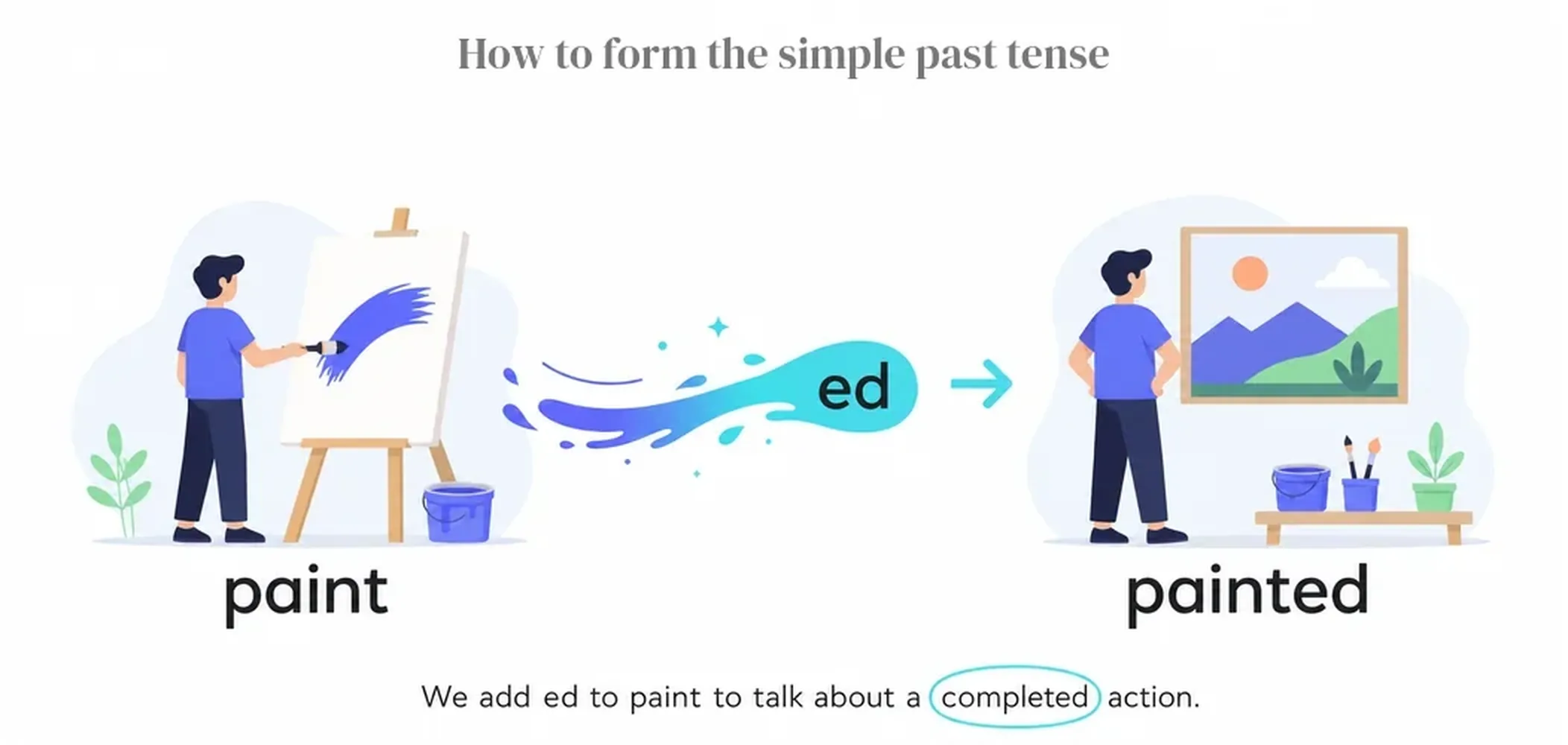
What is the Simple Past Tense?
The simple past tense describes actions that happened in the past and are now finished. We use it to talk about completed events. In English, we form the simple past in two main ways: by adding -ed to regular verbs, or by using irregular verbs that change their spelling completely. This tense is one of the most important you will learn!

How to Form the Simple Past Tense: Regular and Irregular Verbs
| Pronoun | Affirmative | Negative | Question |
|---|---|---|---|
| Regular Verb: work → worked | |||
| I | I worked all day yesterday. | I did not (didn't) work on Sunday. | Did I work late last night? |
| You | You worked very hard last week. | You did not (didn't) work this morning. | Did you work overtime yesterday? |
| He / She / It | He worked from home last month. | She did not (didn't) work on the holiday. | Did it work properly before? |
| We | We worked together on that project. | We did not (didn't) work on weekends. | Did we work enough hours last week? |
| You (plural) | You worked well as a team last year. | You did not (didn't) work during the break. | Did you work the night shift yesterday? |
| They | They worked through the entire night. | They did not (didn't) work last Friday. | Did they work over the weekend? |
| Irregular Verb: go → went | |||
| I | I went to the market this morning. | I did not (didn't) go to the party last night. | Did I go to the right place? |
| You | You went abroad last summer. | You did not (didn't) go to school yesterday. | Did you go to the cinema last week? |
| He / She / It | She went to the doctor last Tuesday. | He did not (didn't) go home after work. | Did it go as planned? |
| We | We went on a trip last month. | We did not (didn't) go out last weekend. | Did we go the wrong way earlier? |
| You (plural) | You went to different places last year. | You did not (didn't) go to the meeting. | Did you go together to the event? |
| They | They went to Paris in 2022. | They did not (didn't) go to the concert. | Did they go by train or by bus? |
| Irregular Verb: have → had | |||
| I | I had a great time at the party. | I did not (didn't) have enough time yesterday. | Did I have an appointment last week? |
| You | You had breakfast very early today. | You did not (didn't) have any money then. | Did you have lunch with her yesterday? |
| He / She / It | He had a meeting with the boss. | She did not (didn't) have any siblings. | Did it have enough fuel last time? |
| We | We had a wonderful holiday last year. | We did not (didn't) have a car back then. | Did we have a reservation that night? |
| You (plural) | You had a lot of fun at the festival. | You did not (didn't) have enough supplies. | Did you have a good experience there? |
| They | They had dinner together last night. | They did not (didn't) have any problems. | Did they have a plan at that time? |
| Irregular Verb: be → was / were | |||
| I | I was very tired last night. | I was not (wasn't) at home yesterday. | Was I wrong about that decision? |
| You | You were late for class this morning. | You were not (weren't) ready on time. | Were you at the conference yesterday? |
| He / She / It | She was a great teacher back then. | He was not (wasn't) happy about it. | Was it cold outside last night? |
| We | We were very surprised by the news. | We were not (weren't) aware of the problem. | Were we invited to the dinner? |
| You (plural) | You were all present at the meeting. | You were not (weren't) prepared for the test. | Were you satisfied with the results? |
| They | They were excited about the trip. | They were not (weren't) ready to leave. | Were they at school last Monday? |
Key Rules for the Simple Past Tense
- Regular verbs add -ed to form the simple past (e.g., work → worked, play → played, talk → talked).
- Verbs ending in -e add only -d (e.g., love → loved, dance → danced).
- Verbs ending in consonant + -y change -y to -ied (e.g., study → studied, try → tried).
- Short verbs (CVC pattern) double the final consonant + -ed (e.g., stop → stopped, plan → planned).
- Irregular verbs do NOT follow the -ed rule and must be memorized individually (e.g., go → went, have → had, be → was/were).
- In negative and question forms, use the auxiliary verb did (for regular and most irregular verbs) or was/were (for the verb "be").
Formula
✔ Positive
Subject
+
past tense verb
+
(+ object)
I played football yesterday.
✖ Negative
Subject
+
did not
+
base verb
+
(+ object)
She did not like the movie.
? Question
Did
+
subject
+
base verb
+
(+ object)?
Did you eat breakfast this morning?
Examples

I walked to school yesterday.
Regular verb · Positive

She ate dinner at 7 o'clock.
Irregular verb · Positive

They did not go to the park.
Negative form

Did he watch the game last night?
Question form

We stayed at home and watched TV.
Two regular verbs in sequence

Did you understand the lesson?
Question with irregular verb
When to use it
Telling Stories
Use simple past to describe what happened in a story or personal experience.
"I went to the beach yesterday. I played in the water and made a sandcastle."
Asking About Past Events
Form questions to ask others what they did in the past.
"Did you see the film last weekend? Where did you go?"
Reporting Finished Actions
Describe actions that started and ended in the past.
"The train arrived at 5 o'clock. We ate lunch at home."
Signal words
yesterday
last week
last year
ago
in 2020
this morning
when I was young
last night
two days ago
then
Common Mistakes
✕
Wrong
I goed to the shop.
✓
Correct
I went to the shop.
Go is irregular. The past tense is 'went', not 'goed'.
✕
Wrong
She did not played the piano.
✓
Correct
She did not play the piano.
In negatives, use base verb after 'did not', not the -ed form.
✕
Wrong
Did you finished your homework?
✓
Correct
Did you finish your homework?
In questions, use base verb after 'did', not the -ed form.
KEY TAKEAWAYS
What to Remember
- The simple past tense describes completed actions that finished in the past.
- Add -ed to the end of regular verbs to form the simple past tense.
- Irregular verbs change their spelling completely and do not follow the -ed rule.
- You must learn irregular verbs by heart because their forms are unpredictable.
- Use the simple past tense to talk about finished events and past experiences.