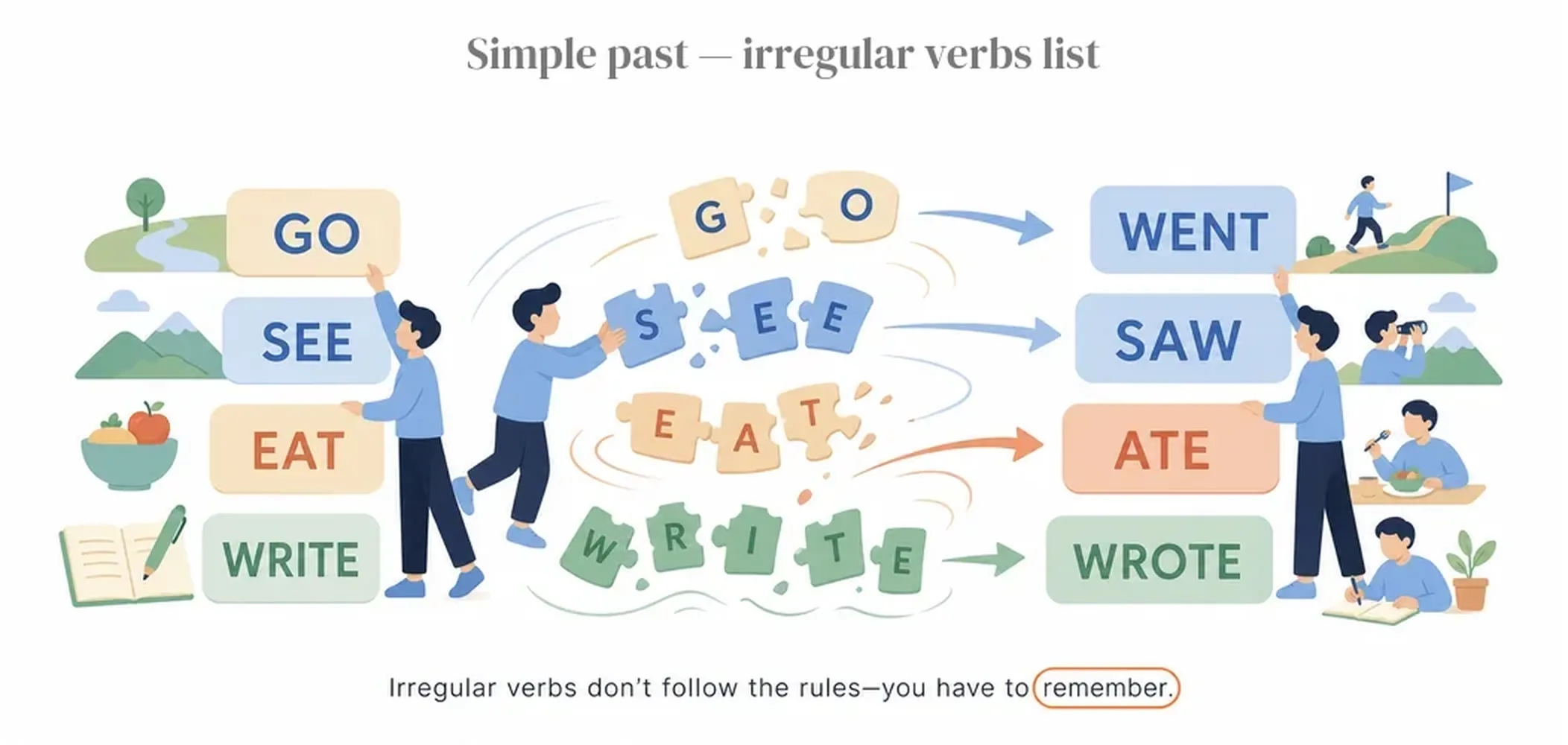
What are irregular verbs?
Most verbs in English follow a simple rule: add -ed to make the past tense. For example, walk becomes walked, and play becomes played. However, some verbs do not follow this rule. These are called irregular verbs. They change completely in the simple past tense. You must learn them by heart because there is no pattern to follow.

How do we use irregular verbs?
We use irregular verbs in the simple past tense to talk about finished actions. The form does not change for different subjects. For example: I went, you went, he went, we went. Learning the most common irregular verbs is important because you will use them every day in English conversation and writing.
Common irregular verbs you must know
The most important irregular verbs are: be (was/were), go (went), have (had), do (did), see (saw), come (came), make (made), get (got), take (took), and know (knew). These verbs appear very often in English. Start by learning these ten verbs well, then slowly add more to your vocabulary.
Irregular Verbs List
| Base Form | Simple Past | Example Sentence |
|---|---|---|
| be | was / were | She was tired after work. |
| become | became | He became a doctor. |
| begin | began | The movie began at eight. |
| break | broke | She broke the glass. |
| bring | brought | He brought food to the party. |
| build | built | They built a new house. |
| buy | bought | I bought a new phone. |
| catch | caught | The dog caught the ball. |
| choose | chose | She chose the red dress. |
| come | came | They came home late. |
| cost | cost | The jacket cost fifty dollars. |
| cut | cut | He cut the paper in half. |
| do | did | She did her homework. |
| draw | drew | He drew a map of the city. |
| drink | drank | I drank coffee this morning. |
| drive | drove | She drove to the airport. |
| eat | ate | We ate pizza for dinner. |
| fall | fell | He fell off his bike. |
| feel | felt | I felt happy yesterday. |
| find | found | She found her keys. |
| fly | flew | They flew to Paris last summer. |
| forget | forgot | He forgot her birthday. |
| get | got | I got a letter today. |
| give | gave | She gave him a gift. |
| go | went | We went to the beach yesterday. |
Examples






What to Remember
- Most English verbs add -ed to form the simple past tense, but irregular verbs change completely.
- Irregular verbs have no pattern, so you must memorize them individually by heart.
- Use the simple past tense to describe actions that are completely finished.
- The simple past form stays the same for all subjects: I went, he went.
- Common irregular verbs include go/went, eat/ate, see/saw, and come/came.