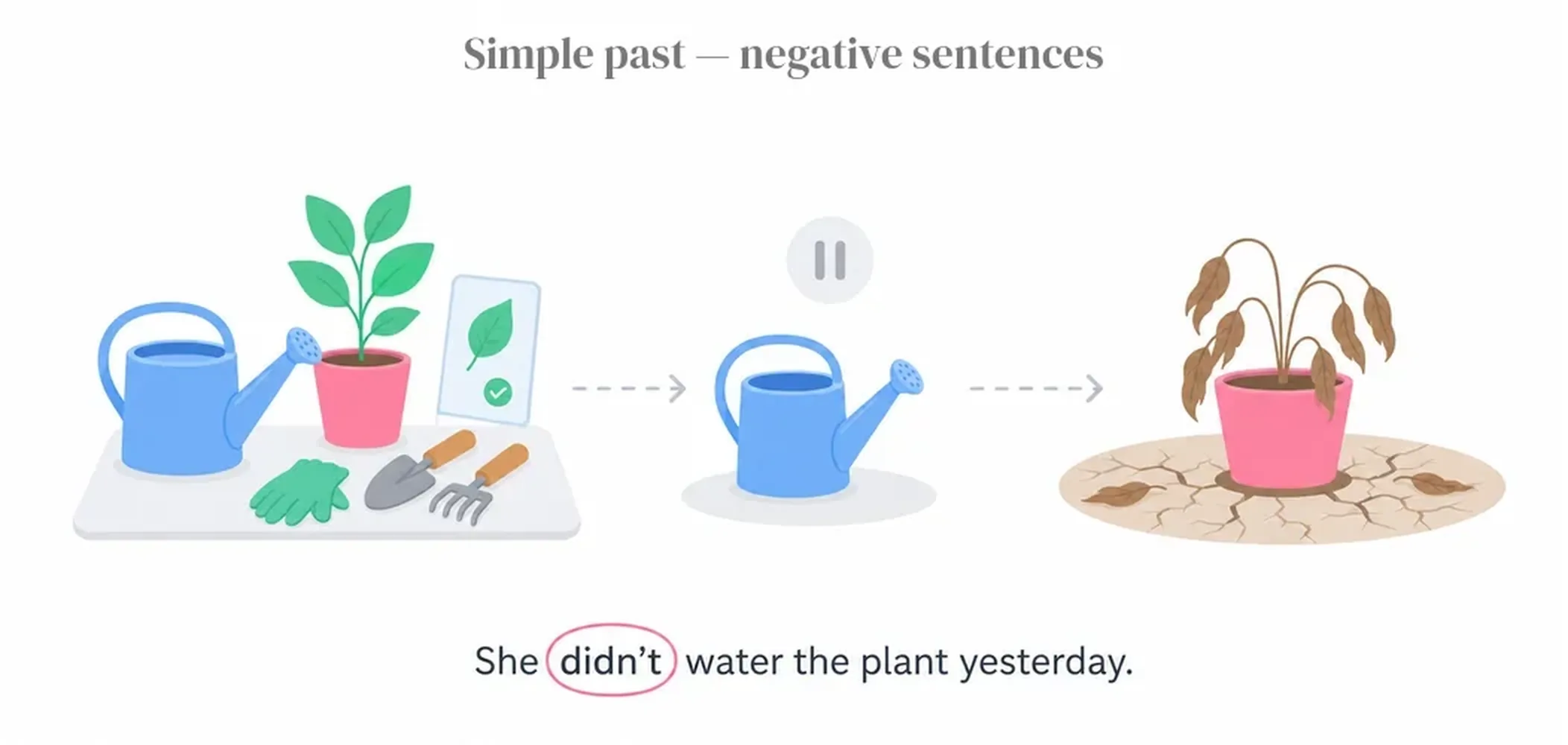
Simple Past — Negative Sentences
To make negative sentences in the simple past, we use did not (or didn't) with the base form of the verb. This is the same for all subjects. We do not change the verb ending when we use didn't.

Examples of Simple Past Negative Sentences
Formula:
Subject + did not / didn't + base verb (infinitive) + rest of sentence
Key rule:
The main verb always returns to its base form — never add -ed after didn't.
Note:
did not and didn't are identical in meaning; didn't is more common in spoken English.
Group 1 — First & Second Person (I, You)
Affirmative
I worked late last night.
Negative
I didn't work late last night.
Why: didn't carries the past tense marker, so the main verb work stays in its base form — not worked. Adding -ed to both would be a double past tense error.
Affirmative
I had breakfast this morning.
Negative
I did not have breakfast this morning.
Why: have is an irregular verb. In negatives, the auxiliary did not handles the past tense, and have returns to its base form — never had.
Affirmative
You remembered my birthday.
Negative
You didn't remember my birthday.
Why: didn't is used with all subjects — there is no change for you. The form is the same whether the subject is I, you, he, she, we, or they.
Affirmative
You told me the truth.
Negative
You did not tell me the truth.
Why: tell → told is irregular in the affirmative, but in the negative the base form tell is always used after did not, regardless of the verb's irregularity.
Group 2 — Third Person Singular (He, She, It)
Affirmative
He called his mother yesterday.
Negative
He didn't call his mother yesterday.
Why: In the present tense, he/she/it require an -s ending (e.g., calls). In the past negative, didn't removes that requirement — the base verb call is used for every subject.
Affirmative
She went to the gym on Monday.
Negative
She did not go to the gym on Monday.
Why: go → went is highly irregular, but in the negative we always revert to the base form go. A common error is writing "She didn't went" — this is incorrect.
Affirmative
He understood the instructions.
Negative
He didn't understand the instructions.
Why: Another irregular verb (understand → understood). Negatives always use the base form after didn't, making this rule consistent and easy to apply.
Affirmative
She bought a new laptop last week.
Negative
She did not buy a new laptop last week.
Why: did not (full form) is used here instead of the contraction. Both are grammatically correct; the full form is slightly more formal or emphatic.
Group 3 — Plural Subjects (We, They)
Affirmative
We finished the project on time.
Negative
We didn't finish the project on time.
Why: For plural subjects like we, the structure is exactly the same as for singular subjects. There is no conjugation change — didn't works uniformly across all subjects.
Affirmative
They arrived at the hotel before midnight.
Negative
They didn't arrive at the hotel before midnight.
Why: Even though arrived is a regular past tense verb, the -ed ending is dropped in the negative. The auxiliary didn't alone signals that the action is in the past.
Affirmative
We saw the film last Saturday.
Negative
We did not see the film last Saturday.
Why: see → saw is irregular. In the negative, the base form see is restored. The full form did not is used to add emphasis — for example, to correct a false belief.
Affirmative
They spoke English during the meeting.
<span style="display:inline-block;background:#DCFCE7
Formula
✖ Negative
Subject
+
did not (didn't)
+
base form verb
+
.
I didn't go to school yesterday.
Examples

I didn't watch TV last night.
Simple past negative · Everyday activity

She did not like the movie.
Simple past negative · Opinion

We didn't go to the park because it was raining.
Simple past negative · Reason given

He didn't finish his homework yesterday.
Simple past negative · School context

They didn't come to the party.
Simple past negative · Social event

You didn't answer the question correctly.
Simple past negative · Classroom
When to use it
Past Activities
Say what you did not do yesterday, last week, or in the past.
"I didn't call my friend yesterday."
Denying Something
Tell someone that something did not happen.
"We didn't eat dinner at that restaurant."
Answering Questions
Give a negative answer to questions about the past.
"Did you sleep well?" "No, I didn't sleep well."
Signal words
yesterday
last week
last month
last year
ago
in 2020
on Monday
this morning
never
Common Mistakes
✕
Wrong
She didn't went to the store.
✓
Correct
She didn't go to the store.
After didn't, use the base form of the verb, not the -ed form.
✕
Wrong
I no go to school yesterday.
✓
Correct
I didn't go to school yesterday.
Always use did not or didn't to make simple past negatives, not 'no'.
KEY TAKEAWAYS
What to Remember
- Use did not or didn't to make simple past negative sentences with all subjects.
- Always use the base form of the verb after didn't, never the past tense form.
- The verb does not change its ending when you use didn't in negative sentences.
- Didn't is the contraction of did not and means the same thing in speech.
- Simple past negatives use the same structure for all subjects: I, you, he, she, it, we, they.