Why Do Learners Make Simple Present Mistakes?
The simple present tense is one of the first tenses you learn in English. But many beginners make the same mistakes again and again. The biggest problem is forgetting to add 's' or 'es' to the verb when the subject is he, she, or it. Other common mistakes happen because learners think about their own language first. Let's look at the mistakes and learn how to fix them!

Common Mistakes and Corrections
1. Missing Third-Person -s / -es
| Incorrect | Correct | Explanation |
|---|---|---|
| She work in a hospital every day. | She works in a hospital every day. | With third-person singular subjects (he, she, it), add -s or -es to the base verb. "She work" is a very common learner error. |
| My brother teach mathematics at a secondary school. | My brother teaches mathematics at a secondary school. | Verbs ending in -ch, -sh, -x, -s, -z take -es in the third person: teach → teaches, wash → washes. |
| The dog go outside every morning when I open the door. | The dog goes outside every morning when I open the door. | Go is irregular in the third person and becomes goes, not "gos". Similarly: do → does, have → has. |
2. Incorrect Negative Forms
| Incorrect | Correct | Explanation |
|---|---|---|
| He don't like spicy food at all. | He doesn't like spicy food at all. | Use doesn't (does not) for he/she/it in negatives. Don't is only for I, you, we, they. The base verb follows: "doesn't like", not "doesn't likes". |
| I not understand this grammar rule very well. | I don't understand this grammar rule very well. | You cannot place not directly after the subject without an auxiliary. Always use do/does + not + base verb to form negatives in the simple present. |
| She doesn't works on Sundays. | She doesn't work on Sundays. | After doesn't, always use the base form of the verb (infinitive without "to"). The auxiliary does already carries the third-person marking. |
3. Wrong Auxiliary in Questions
| Incorrect | Correct | Explanation |
|---|---|---|
| Does your parents lives nearby? | Do your parents live nearby? | Parents is plural, so use do, not does. Also, the main verb after the auxiliary stays in the base form: "live", not "lives". |
| He plays football on weekends? | Does he play football on weekends? | In English, yes/no questions require inversion with an auxiliary. Move does to the front and revert the verb to its base form. Simply raising intonation is not enough in written form. |
4. Using Simple Present Instead of Present Continuous (and Vice Versa)
| Incorrect | Correct | Explanation |
|---|---|---|
| I am knowing the answer to that question. | I know the answer to that question. | Stative verbs like know, understand, believe, love, want, need describe states, not actions. They are almost never used in continuous tenses — use the simple present instead. |
| Look! That child runs into the road. | Look! That child is running into the road. | Signals like "Look!" or "right now" indicate an action happening at this exact moment, which requires the present continuous, not the simple present. |
5. Habit & Frequency Adverb Placement
| Incorrect | Correct | Explanation |
|---|---|---|
| She drinks always coffee in the morning. | She always drinks coffee in the morning. | Frequency adverbs like always, usually, often, sometimes, never are placed before the main verb but after the verb "to be": "She is always tired." |
| My father watch the news every evening before dinner. | My father watches the news every evening before dinner. | Time expressions like every day / every evening / on Mondays signal a habitual action — use the simple present and remember to add -es for a third-person singular subject. |
Examples

He plays guitar in a band.
He/she/it — add 's' to the verb
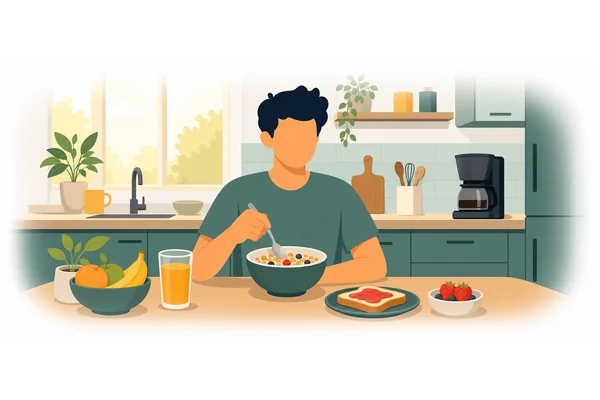
They don't drink coffee in the morning.
They — use 'don't', not 'doesn't'

Does he like playing football?
He — use 'does' for questions

I go to the market every Saturday.
I — no 's' at the end
Signal words
always
usually
often
sometimes
never
every day
every week
in the morning
at night
on Monday
Common Mistakes
✕
Wrong
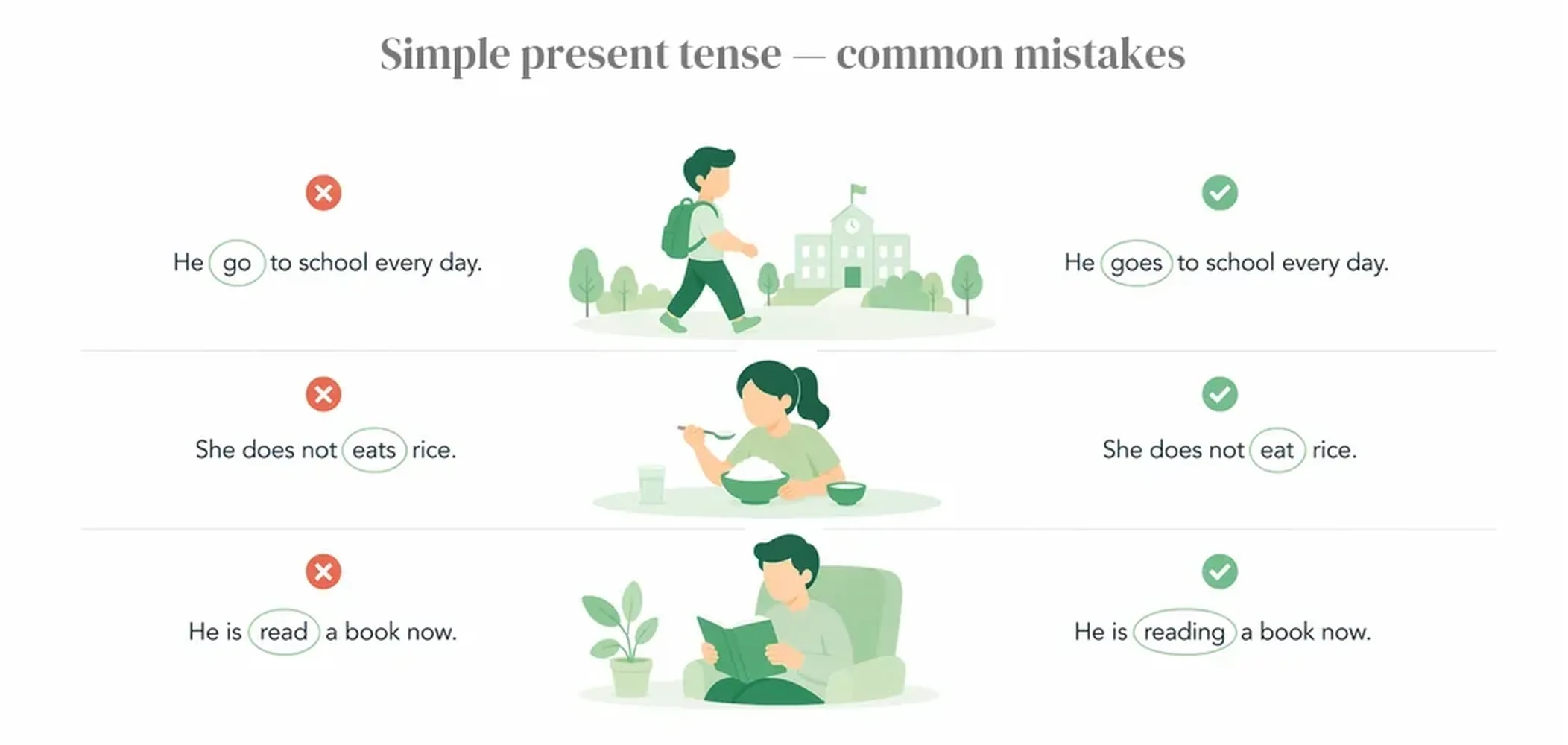
He go to school every day.
✓
Correct
He goes to school every day.
Third person singular (he/she/it) needs 's' at the end of the verb.
✕
Wrong
She don't like coffee.
✓
Correct
She doesn't like coffee.
With he/she/it, use 'doesn't' not 'don't' in negative sentences.
✕
Wrong
Do she work here?
✓
Correct
Does she work here?
Use 'does' for questions with he/she/it, not 'do'.
✕
Wrong
I goes to the gym on Monday.
✓
Correct
I go to the gym on Monday.
With 'I', 'you', 'we', 'they', don't add 's' to the verb.
✕
Wrong
My sister watch TV in the evening.
✓
Correct
My sister watches TV in the evening.
Verbs ending in 'ch', 'sh', 'x', 'z', 's' need 'es', not just 's'.
✕
Wrong
He study English three times a week.
✓
Correct
He studies English three times a week.
When a verb ends in 'y', change 'y' to 'i' and add 'es': study → studies.
✕
Wrong
Does you have a pet?
✓
Correct
Do you have a pet?
With 'you', use 'do' not 'does', even in questions.
KEY TAKEAWAYS
What to Remember
- Add 's' or 'es' to the verb when the subject is he, she, or it.
- Use the base form of the verb for I, you, we, and they without any changes.
- Don't forget the 's' even if it sounds strange in your own language.
- Use the simple present for habits, facts, and things that happen regularly.
- Remember that negative sentences and questions need the auxiliary verb 'do' or 'does'.