Questions in the Simple Present
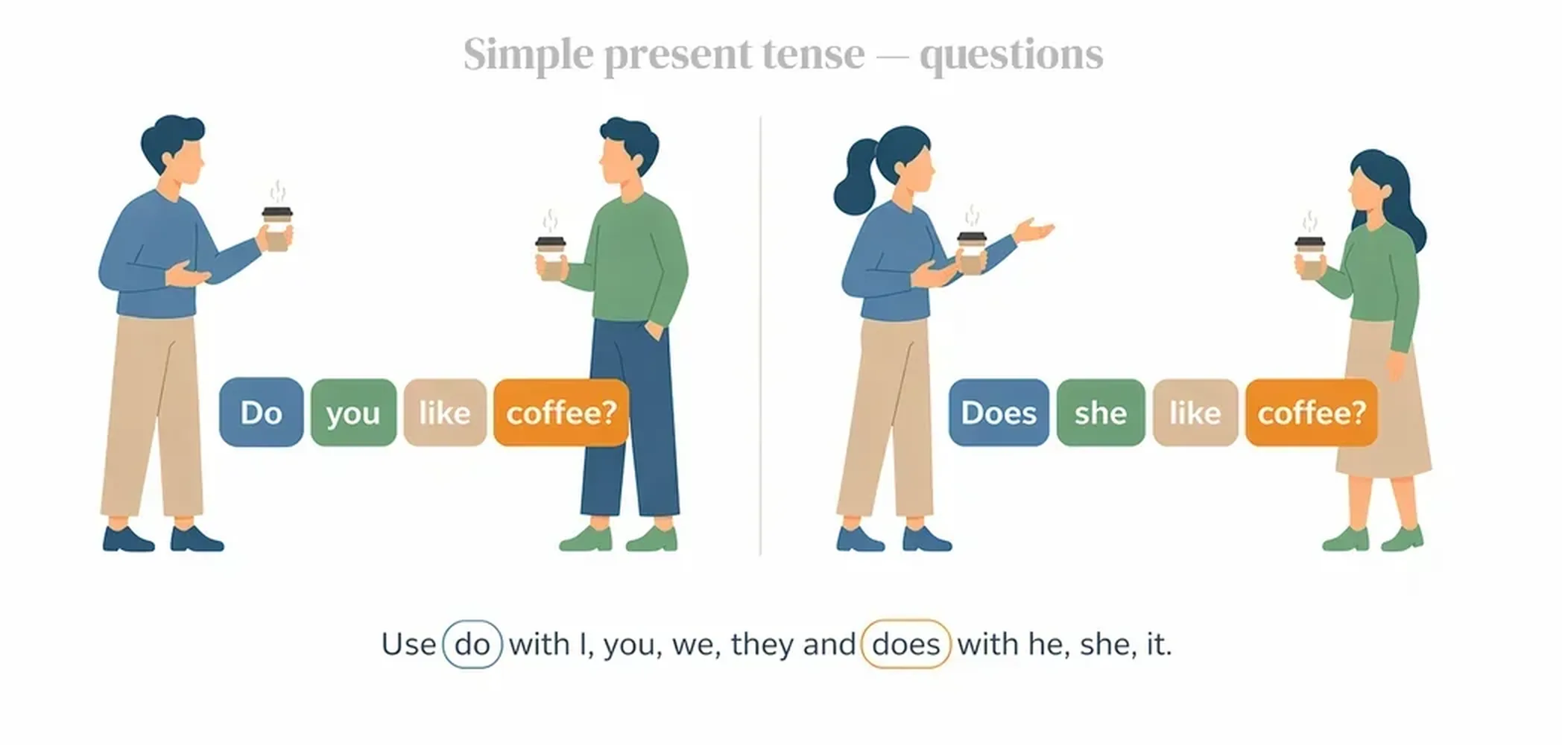
Questions in the simple present tense follow a special word order. We use the auxiliary verb 'do' or 'does' at the beginning of the question. The subject comes second, and the main verb comes third. This is different from positive sentences.

Simple Present Tense — Questions
To form a yes/no question in the simple present tense, place the auxiliary verb do or does before the subject. The main verb stays in its base form (no -s ending).
Structure: Do / Does + subject + base verb + … ?
e.g. Does she work here? | Do they like coffee?
e.g. Does she work here? | Do they like coffee?
Group 1 — "Do" with I, You, We, They
Positive → Question
You like coffee. →
Do you like coffee?
✦ Use do with you (singular or plural). The verb like stays in its base form — no -s is added.
Positive → Question
They live near the park. →
Do they live near the park?
✦ They is a third-person plural subject, so we use do, not does.
Positive → Question
We have a meeting on Monday. →
Do we have a meeting on Monday?
✦ We takes do. Notice the main verb have does not change to has in the question.
Positive → Question
I need more time. →
Do I need more time?
✦ Even the first-person singular I uses do, not does.
Group 2 — "Does" with He, She, It
Positive → Question
She works late on Fridays. →
Does she work late on Fridays?
✦ She is third-person singular → use does. The -s moves from the main verb to the auxiliary: works → does … work.
Positive → Question
He speaks three languages. →
Does he speak three languages?
✦ He is third-person singular. The main verb returns to its base form speak — never speaks in the question.
Positive → Question
The train leaves at 7 a.m. →
Does the train leave at 7 a.m.?
✦ A noun like the train replaces it grammatically — still third-person singular, so does is required.
Positive → Question
The app crashes on older devices. →
Does the app crash on older devices?
✦ The app is a singular noun (≈ it) → does. Base form crash is used, not crashes.
Group 3 — Information Questions (Wh- words)
Wh- Question
Where do you work?
✦ Wh- questions follow: Wh-word + do/does + subject + base verb. Here where asks for place information.
Wh- Question
What does she do for a living?
Formula
? Question
Do
+
you/we/they
+
verb
+
?
Do you like coffee?
Examples

Do you speak English?
Basic yes/no question · Plural subject

Does he play football?
Basic yes/no question · Singular subject

What do they do?
Question word question · Plural subject

Where does she live?
Question word question · Singular subject

When do you go to school?
Question word question · Time question

Does it rain in summer?
Basic yes/no question · Singular subject 'it'
When to use it
Starting conversations
Use simple present questions to ask people about their daily habits and routines.
"Do you like your job?" or "What time do you wake up?"
Asking for information
Ask questions to learn about someone's life, work, or interests.
"Does she have any brothers?" or "Where do your parents live?"
Checking facts
Use questions to confirm information you think is true.
"Do you work in an office?" or "Does the shop close at 6 p.m.?"
Signal words
Do
Does
What
Where
When
Who
Why
How
Which
Common Mistakes
✕
Wrong
You speak English?
✓
Correct
Do you speak English?
In English, we need 'do' at the beginning of most simple present questions.
✕
Wrong
Does he likes pizza?
✓
Correct
Does he like pizza?
When we use 'does', the main verb stays in base form. Do not add 's' to the verb.
KEY TAKEAWAYS
What to Remember
- Use 'do' or 'does' at the beginning of simple present tense questions.
- The subject comes immediately after the auxiliary verb 'do' or 'does'.
- The main verb follows the subject in its base form.
- Use 'does' with third person singular subjects; use 'do' with all other subjects.
- This word order (do/does + subject + verb) is different from positive sentences.