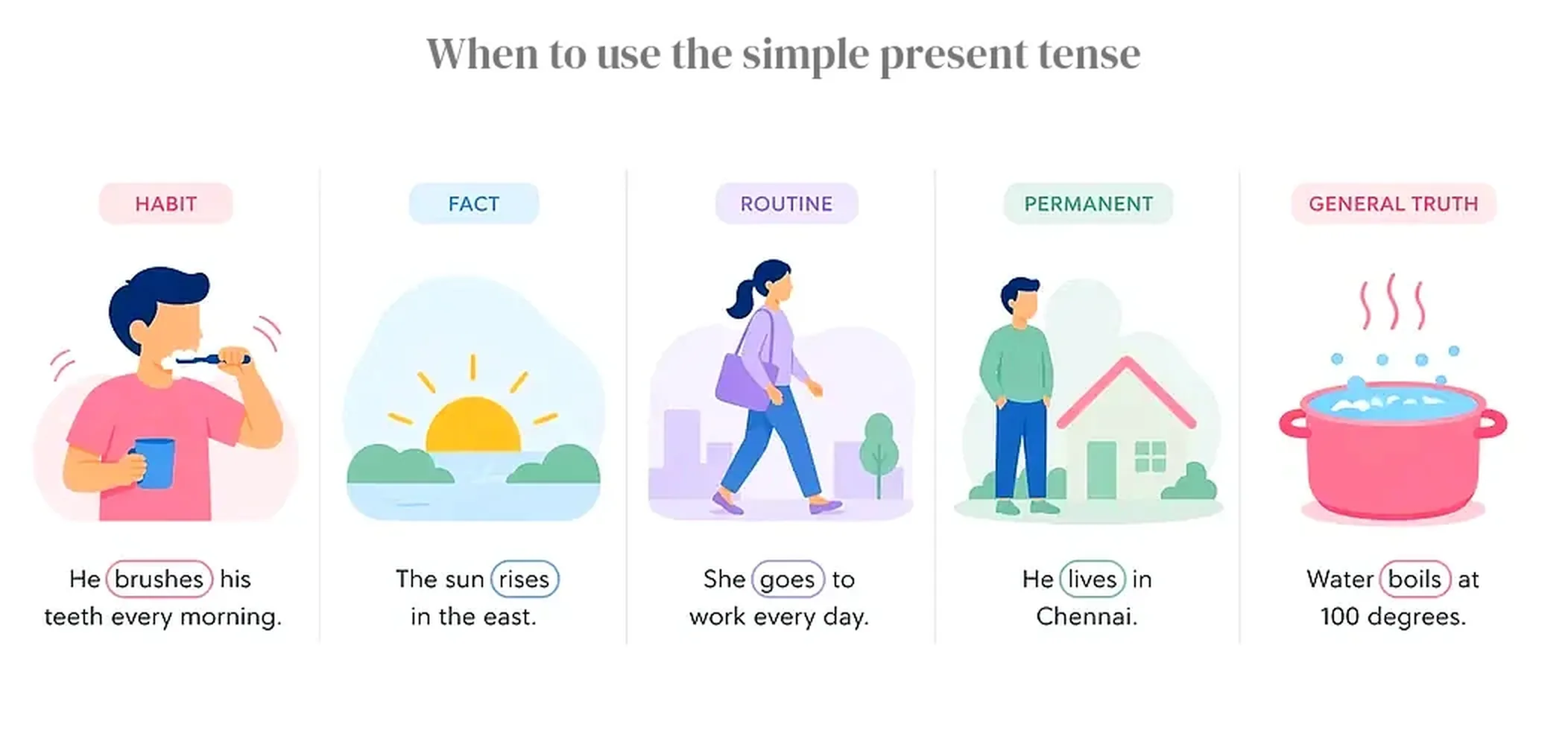
When to Use the Simple Present Tense
The simple present tense is one of the most important tenses in English. We use it to talk about facts, habits, and things that happen regularly. It is also used for permanent situations and general truths. Learning when to use the simple present will help you speak and write correctly in everyday English.
When to Use Simple Present vs. Present Continuous
Many learners confuse the simple present with the present continuous (am/is/are + -ing). Here is when to use each one.
| Use Simple Present | Use Present Continuous |
|---|---|
| Habits and regular actions "I exercise three times a week." "She drinks coffee every morning." |
Actions happening right now "I am exercising right now." "She is drinking coffee in the cafe." |
| "He works in an office." (General fact about his life) | "He is working in an office right now." (Happening at this moment) |
| "They live in Tokyo." (Where they are based) | "They are living in Tokyo for three months." (Temporary situation) |
Simple Present for Scheduled Future Events
The simple present tense can describe events that are scheduled or timetabled in the future. This is common with transportation, events, and appointments.
Examples:
- "The train leaves at 5 PM." (The timetable shows this departure time.)
- "The movie starts at 8 o'clock tonight." (The schedule is set.)
- "My flight departs tomorrow at 6 AM." (This is on the airline schedule.)
- "The conference begins next Monday." (The date is officially scheduled.)
Important note: This use refers to events that are fixed by a schedule or timetable, not personal plans. For personal future plans, use "going to" or "will" instead.
Permanent Situations vs. Temporary Situations
A permanent situation is true for a long time and unlikely to change soon. Temporary situations are expected to end — use the present continuous for these.
| Permanent → Simple Present | Temporary → Present Continuous |
|---|---|
| "I am a teacher." (Identity) | "I am working as a teacher this year." (May not be permanent) |
| "She lives in London." (Long-term residence) | "She is living in London for six months." (Will move after) |
| "They own a restaurant." (Long-term ownership) | "They are renovating their restaurant." (Work in progress, temporary) |
| "He works as a doctor." (Lasting profession) | "He is working late tonight." (Just for tonight) |
Understanding Stative Verbs
Stative verbs describe states, feelings, or conditions — not actions. They are rarely used in the present continuous. Always use the simple present with these verbs.
| Category | Verbs | Correct Example |
|---|---|---|
| Liking / Disliking | like, love, hate, enjoy, prefer | "She loves chocolate." (NOT "is loving") |
| Thinking | believe, think, know, understand, remember, forget | "I understand the lesson." (NOT "am understanding") |
| Possession | have, own, possess | "They have two cars." (NOT "are having") |
| Being | be, seem, appear, look | "He seems tired." (NOT "is seeming") |
| Sensing | see, hear, smell, taste, feel | "This coffee smells delicious." (NOT "is smelling") |
Simple Present vs. Present Perfect
The simple present and present perfect are both connected to the present, but they serve different purposes.
| Simple Present | Present Perfect |
|---|---|
| Habits, routines, repeated actions (no emphasis on when they started) | Actions started in the past that are still relevant or continuing now |
| "I visit my grandparents every month." (Regular habit) | "I have visited Paris three times." (Count relevant now) |
| "She exercises in the morning." (Her routine) | "She has lived here for five years." (Started past, continues now) |
Key difference: "I visit my parents every month" describes the regular action. "I have visited my parents three times this year" describes how many times it has happened so far.
General Truths and Facts
Use the simple present for statements that are always true or universally accepted.
Examples:
- "Water boils at 100 degrees Celsius." (Scientific fact)
- "The Earth orbits the Sun." (Universal truth)
- "Lions are found in Africa and Asia." (General fact about the species)
- "Paris is the capital of France." (Factual information)
- "Cats have four legs." (General characteristic)
These statements remain true regardless of when you say them, so the simple present is the correct choice.
Irregular Verbs: Be, Do, and Have
Three common verbs have irregular forms in the simple present. Memorise these — they are used constantly.
The Verb "Be"
| Subject | Affirmative | Negative | Question |
|---|---|---|---|
| I | am | am not | Am I...? |
| You | are | are not (aren't) | Are you...? |
| He / She / It | is | is not (isn't) | Is he/she/it...? |
| We | are | are not (aren't) | Are we...? |
| They | are | are not (aren't) | Are they...? |
The Verb "Do"
| Subject | Affirmative | Negative | Question |
|---|---|---|---|
| I | do | don't (do not) | Do I...? |
| You | do | don't (do not) | Do you...? |
| He / She / It | does | doesn't (does not) | Does he/she/it...? |
| We | do | don't (do not) | Do we...? |
| They | do | don't (do not) | Do they...? |
The Verb "Have"
| Subject | Affirmative | Negative | Question |
|---|---|---|---|
| I | have | don't have | Do I have...? |
| You | have | don't have | Do you have...? |
| He / She / It | has | doesn't have | Does he/she/it have...? |
| We | have | don't have | Do we have...? |
| They | have | don't have | Do they have...? |
- "I am a student." / "Are you a student?"
- "She is happy." / "Is she happy?"
- "He does his homework every day." / "Does he do his homework?"
- "They have a dog." / "Do they have a dog?"
Examples




What to Remember
- Use the simple present tense to describe facts, habits, and regular actions in your daily life.
- Add -s or -es to the verb when the subject is he, she, or it.
- Use the simple present tense for general truths and permanent situations that don't change.
- Form negative sentences with do not or does not before the main verb.
- Remember that some verbs like be have irregular forms: am, is, are.