Understanding English Tenses
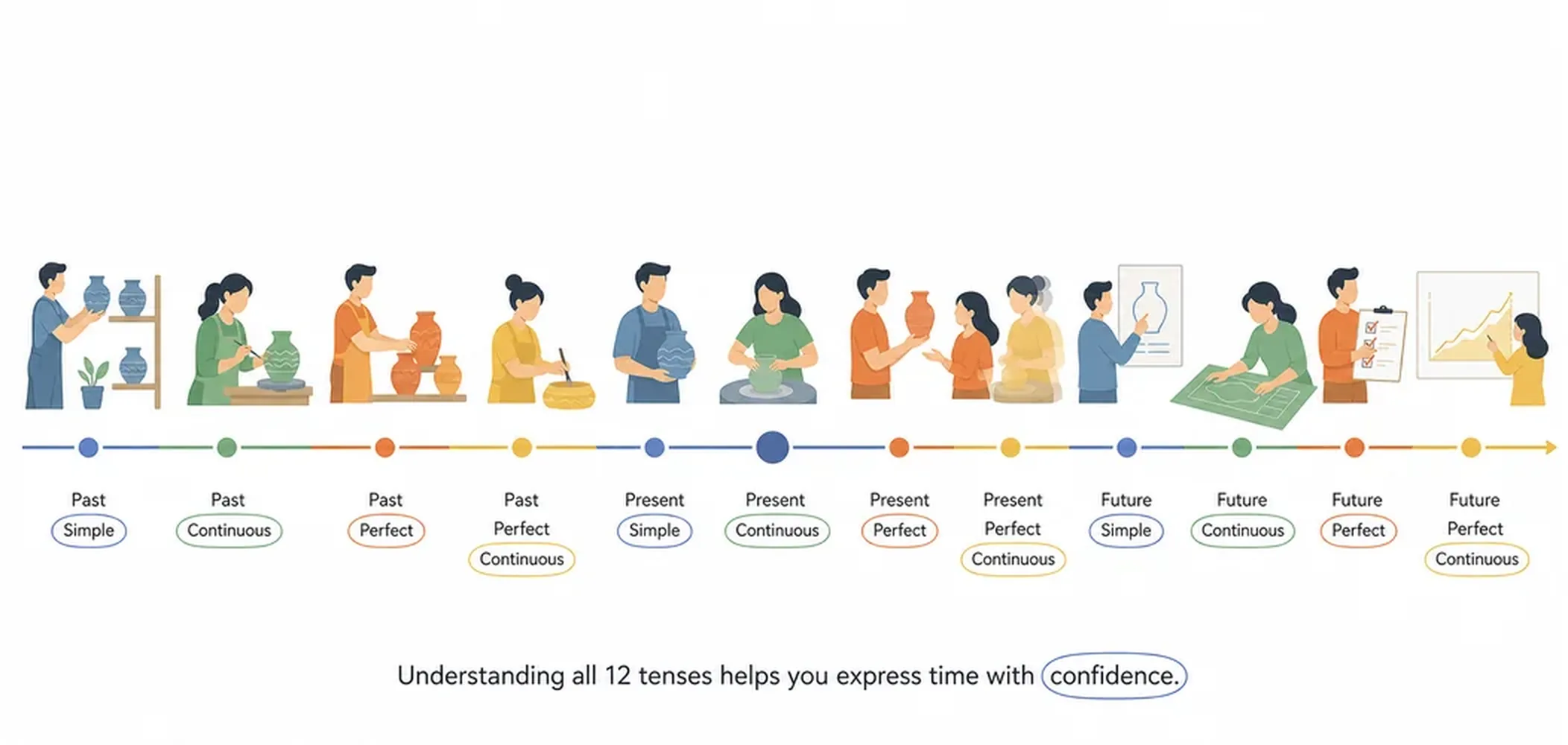
English has 12 main tenses, divided into four time periods: present, past, future, and conditional. Each time period contains three aspects: simple (completed actions), continuous (ongoing actions), and perfect (actions with relevance to another point in time). Understanding these tenses is essential for expressing yourself accurately and naturally in English. This guide breaks down all 12 tenses with clear explanations and practical examples to help you master them.

Present Tenses (4 Tenses)
The present tenses describe actions and situations happening now, recently, or habitually. Present Simple expresses facts, habits, and routines (I work as a teacher). Present Continuous describes actions happening right now (I am working on a project). Present Perfect connects past actions to the present moment (I have worked here for five years). Present Perfect Continuous emphasizes the duration of an ongoing situation (I have been working all morning). Each present tense has a specific function and cannot be used interchangeably.
Past Tenses (4 Tenses)
Past tenses describe completed or ongoing actions in the past. Past Simple is used for actions completed at a specific time (I worked yesterday). Past Continuous describes actions that were ongoing at a past moment (I was working when you called). Past Perfect expresses actions completed before another past action (I had finished before she arrived). Past Perfect Continuous shows the duration of a past action before another past event (I had been working for two hours when the power cut). These tenses help establish a clear timeline of events.
Future & Conditional Tenses (4 Tenses)
Future tenses express actions and situations yet to happen. Conditional tenses describe hypothetical situations and their imaginary outcomes. Each of the four tenses below serves distinct communicative purposes and helps convey different degrees of certainty and timing in future scenarios.
| Tense | Use & Form | Example |
|---|---|---|
| Future Simple | Describes plans, predictions, and decisions made at the moment of speaking. Form: will + base verb | I will finish tomorrow. / She will arrive at 6 PM. |
| Future Continuous | Describes an action in progress at a specific future time. Form: will be + -ing verb | I will be working all day. / They will be studying when you arrive. |
| Future Perfect | Expresses actions that will be completed by a specific future time. Form: will have + past participle | I will have finished by 5 PM. / She will have left before noon. |
| Conditional | Discusses imaginary, hypothetical, or dependent situations. Form: would + base verb (often following "if" clauses) | If I had more time, I would help. / If you studied harder, you would pass. |
How to Choose the Right Tense
Selecting the correct tense depends on three factors: the time of the action (present, past, future), the aspect or type of action (simple, continuous, perfect), and the relationship between multiple actions. Ask yourself: When does this action happen? Is it complete or ongoing? Does it relate to another action? Using a tense checklist and practicing with context-based sentences will help you develop intuition for tense selection.
All 12 Tenses at a Glance
| Feature | Simple Present | Present Continuous | Present Perfect | Present Perfect Continuous | Simple Past | Past Continuous | Past Perfect | Past Perfect Continuous | Simple Future | Future Continuous | Future Perfect | Future Perfect Continuous |
|---|---|---|---|---|---|---|---|---|---|---|---|---|
| Time Period | Present / General | Present (ongoing) | Past → Present | Past → Present (ongoing) | Past (completed) | Past (in progress) | Before a past moment | Before a past moment (duration) | Future | Future (in progress) | Before a future moment | Before a future moment (duration) |
| Aspect | Simple | Continuous / Progressive | Perfect | Perfect Continuous | Simple | Continuous / Progressive | Perfect | Perfect Continuous | Simple | Continuous / Progressive | Perfect | Perfect Continuous |
| Form | Subject + base verb (add -s/-es for 3rd person singular) | Subject + am/is/are + verb-ing | Subject + have/has + past participle | Subject + have/has + been + verb-ing | Subject + past tense verb (regular: -ed; irregular: varies) | Subject + was/were + verb-ing | Subject + had + past participle | Subject + had + been + verb-ing | Subject + will + base verb | Subject + will + be + verb-ing | Subject + will + have + past participle | Subject + will + have + been + verb-ing |
| When to Use | Habits, routines, facts, scheduled events, general truths | Actions happening right now or around the current period; temporary situations; planned near-future events | Past actions with present relevance; life experiences without a specific time; recently completed actions | An action that started in the past and is still continuing or has just stopped, emphasising duration | Completed actions at a definite time in the past; sequences of past events; past habits | An action in progress at a specific moment in the past; background context for a story; interrupted past actions | An action completed before another past action or a specific past time ("the past of the past") | An ongoing action that was in progress up to or just before a specific past moment, emphasising duration | Spontaneous decisions, predictions, promises, offers, or requests about the future | An action that will be in progress at a specific moment in the future; polite enquiries about plans | An action that will be completed before a specific future time or another future event | Emphasising the duration of an ongoing action up to a point in the future |
| Positive Example | She works every morning. | She is working right now. | She has worked here for years. | She has been working all morning. | She worked late yesterday. | She was working when I called. | She had worked there before the move. | She had been working for hours before she stopped. | She will work tomorrow. | She will be working at noon. | She will have worked here for ten years by July. | She will have been working for six hours by dinner. |
| Negative Example | She doesn't work on weekends. | She isn't working right now. | She hasn't worked here before. | She hasn't been working long. | She didn't work late yesterday. | She wasn't working when I called. | She hadn't worked there before. | She hadn't been working long when she quit. | She won't work tomorrow. | She won't be working at noon. | She won't have worked here long by July. | She won't have been working that long by dinner. |
| Question Example | Does she work every day? | Is she working right now? | Has she worked here before? | Has she been working all day? | Did she work late yesterday? | Was she working when you called? | Had she worked there before? | Had she been working long before she quit? | Will she work tomorrow? | Will she be working at noon? | Will she have worked here for a decade by July? | Will she have been working for six hours by dinner? |
| Key Signal Words | always, usually, often, sometimes, never, every day/week, generally | now, right now, at the moment, currently, today, still, look!, listen! | already, yet, just, ever, never, recently, lately, since, for, so far | for, since, all day/week, how long, lately, recently, still | yesterday, last night/week/year, ago, in 2010, once, then, when | while, when, as, at that moment, at 5 o'clock yesterday, all day (past) | before, by the time, already, after, when (for earlier event), never (before) | for, since, how long, before, until, by the time (past reference) | tomorrow, next week/month/year, soon, in the future, tonight | at this time tomorrow, at noon/midnight, next Monday at 3 pm, this time next week | by tomorrow, by next year, by the time, before (future point), by 5 pm | by…for, for…by the time, how long…by, by next year for…months |
Examples





What to Remember
- English has 12 tenses organized into four time periods with three aspects each: simple, continuous, and perfect.
- Simple aspect expresses completed or habitual actions; continuous aspect shows ongoing actions at a specific time.
- Perfect aspect indicates actions with relevance to another point in time, often showing connection between two moments.
- Present tenses describe current situations; past tenses describe completed events; future describes planned or predicted events.
- Conditional tenses express hypothetical situations, possibilities, or outcomes that depend on specific conditions or circumstances.