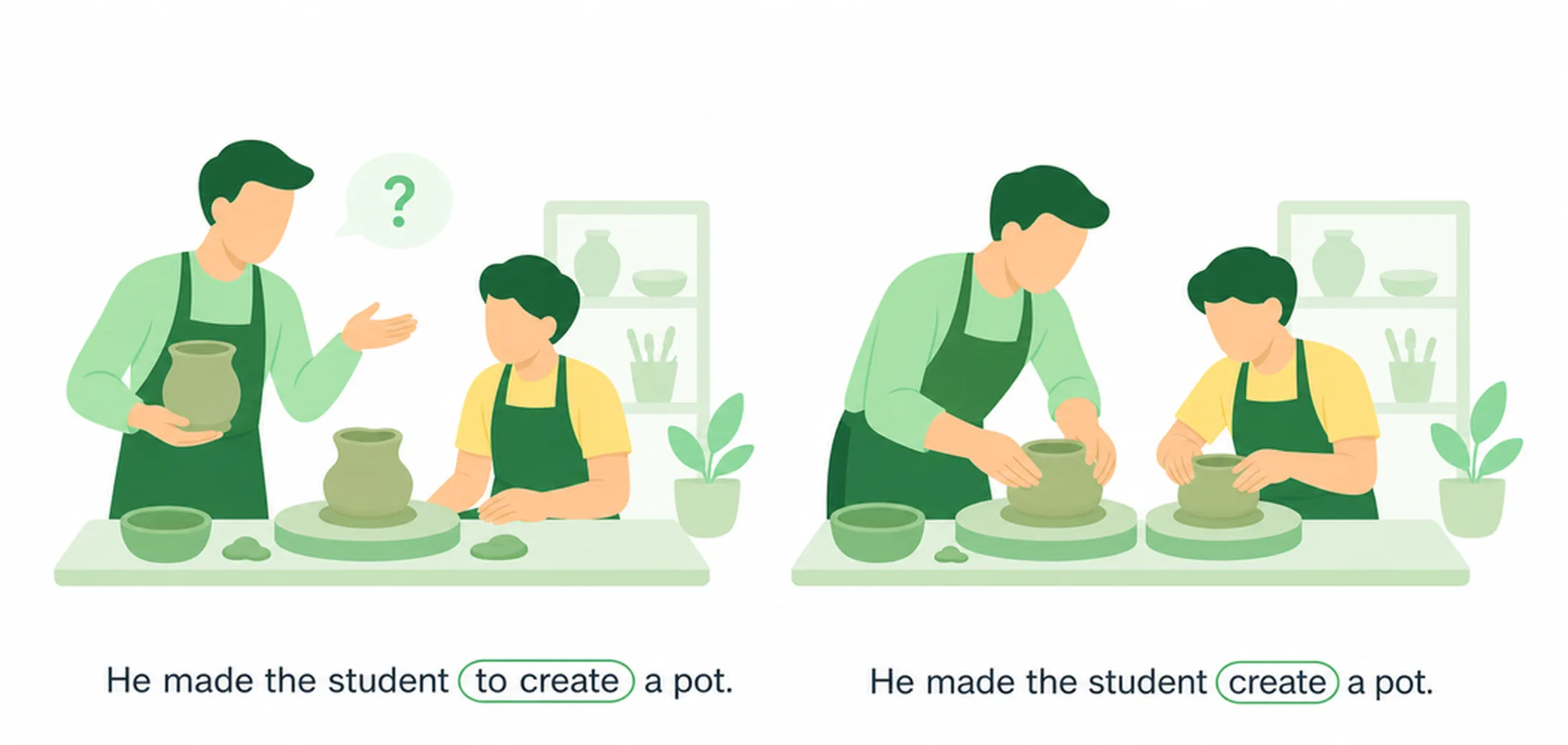
Why Causative Errors Persist at C1
Even advanced learners confuse causative structures because English employs multiple verbs (make, have, get, let) with subtly different meanings and complementation patterns. The distinction between bare infinitives and gerunds, combined with the semantic nuances each verb carries, creates a fertile ground for errors. Native intuition often fails when learners try to transfer patterns from their L1 or over-generalize one structure across all causatives.
Correct vs. Incorrect Causative Structures at a Glance
| Category | Incorrect Usage | Correct Usage | Explanation |
|---|---|---|---|
| MAKE — force or cause someone to do something | |||
| Form | make + object + to + base verb | make + object + bare infinitive (no "to") | "Make" is a bare infinitive causative; adding "to" is the most common learner error. |
| When to use | — | When someone is forced or compelled to do something, often without a choice. | Implies authority, pressure, or an irresistible cause. |
| Positive example | She made him to apologise. | She made him apologise. | Drop "to" after "make" in the active voice. |
| Negative example | They didn't make the students to stay late. | They didn't make the students stay late. | The rule applies in negative sentences too — no "to". |
| Question example | Did they make you to sign the contract? | Did they make you sign the contract? | Same structure in questions — bare infinitive always. |
| Key signal words | — | force, compel, require, oblige, pressure | These signals suggest "make" is the right causative to use. |
| HAVE — arrange for someone to do something for you | |||
| Form | have + object + to + base verb | have + object + bare infinitive (person does it) OR have + object + past participle (thing receives the action) |
Do not add "to". Use bare infinitive when the object is a person; use past participle when the object is a thing being acted upon. |
| When to use | — | When you delegate a task to someone else, often a professional or subordinate. No coercion implied. | Neutral in tone — simply arranging for something to be done. |
| Positive example | I had the mechanic to fix my car. I had my car fix. |
I had the mechanic fix my car. (person + bare inf.) I had my car fixed. (thing + past participle) |
No "to" with a person. When the object is a thing receiving the action, use the past participle form. |
| Negative example | She didn't have her nails do. | She didn't have her nails done. | When the object (nails) receives the action, use the past participle, not the base form. |
| Question example | Did you have the plumber to check the pipes? | Did you have the plumber check the pipes? | Remove "to" — the plumber is the agent performing the action, so use bare infinitive. |
| Key signal words | — | arrange, delegate, hire, pay someone to, commission | Suggests a service or delegated task — "have" fits best. |
| GET — persuade or arrange for someone to do something | |||
| Form | get + object + bare infinitive (no "to") | get + object + to + base verb (person) OR get + object + past participle (thing) |
"Get" is unique: it REQUIRES "to" before the verb when the object is a person. With things, use the past participle. |
| When to use | — | When persuading or convincing someone to do something, or when informally arranging for something to be done. | More informal and conversational than "have"; implies some effort to persuade. |
| Positive example | I got my brother help me move. I got my phone repairing. |
I got my brother to help me move. I got my phone repaired. |
Always use "to" with a person; use the past participle (not -ing) when the thing receives the action. |
| Negative example | I couldn't get him understand the problem. | I couldn't get him to understand the problem. | "To" is mandatory with "get" when the object is a person. |
| Question example | How did you get her agree to that? | How did you get her to agree to that? | "To" remains in questions — never drop it with "get". |
| Key signal words | — | convince, persuade, encourage, talk into, manage to arrange | Suggests effort or persuasion — "get" is the natural choice. |
| LET — allow someone to do something | |||
| Form | let + object + to + base verb | let + object + bare infinitive (no "to") | Like "make", "let" takes a bare infinitive. Adding "to" is incorrect. |
| When to use | — | When giving permission for someone to do something; the subject has the authority to allow or deny. | Implies willingness or permission from the subject — no force involved. |
| Positive example | She let him to borrow her car. | She let him borrow her car. | Remove "to" — "let" always uses the bare infinitive. |
| Negative example | My parents didn't let me to go to the party. | My parents didn't let me go to the party. | Negation doesn't change the structure — still no "to". |
| Question example | Will you let me to try it? | Will you let me try it? | Bare infinitive in all sentence types with "let". |
| Key signal words | — | allow, permit, give permission, not stop, enable | When permission is the core meaning, "let" is appropriate. |
| BONUS: Common Confusion — "Allow" vs "Let" | |||
| Form confusion | They allowed him go early. They let him to go early. |
They allowed him to go early. They let him go early. |
"Allow" uses "to + infinitive"; "let" uses the bare infinitive. Learners often mix up which needs "to". |
| Passive voice note | He was let leave early. (passive of "let") | He was allowed to leave early. (use "allow" in passive) | "Let" has no standard passive form. Switch to "allow" + to-infinitive in the passive voice. |
MAKE = force → bare infinitive (no "to")
HAVE = arrange → bare infinitive (person) / past participle (thing) — no "to"
GET = persuade → always needs "to" (person) / past participle (thing)
LET = permit → bare infinitive (no "to")
The single most important rule: Only GET uses "to" + infinitive with a person. MAKE, HAVE, and LET all use the bare infinitive. Additionally, when the object is a thing receiving the action (not the agent doing it), both HAVE and GET use the past participle, never the base verb or -ing form.
Examples



What to Remember
- Use MAKE with bare infinitives for direct causation; GET requires to-infinitive and implies more effort or difficulty.
- HAVE typically means delegating a task to someone else; it pairs with bare infinitives in active voice.
- LET indicates permission or allowance and always takes a bare infinitive, never a to-infinitive or gerund.
- Each causative verb carries distinct semantic nuances; choosing wrong verb changes meaning even when grammatically similar structures exist.
- Avoid transferring L1 causative patterns; English causatives don't always match your native language's structure or complementation rules.