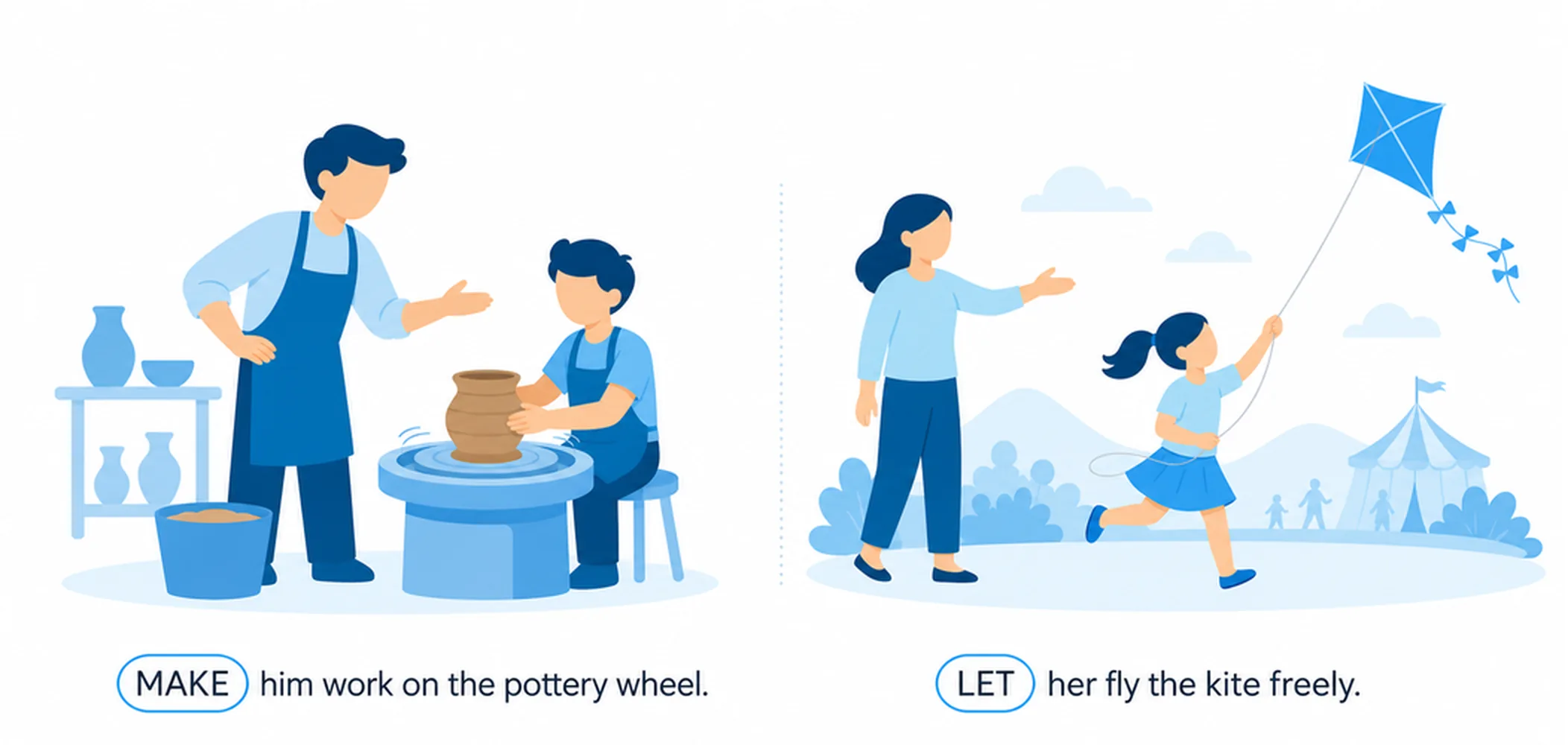
The Core Distinction Between Make and Let
Both 'make' and 'let' are causative verbs that express causing someone to perform an action, yet they operate on fundamentally different semantic axes. 'Make' conveys compulsion, obligation, or external force—the subject actively causes another person to do something, often against their will or inclination. Conversely, 'let' denotes permission, allowance, or non-interference—the subject permits or refrains from preventing another person from doing something. Understanding this distinction is crucial for nuanced expression at the advanced level, as the choice between them significantly alters the tone and implication of your utterance.
Structural and Semantic Differences
Both verbs follow the pattern: Subject + causative verb + object + bare infinitive (without 'to'). Structurally, they are identical. The critical difference lies in agency and volition. With 'make', the object typically has little or no choice—compliance is enforced or expected. With 'let', the object retains autonomy; the subject merely removes barriers or grants permission. Additionally, 'make' often carries connotations of reluctance or difficulty on the part of the object, whereas 'let' is neutral or positive regarding the object's willingness.
Practical Applications
Choose 'make' in contexts involving workplace directives, parental enforcement, contractual obligations, or situations where resistance is likely. Opt for 'let' when discussing privileges, informal permissions, collaborative arrangements, or situations where the object is willing or eager. In formal writing or diplomatic contexts, 'let' often softens communication, while 'make' projects authority.
Make vs Let — Side-by-Side Comparison
| Dimension | MAKE | LET |
|---|---|---|
| Form | make + object + bare infinitive (make someone do something) |
let + object + bare infinitive (let someone do something) |
| Core Meaning | To force or cause someone to do something; the action happens because of the subject's pressure or authority. | To allow or permit someone to do something; the subject removes a barrier so the action can happen. |
| Connotation | Forceful, compulsory, controlling. Often implies the object did not choose to act. | Permissive, enabling, supportive. Often implies the object wanted to act and was given the green light. |
| Subject Role | The subject acts as a controller or enforcer who compels the action. | The subject acts as a gatekeeper or enabler who grants permission. |
| Object Volition | The object typically has no choice; the action may be unwanted or reluctant. | The object usually wants to perform the action and is simply being given permission. |
| When to Use | Use when describing obligation, compulsion, rules, or emotional causation (e.g., something causing a feeling). | Use when describing permission, freedom of action, or allowing a natural event to occur. |
| Positive Example | "The teacher made the students rewrite the essay." (They had to do it — no choice.) |
"The teacher let the students rewrite the essay." (They were allowed to do it — they may have wanted to.) |
| Negative Example | "His parents didn't make him clean his room." (They chose not to force him.) |
"His parents didn't let him stay up late." (Permission was refused.) |
| Question Example | "Did the coach make the team run extra laps?" | "Did the coach let the team leave practice early?" |
| Typical Context | Rules and discipline, authority figures, emotional reactions ("It made me laugh/cry"), pressure situations. | Parenting, workplace flexibility, requests for permission, encouraging independence. |
| Key Signal Words / Synonyms | force, compel, require, oblige, cause, pressure, order | allow, permit, enable, authorize, give permission, approve |
| Passive Voice Note | In passive, to is added before the infinitive: "She was made to apologize." |
Let rarely forms a true passive in standard English. "Be allowed to" is used instead: "He was allowed to leave." |
| 🔑 Key Difference: Use make when the subject forces or compels an action — the object has little or no choice. Use let when the subject permits or allows an action — the object is free to act because the subject said yes. The same sentence structure hides two very different power dynamics: control vs. permission. | ||
Examples






What to Remember
- Make expresses compulsion or force; the subject causes someone to do something against their will.
- Let expresses permission or allowance; the subject permits or doesn't prevent someone from doing something.
- Make requires the base form of the verb after the object: make someone do something.
- Let also requires the base form: let someone do something, not to do something.
- The core distinction: make involves external pressure; let involves absence of restriction or active permission.