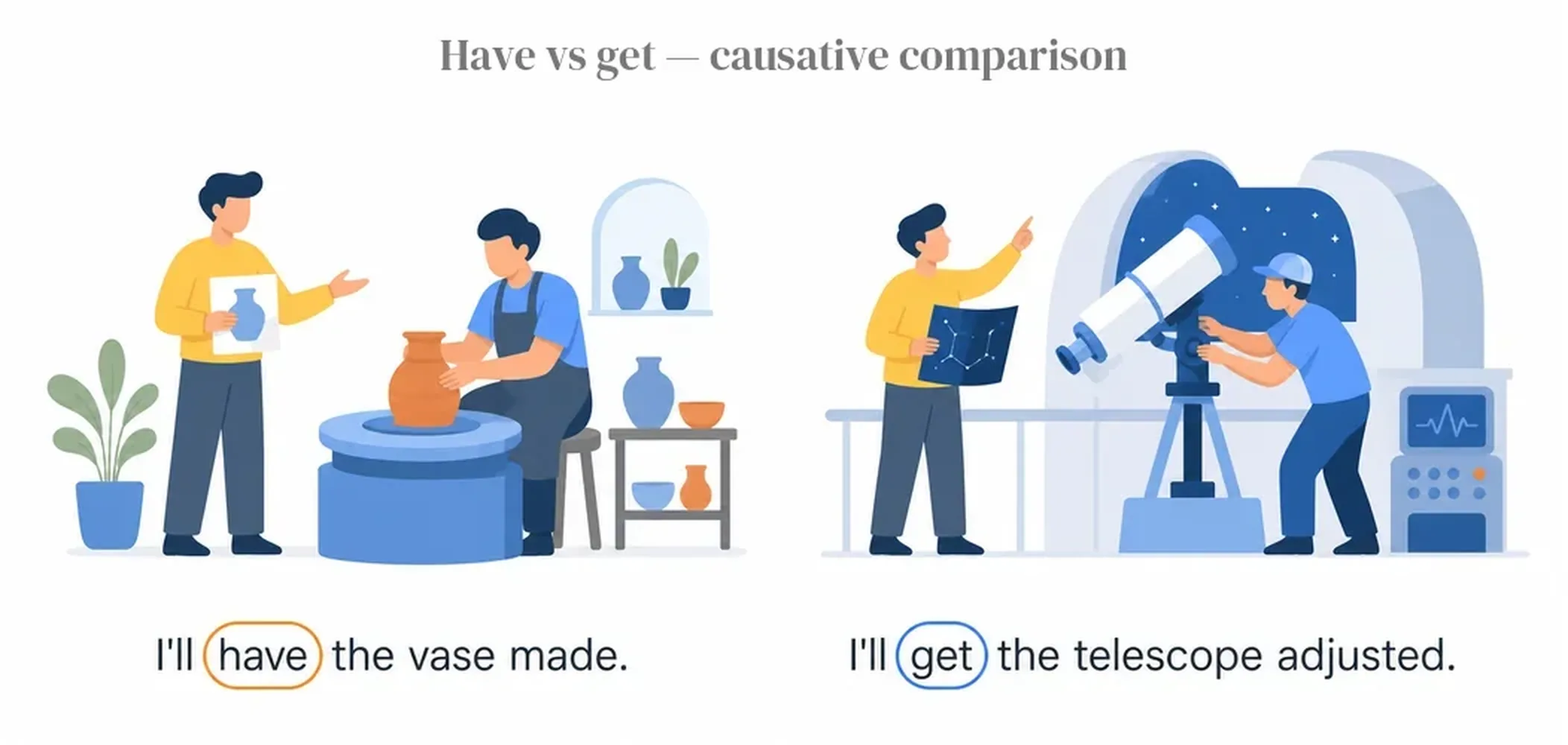
Have vs Get: Causative Verbs Explained
Both 'have' and 'get' function as causative verbs, meaning they describe causing someone else to perform an action. However, they differ fundamentally in tone and implication. 'Have' typically conveys a sense of authority, arrangement, or delegation—the subject arranges for something to be done, often by someone in a subordinate position or through a professional service. 'Get', by contrast, emphasises persuasion, negotiation, or sometimes coercion; it suggests the subject must convince or compel another person to act. Understanding these nuances is essential for precise, native-like expression at C1 level.
Key Structural Differences
The most visible grammatical difference lies in the infinitive form. 'Have' uses a bare infinitive (have + object + bare verb): 'I had him fix it.' 'Get', however, requires the 'to' infinitive (get + object + to + verb): 'I got him to fix it.' This structural distinction mirrors the semantic one—'have' treats the action as straightforward arrangement, while 'get' signals negotiation or effort. Additionally, 'have' often implies a power dynamic or professional relationship, whereas 'get' works equally well with peers, family, or situations requiring persuasion.
C1 Precision Tip
At C1 level, recognise that swapping 'have' and 'get' changes the narrative perspective. 'I had him fix it' presents the action as arranged or delegated; 'I got him to fix it' implies negotiation or difficulty. In formal writing (business reports, academic essays), 'have' is more common and neutral. In spoken discourse or narrative, 'get' adds nuance about interpersonal dynamics. Both are grammatically correct in most contexts—the choice reflects your intended emphasis.
Have vs Get: Side-by-Side Comparison
| Dimension | HAVE (causative) | GET (causative) |
|---|---|---|
| Form | have + object + bare infinitive (base verb) have someone do something |
get + object + full infinitive (to + verb) get someone to do something |
| When to Use | Used when the subject arranges or instructs someone to do something, often in a professional, managerial, or service context. Implies authority or a routine arrangement. The doer's willingness is less emphasized. | Used when the subject persuades, convinces, or manages to make someone do something. Implies effort, negotiation, or overcoming resistance. The process of convincing is often implied. |
| Tone & Register | More formal and neutral. Commonly used in professional, business, and service settings. Suggests smooth delegation without friction. | More informal and conversational. Suggests a degree of effort or persuasion. Can appear in both casual and professional contexts but carries a sense of achievement. |
| Positive Example | "She had her assistant prepare the report." "We have the technician service our machines every month." |
"She got her assistant to prepare the report." "He finally got the technician to fix the problem." |
| Negative Example | "I didn't have anyone check the figures before the meeting." | "I couldn't get anyone to check the figures before the meeting." |
| Question Example | "Did you have someone review the contract?" | "Did you get someone to review the contract?" |
| Passive Equivalent (thing done for subject) |
have + object + past participle "She had her car repaired." (focus on the service received) |
get + object + past participle "She got her car repaired." (implies more effort or initiative to make it happen) |
| Typical Context |
• Managing a team or staff • Service transactions (doctor, lawyer, repairman) • Formal business delegation • Routine or scheduled arrangements |
• Persuading a reluctant person • Informal requests among friends or family • Overcoming obstacles to make something happen • Expressing a sense of accomplishment |
| Key Signal Words / Phrases | arrange, instruct, delegate, authorize, employ, hire — actions that suggest authority or pre-established roles | convince, persuade, manage to, finally, eventually, talk into — actions that suggest effort or negotiation |
| Interchangeability | In many everyday sentences, have and get (+ past participle form) are interchangeable: "I had/got my hair cut." However, when followed by a person + verb, the grammatical structure differs (have + bare infinitive vs. get + to-infinitive) and the nuance of authority vs. persuasion remains distinct. | |
| ★ Key Difference: Use HAVE when you are directing or arranging for someone to do something through authority, position, or a service relationship — no persuasion is needed and the focus is on the outcome. Use GET when you are convincing or persuading someone to do something — the focus is on the effort involved in making it happen. Grammatically, have is followed by the bare infinitive (no "to"), while get requires the full infinitive (with "to"). | ||
What to Remember
- Use 'have' when the subject arranges or delegates an action through authority or professional service.
- Use 'get' when the subject persuades, negotiates, or coerces someone into performing an action.
- 'Have' implies a more formal, authoritative relationship; 'get' suggests effort or difficulty in convincing.
- Both verbs require an object and base form verb: have/get someone do something.
- Don't confuse 'have' (arrangement) with 'get' (persuasion); tone and effort distinguish their meanings.