What Are Causative Verbs?
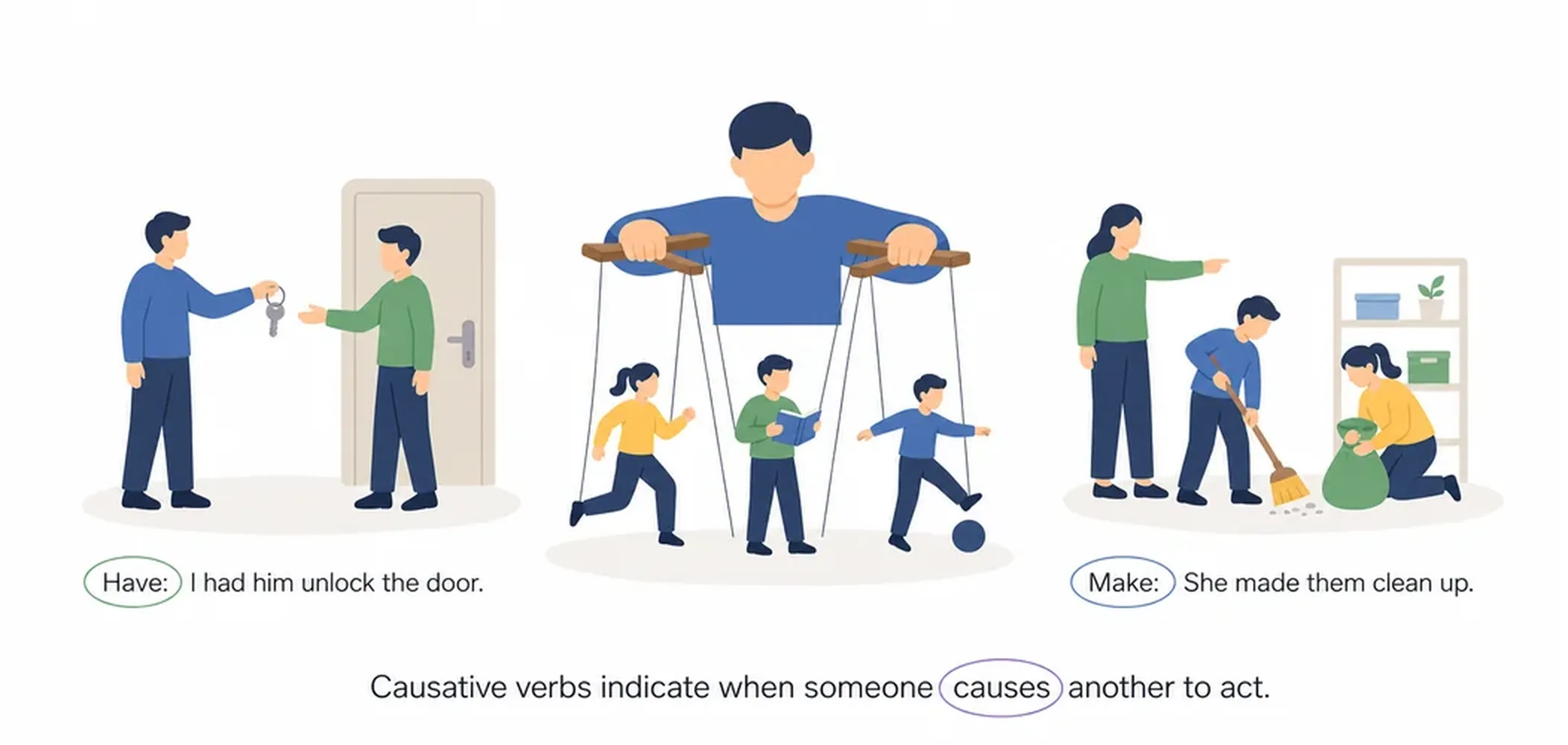
Causative verbs express the idea that one person causes, allows, or enables another person to perform an action, rather than performing the action themselves. In English, the primary causative verbs are make, have, get, let, and cause. These structures are essential for expressing indirect agency and are particularly prevalent in formal and professional contexts. Understanding causatives allows you to convey nuanced meanings about responsibility, permission, and delegation with precision.
The Five Main Causative Structures
The verb make expresses compulsion or obligation: the subject forces or compels someone else to do something. The verb have (in causative form) suggests a request or instruction within a hierarchy or authority relationship. The verb get implies persuasion or negotiation; it suggests the subject convinces someone to do something. The verb let denotes permission and allowance without coercion. Finally, cause is the most formal causative, often used in academic or technical writing to describe indirect responsibility or consequence. Each carries distinct connotations about the nature of the relationship between the causer and the person performing the action.
Structural Variations and Registers
Causative verbs function with specific grammatical patterns. Make, let, and have typically require a bare infinitive (without 'to'): 'She made him apologize.' Get, by contrast, requires a to-infinitive: 'She got him to apologize.' Cause similarly takes a to-infinitive in formal registers: 'The scandal caused him to resign.' Register matters significantly; make and let are more colloquial, while cause and get are versatile across registers. In passive constructions, causatives shift slightly: 'He was made to apologize' (make becomes active even in passive voice), whereas 'He was got to confess' sounds awkward—get causatives rarely appear in passive form. Mastery of these distinctions is crucial for C1 proficiency, as misuse can affect both grammatical accuracy and stylistic appropriateness.
Causative Verbs at a Glance
| Dimension | MAKE | HAVE | GET | LET | CAUSE |
|---|---|---|---|---|---|
| Meaning / Connotation | Force or compel someone to do something; implies pressure or obligation, often against the person's will | Arrange for or instruct someone to do something; neutral delegation, no strong pressure implied | Persuade, convince, or manage to get someone to do something; implies effort or negotiation | Allow or permit someone to do something; implies giving permission or not preventing an action | Bring about an action or result, often indirectly or unintentionally; used for abstract or formal causation |
| Infinitive Type | Bare infinitive (no to) make + object + verb |
Bare infinitive (no to) have + object + verb |
To-infinitive get + object + to verb |
Bare infinitive (no to) let + object + verb |
To-infinitive cause + object + to verb |
| Register | Neutral to informal; common in everyday speech and writing | Neutral to slightly formal; common in professional and business contexts | Informal to neutral; very common in conversational English | Informal to neutral; frequently used in casual speech and parenting contexts | Formal; typical of academic, scientific, legal, or written English |
| Degree of Force / Control | High — the causer forces the action; the object has little or no choice | Medium — the causer directs or delegates but without strong coercion | Medium — the causer must put in effort; outcome not guaranteed | Low — the causer removes a barrier; no pressure is exerted | Variable — often indirect or unintentional; focus is on the outcome rather than control |
| Positive Example | The teacher made the students rewrite their essays. | She had the technician fix her laptop. | He got his sister to lend him some money. | They let the children stay up late on Friday. | The loud noise caused the baby to wake up. |
| Negative Example | You can't make me apologise if I did nothing wrong. | I didn't have anyone check my work before submitting it. | She couldn't get her boss to approve the budget. | His parents didn't let him go to the party. | Poor communication didn't cause the project to fail on its own. |
| Question Example | Did your coach make you train every single day? | Did you have a plumber repair the pipes? | How did you get them to agree so quickly? | Will you let me know when you arrive? | What caused the system to crash overnight? |
| Typical Subject | Authority figures: teachers, managers, parents, governments | People in charge who delegate: employers, clients, homeowners | Anyone trying to persuade: colleagues, friends, negotiators | Gatekeepers or permission-givers: parents, managers, authorities | Events, circumstances, conditions, or abstract forces |
| Key Signal Words / Synonyms | force, compel, require, oblige | arrange, instruct, assign, commission | persuade, convince, encourage, talk into | allow, permit, authorise, enable | result in, lead to, bring about, trigger |
| 🔑 Key Difference: All five verbs express causation, but they differ in three crucial ways. Make implies the strongest force or compulsion, while let implies the weakest — mere permission. Have sits in the middle as neutral delegation, and get adds the nuance of effort or persuasion. Cause is unique in that it is the most formal and is typically used when the causer is an event, condition, or abstract force rather than a person in authority. Grammatically, make, have, and let all take a bare infinitive (no to), whereas get and cause always require a to-infinitive — a distinction that frequently appears in grammar tests. | |||||
Examples





What to Remember
- Causative verbs (make, have, get, let, cause) express one person causing another to perform an action.
- Make and have require a bare infinitive; get requires a to-infinitive in most contexts.
- Let expresses permission and takes a bare infinitive; cause is more formal.
- The causative structure shows indirect agency—the subject doesn't perform the action themselves.
- Causatives are common in formal and professional writing to express delegation and responsibility precisely.