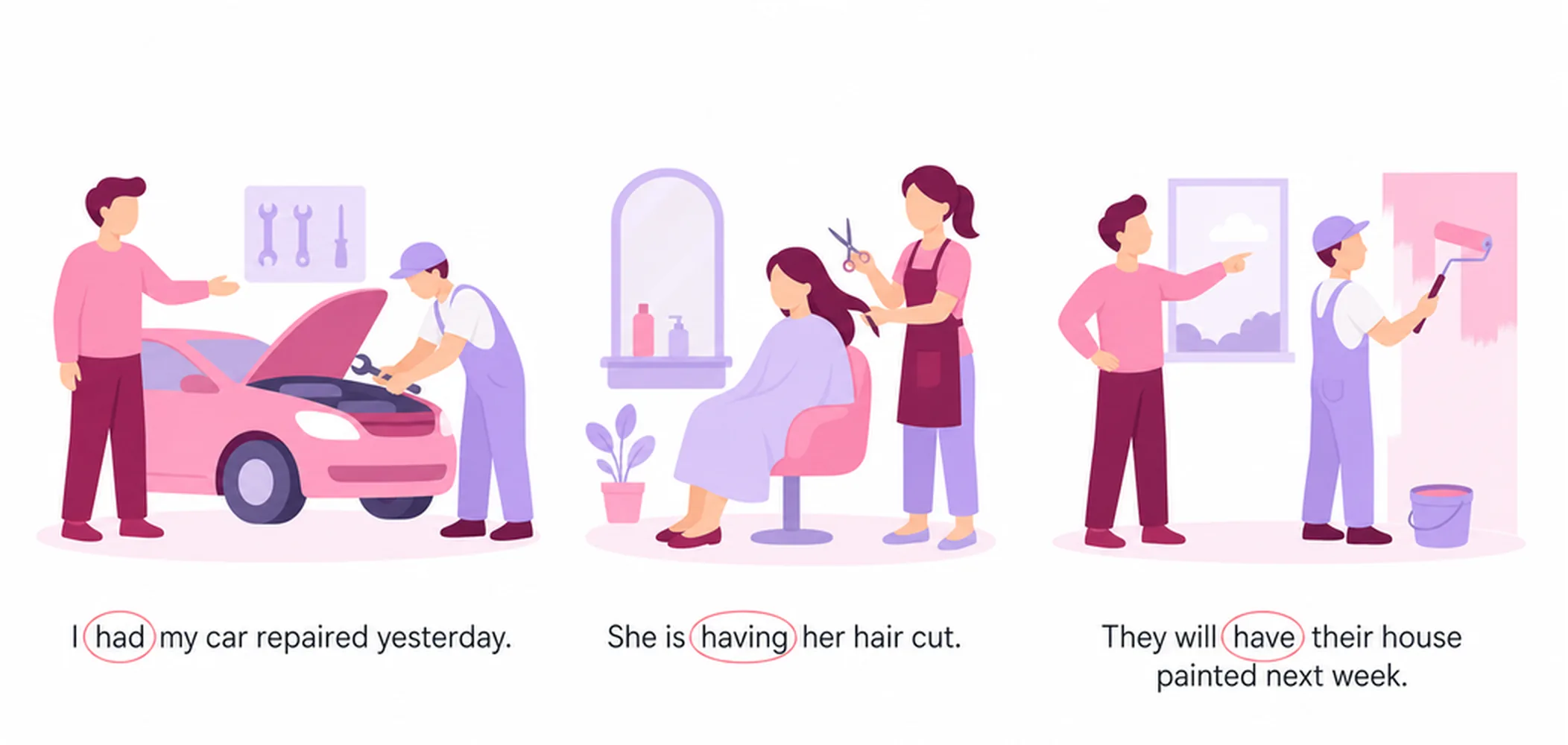
Understanding the Causative Structure
The causative structure 'have something done' expresses the idea that you cause or arrange for someone else to perform an action for you, rather than doing it yourself. This is a sophisticated grammatical construction that shifts responsibility or agency away from the subject. The structure emphasizes the result or completion of an action, not the person performing it. At C1 level, this structure is essential for expressing causative relationships with precision and nuance in both formal and informal contexts.
Core Usage Patterns and Tenses
The auxiliary verb 'have' carries the tense, while 'done' remains in the past participle form. This structure works across all tenses: present (have done), past (had done), perfect (have had done), and future (will have done). The object of the sentence—the thing being done—comes between 'have' and the past participle. Importantly, the agent (the person who actually performs the action) is either omitted or introduced with 'by,' depending on whether it's important or irrelevant to the meaning. When the agent is omitted, the focus is on the action and its result; when included with 'by,' it provides additional information.
Distinguishing from Similar Structures
The causative 'have something done' differs from 'make someone do something' and 'get someone to do something.' With 'make,' there is often a sense of force or obligation; with 'get,' there's an implication of persuasion. The 'have something done' structure is more neutral and formal, focusing on the completion of a service or task. Additionally, this structure differs from the passive voice: 'have something done' emphasizes agency and intentional arrangement, whereas the passive simply describes an action without implying who arranged it. At C1 level, recognizing these subtle distinctions is crucial for precision.
Have Something Done vs. Similar Structures
| Dimension | Have something done | Get something done | Make someone do something | Get someone to do something |
|---|---|---|---|---|
| Form | Subject + have + object + past participle | Subject + get + object + past participle | Subject + make + person + bare infinitive | Subject + get + person + to + infinitive |
| Formality | Neutral to formal; common in both written and spoken English | Informal to neutral; more common in everyday spoken English | Neutral; used in both formal and informal contexts | Informal to neutral; conversational tone |
| When to use | When someone arranges for a professional or another person to do something for them; the subject does not do it personally | Similar to have something done but often implies more effort or difficulty in arranging it; also used when the subject personally completes a task | When someone forces or causes another person to do something, often with authority or pressure; the doer may not want to comply | When someone persuades or convinces another person to do something; less forceful than make |
| Positive example | She had her car serviced at the garage last week. | He finally got his laptop repaired after months of waiting. | The teacher made the students rewrite their essays. | She got her brother to help her move the furniture. |
| Negative example | I didn't have my hair cut because the salon was closed. | They couldn't get the roof fixed before the storm arrived. | You can't make me apologise for something I didn't do. | I couldn't get him to agree to the new terms of the contract. |
| Question example | Where do you usually have your teeth checked? | Did you manage to get the report finished in time? | How did she make him change his mind so quickly? | Did you get the plumber to fix the leak yet? |
| Agent (doer) | Another person (often a professional); the subject delegates the task | Another person or the subject themselves; implies some effort to complete the task | A specific named or implied person who is compelled to act | A specific named or implied person who is persuaded to act |
| Volition / Force | No force implied; arrangement is voluntary and mutually agreed | No force implied; slight sense of effort or challenge in the arrangement | Strong force or compulsion implied; the other person may not want to do it | Mild persuasion implied; the other person is convinced, not forced |
| Key signal words | have … done, had … done, having … done | get … done, got … done, getting … done | make … do, made … do, force, compel, require | get … to do, persuade, convince, encourage |
| Common mistakes | Using the infinitive instead of past participle: ✗ have my car service → ✓ have my car serviced | Confusing with have something done; remember get can also mean personally completing a task | Adding to: ✗ make him to do → ✓ make him do (bare infinitive required) | Dropping to: ✗ get him do → ✓ get him to do (full infinitive required) |
| Key Difference: Have something done and get something done both describe arranging for a task to be completed by someone else (causative structures focused on the task), with get carrying a slightly more informal or effortful tone. In contrast, make someone do something and get someone to do something focus on the person performing the action — make implies force or compulsion (and takes a bare infinitive), while get someone to do implies persuasion or convincing (and takes a full infinitive with to). Choosing between these four structures depends on whether the focus is on the task or the person, and on the degree of force or arrangement involved. | ||||
Examples






What to Remember
- Use 'have + object + past participle' to show someone else performs the action for you.
- The focus is on the result or completion, not on who actually performs the task.
- 'Have something done' shifts responsibility from the subject to another person or agent.
- In passive constructions, the subject receives the action rather than performing it directly.
- Avoid confusing 'have done' with 'get something done,' which carries similar meaning but informal tone.