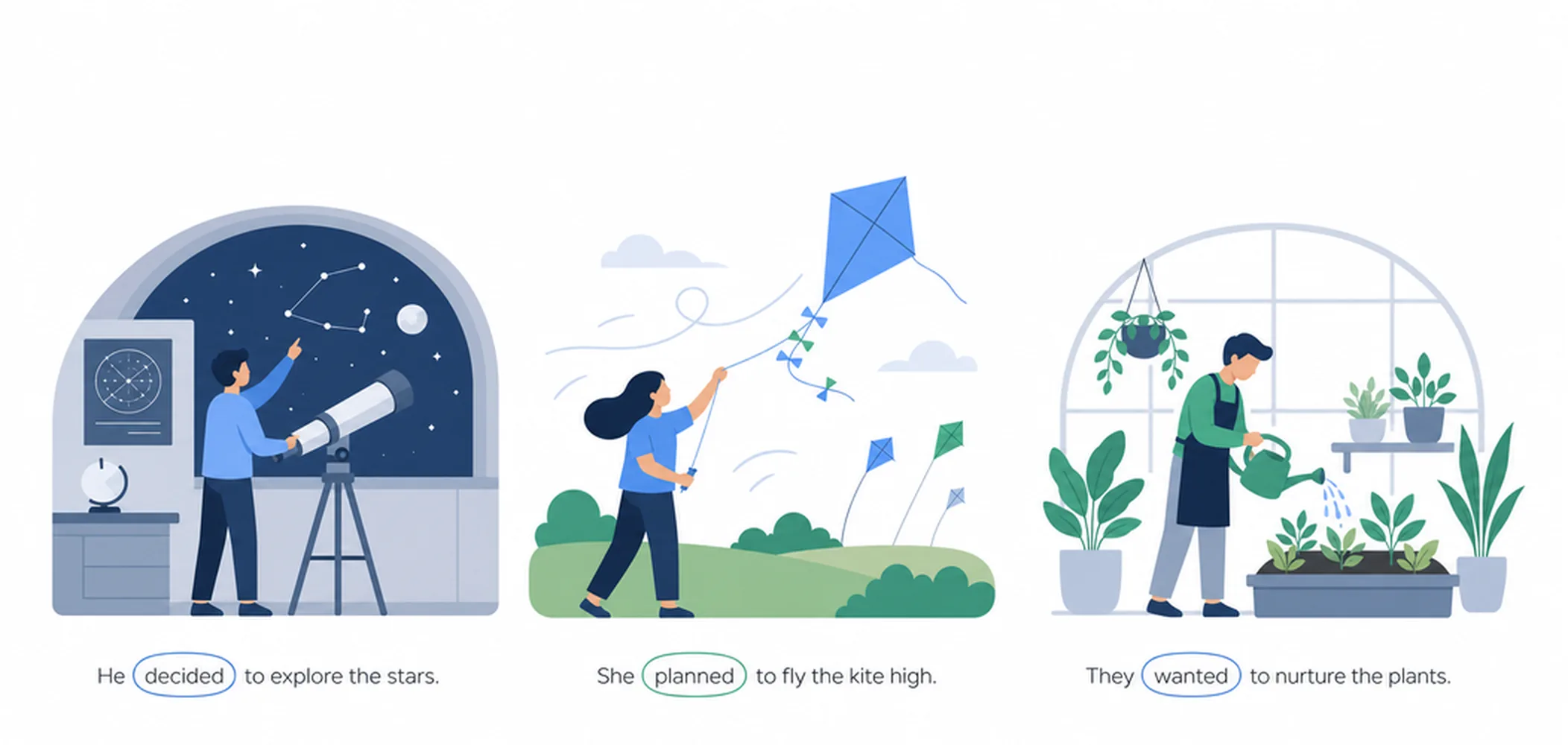
What are verbs followed by infinitives?
Many English verbs are followed directly by an infinitive (the base form of a verb with 'to'). This is a key grammar pattern at B2 level. For example: 'I want to travel' or 'She decided to study medicine.' The infinitive acts as the object of the main verb, completing its meaning. Different verbs have different patterns—some always take infinitives, while others can take both infinitives and gerunds (verb+ing forms).
Common verbs followed by infinitives
Many common verbs naturally pair with infinitives. These include: agree, arrange, attempt, choose, decide, demand, expect, fail, forget, help, hope, manage, need, offer, plan, pretend, promise, refuse, remember, seem, tend, want, and wish. For instance: 'He agreed to help me' or 'They managed to finish on time.' Learning these verbs as fixed patterns will strengthen your fluency. Some verbs like 'remember' and 'forget' have different meanings depending on whether you use an infinitive or gerund, so pay attention to context.
Verbs of perception and causation
Certain verbs related to perception (seeing, hearing) and causation (making, letting) often use the infinitive without 'to' (called the bare infinitive). Examples: 'I saw her leave' or 'Let me help you.' With causative verbs like 'make,' 'let,' and 'have,' the infinitive has no 'to': 'The teacher made us rewrite the essay.' However, 'help' is flexible: both 'Help me to carry' and 'Help me carry' are correct, though the second is more common in American English.
Full List of Verbs Followed by Infinitive
| Verb | Form | Example | Note |
|---|---|---|---|
| afford | afford + to-inf | I can't afford to buy a new car. | Usually used with can/can't |
| agree | agree + to-inf | They agreed to meet on Monday. | No object before infinitive |
| aim | aim + to-inf | We aim to finish by Friday. | Expresses intention |
| appear | appear + to-inf | She appears to be tired. | Formal; similar to seem |
| arrange | arrange + to-inf | I arranged to see the doctor. | Implies planning |
| ask | ask + to-inf / ask + obj + to-inf | She asked to leave. / He asked me to help. | Can take an object |
| attempt | attempt + to-inf | He attempted to escape. | Also takes -ing with similar meaning |
| beg | beg + to-inf / beg + obj + to-inf | I beg to disagree. / She begged him to stay. | Formal or emotional tone |
| care | care + to-inf | I don't care to repeat myself. | Usually in negative or question |
| cease | cease + to-inf | It never ceases to amaze me. | Formal; also takes -ing |
| choose | choose + to-inf | She chose to ignore him. | Implies deliberate decision |
| claim | claim + to-inf | He claims to know the answer. | Often implies doubt |
| come | come + to-inf | I came to understand her point. | Expresses gradual change |
| consent | consent + to-inf | She consented to sign the form. | Formal register |
| dare | dare + to-inf / dare + bare inf | He dared to speak up. / Don't dare touch it. | Modal use drops to |
| decide | decide + to-inf | We decided to leave early. | Very common; implies resolution |
| decline | decline + to-inf | She declined to comment. | Formal refusal |
| demand | demand + to-inf | He demanded to see the manager. | Subject demands for themselves |
Examples






What to Remember
- Many common verbs like want, decide, agree, and arrange are directly followed by the infinitive form.
- The infinitive is the base form of a verb preceded by 'to': to go, to study, to travel.
- The infinitive functions as the object of the main verb, completing and explaining its meaning.
- Some verbs take both infinitives and gerunds, but with different meanings: remember to call versus remember calling.
- Common mistake: use the base infinitive after modal verbs (can go, must study) without 'to'.