Grammar B2 Infinitive vs Gerund

What is a gerund?

What is a gerund?

What is a Gerund?

A gerund is the -ing form of a verb that functions as a noun in a sentence. Unlike a present participle, which acts as an adjective or part of a continuous tense, a gerund has all the properties of a noun—it can be the subject of a sentence, the object of a verb, or the object of a preposition. For example, in the sentence "Swimming is my favorite hobby," swimming is a gerund because it names an activity and serves as the subject of the verb is.

Key Characteristics of Gerunds

Gerunds can take objects and adverbial modifiers just like verbs do, which makes them powerful and flexible. For instance, you can say "Reading novels helps me relax" where reading (the gerund) takes novels as its object. Additionally, gerunds can be preceded by possessive pronouns or nouns ("His constant complaining bothers me") and can appear in various positions within a sentence. Understanding when to use a gerund versus an infinitive is important at the B2 level, as many verbs in English are followed by one form or the other.

How to Form a Gerund

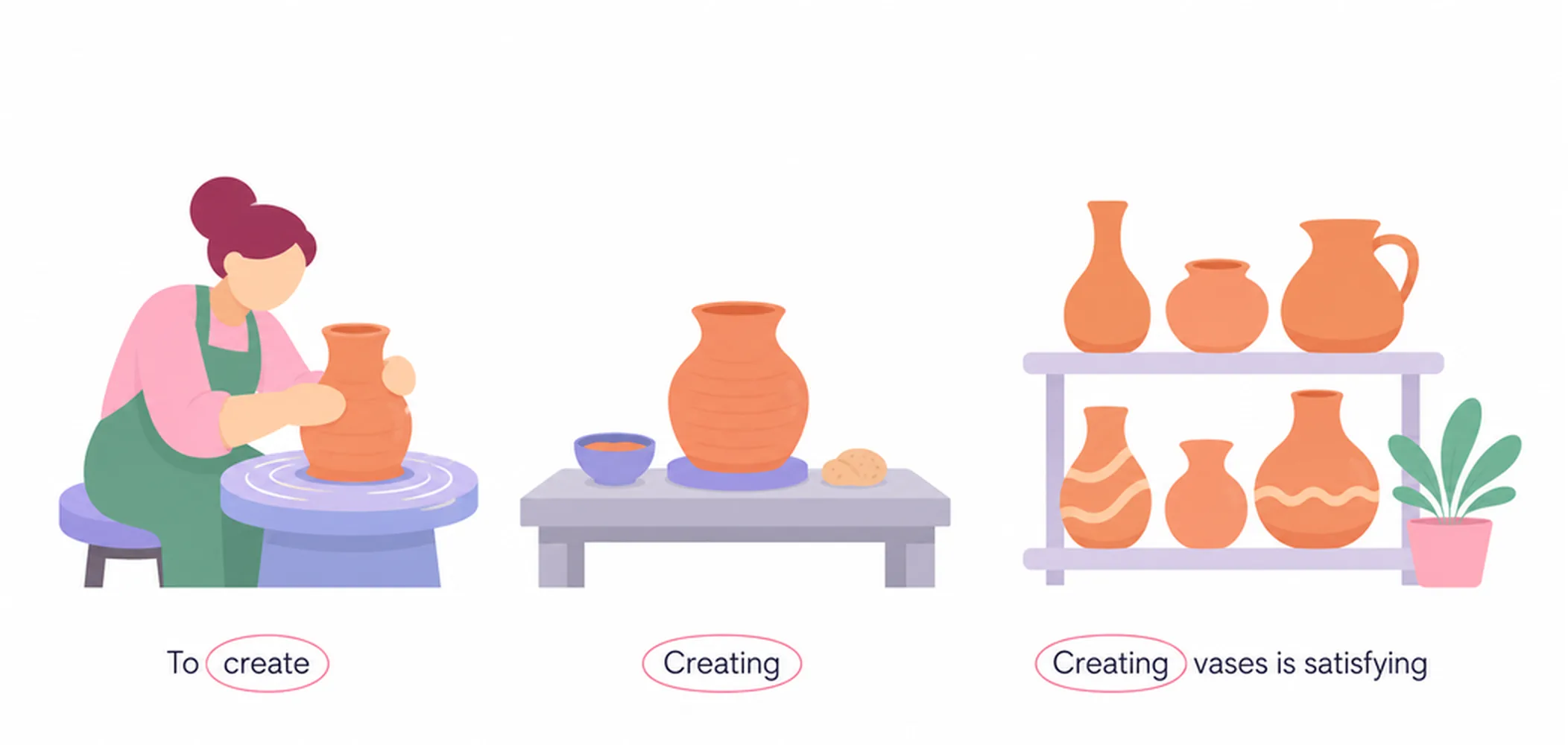
To form a gerund, add -ing to the base form of a verb. The gerund functions as a noun and can be the subject of a sentence, the object of a verb, or the object of a preposition.

Basic Formation
Verb Stem + Suffix = Gerund (Noun)
Base form of verb -ing Noun form
Spelling Rules
Verbs ending in silent -e: Drop the -e before adding -ing.
Example: makemaking, writewriting
Verbs with a short vowel + consonant: Double the final consonant before adding -ing.
Example: runrunning, sitsitting
Verbs ending in -ie: Change -ie to -y before adding -ing.
Example: lielying, tietying
Example in a sentence: Swimming is my favorite activity.
Here, "swimming" is the gerund, used as the subject of the sentence.
Another example: I enjoy reading novels.
Here, "reading" is the gerund, used as the object of the verb "enjoy."

Examples

Running a marathon requires months of training.
Subject of the sentence · Gerund
I enjoy listening to classical music on weekends.
Object of the verb 'enjoy' · Gerund
Before leaving the office, she sent an email to her team.
Object of the preposition 'before' · Gerund
His writing style has improved significantly over the years.
Possessive + gerund · Gerund
They insisted on paying for dinner themselves.
Object of the preposition 'on' · Gerund
Traveling abroad has broadened my perspective on life.
Subject of the sentence · Gerund
When to use it
As the Subject
Use a gerund as the subject of a sentence when you want to name an activity or action as a topic.
"Writing daily has become part of my routine."
After Certain Verbs
Many verbs in English are followed by gerunds rather than infinitives. Common ones include enjoy, avoid, suggest, and finish.
"She avoided mentioning the incident at the meeting."
After Prepositions
Gerunds always follow prepositions. You cannot use an infinitive after a preposition in English.
"He thanked me for helping him move."
In Formal Writing
Gerunds are often used in academic and professional contexts to discuss processes, activities, and abstract concepts.
"The implementation of new policies requires careful planning."
Signal words
enjoy avoid suggest finish mind consider postpone involve before after without
Common Mistakes
Wrong
I enjoy to read novels.
Correct
I enjoy reading novels.
The verb 'enjoy' is always followed by a gerund, never by an infinitive.
Wrong
After to finish breakfast, we left.
Correct
After finishing breakfast, we left.
Prepositions must always be followed by gerunds, not infinitives.
Wrong
Swim is good exercise.
Correct
Swimming is good exercise.
When used as a noun/subject, the verb must take the -ing form (gerund).
Wrong
I am interesting in learning Spanish.
Correct
I am interested in learning Spanish.
After 'interested in' (preposition), use a gerund. Note: 'interested' (past participle adjective), not 'interesting'.
KEY TAKEAWAYS

What to Remember

  • A gerund is the -ing form of a verb that functions as a noun in a sentence.
  • Gerunds can serve as subjects, objects of verbs, or objects of prepositions in sentences.
  • Unlike present participles, gerunds name activities and have noun properties, not adjective properties.
  • Gerunds can take objects and adverbial modifiers just like the base verb would.
  • Some verbs require gerunds as objects (enjoy, avoid, finish), not infinitives.
← Previous
What is an infinitive?
Next →
Verbs followed by infinitive — full list