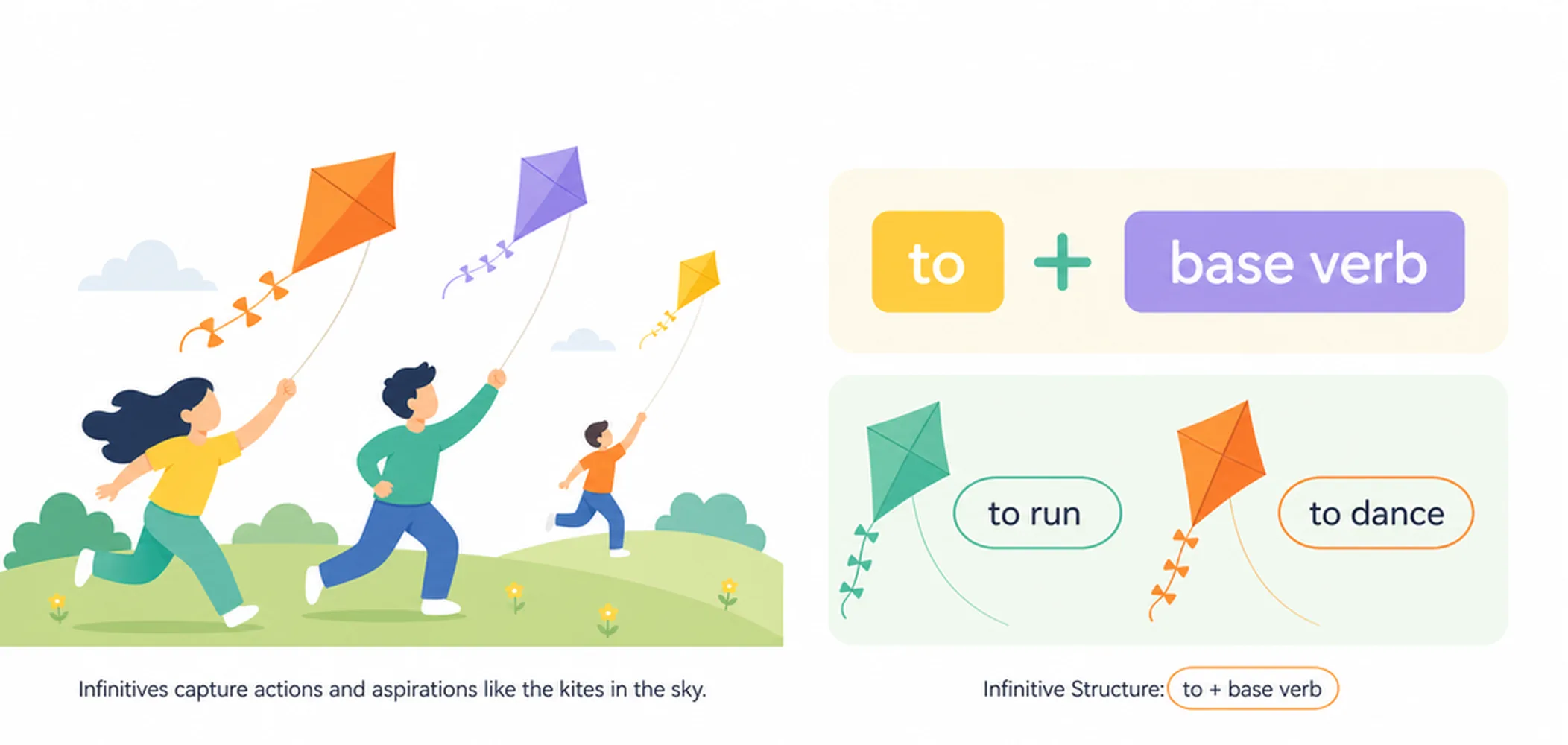
What is an Infinitive?
An infinitive is the base form of a verb, typically preceded by the word 'to'. It represents the action or state in its most basic form, without any indication of tense, person, or number. In English, infinitives function as nouns, adjectives, or adverbs within a sentence, allowing them to perform roles beyond their traditional verb function. For example, in the sentence 'I want to travel,' the infinitive 'to travel' acts as the object of the verb 'want.' Infinitives are one of the most flexible and widely used verb forms in English.
Key Characteristics of Infinitives
The most recognizable feature of an infinitive is the particle 'to' placed before the base verb form (to go, to speak, to understand). However, infinitives can also appear without 'to' in certain contexts, known as bare infinitives, particularly after modal verbs like 'can,' 'must,' and 'should' (e.g., 'I must go' rather than 'I must to go'). Infinitives do not change form based on the subject—they remain the same whether used with 'I,' 'he,' 'they,' or any other pronoun. This consistency makes them predictable and easy to identify in sentences.
Infinitive vs Gerund: Key Differences
| Feature | Infinitive | Gerund |
|---|---|---|
| Form | to + base verb e.g., to run, to eat, to think |
base verb + -ing e.g., running, eating, thinking |
| Grammatical Role | Acts as a noun, adjective, or adverb; often expresses purpose, intention, or a future-oriented action | Acts as a noun; often expresses a habit, general truth, or ongoing/completed action |
| When to Use | After verbs expressing desire, intention, decision, or expectation; to express purpose; after adjectives | After verbs expressing enjoyment, avoidance, completion, or habits; as the subject of a sentence; after prepositions |
| Positive Example | She wants to learn Spanish. He went to the gym to exercise. |
She enjoys learning Spanish. Exercising every day is healthy. |
| Negative Example | He decided not to go to the party. She chose not to reply. |
He avoided going to the party. Not replying was a mistake. |
| Question Example | Do you want to try this dish? Is it safe to swim here? |
Do you enjoy trying new dishes? Is swimming here allowed? |
| Verbs That Trigger It | want, hope, need, decide, plan, expect, agree, refuse, offer, promise, tend, manage | enjoy, avoid, finish, suggest, consider, keep, practise, admit, deny, risk, delay, miss |
| After Prepositions | Not used directly after a preposition ❌ She is good at to sing. |
Always used after a preposition ✅ She is good at singing. |
| As Subject of a Sentence | Possible but sounds formal or literary To err is human. |
Natural and common in everyday use Making mistakes is human. |
| Verbs That Change Meaning | I stopped to smoke. (I paused in order to smoke) I remembered to call him. (I didn't forget to call) |
I stopped smoking. (I quit the habit) I remembered calling him. (I recall having called) |
| Key Signal Words / Phrases | in order to, so as to, be able to, would like to, it is + adjective + to | be used to, look forward to, in addition to, instead of, can't help, it's no use, it's worth |
| Key Difference: An infinitive (to + verb) typically points forward in time, expressing purpose, intention, or a desired future action, while a gerund (verb + -ing) treats an action as a noun — often something habitual, completed, or general. When a verb can take both forms (e.g., stop, remember, try, forget), the meaning changes significantly, so choosing correctly depends on the intended meaning. As a rule of thumb: infinitive = looking ahead; gerund = reflecting on or naming an activity. | ||
Examples






What to Remember
- An infinitive is the base form of a verb, usually preceded by the word 'to'.
- Infinitives function as nouns, adjectives, or adverbs, not as finite verbs in sentences.
- Use infinitives after certain verbs like want, need, hope, plan, and decide.
- Gerunds (-ing forms) act as nouns, but infinitives show intention or purpose more clearly.
- Some verbs take infinitives while others take gerunds; this distinction requires memorization.