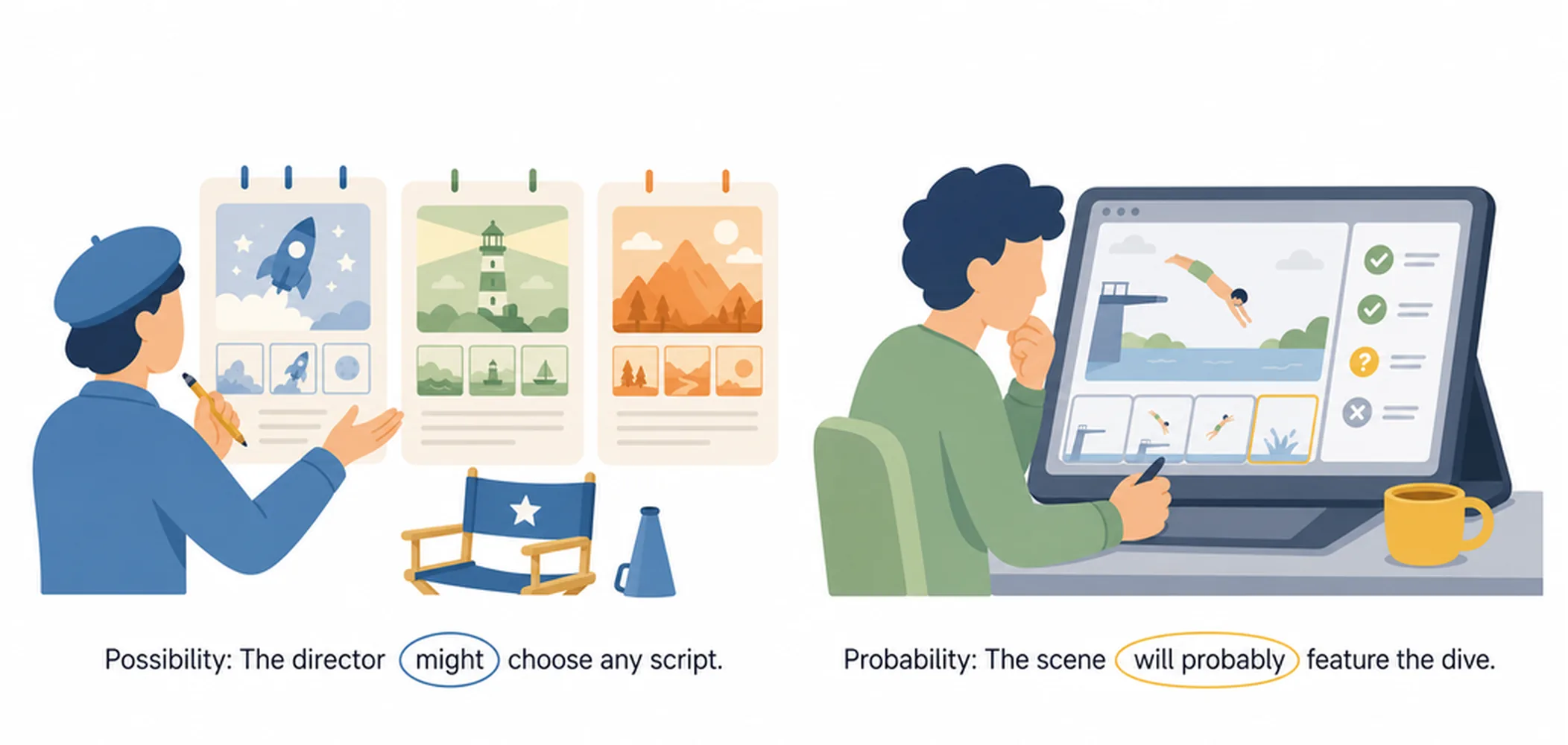
What are modal verbs for possibility and probability?
Modal verbs are special verbs that show the speaker's attitude or certainty about something. When we talk about possibility and probability, we use modal verbs to express how likely something is to happen or be true. For example, we might say 'It might rain tomorrow' (less certain) or 'It will definitely rain tomorrow' (very certain). Modal verbs for possibility and probability include can, could, may, might, must, and should. Each one shows a different level of certainty, from very possible to very certain.
Levels of certainty: from possible to certain
Different modal verbs show different levels of certainty. 'Can' and 'could' express general possibility (something is possible in general). 'May' and 'might' express present possibility (something might happen now or in the future). 'Must' expresses strong probability or certainty (we are very sure something is true). 'Should' suggests what we expect to happen based on normal circumstances. Understanding these levels helps you communicate more precisely. For example, 'He could be at home' means it is possible, but 'He must be at home' means you are quite sure he is there.
Using modals with present and past situations
For present and future situations, we use the base form of the main verb after the modal: 'She might arrive tomorrow.' For past situations, we use the modal + have + past participle: 'She might have arrived yesterday.' This structure shows possibility about something that already happened. Remember that the modal verb comes first, followed by the correct verb form. Be careful with spelling and verb tense—these structures are important for accurate English at the B1 level.
Modal Verbs for Possibility and Probability: Comparison by Certainty Level
| Category | CAN | COULD | MAY | MIGHT | MUST | SHOULD |
|---|---|---|---|---|---|---|
| Level of Certainty | Theoretical possibility (~50% or general) | Weak possibility (~30–40%) | Moderate possibility (~50%) | Low possibility (~25–40%) | Very high certainty (~90–95%) | Reasonable expectation (~70–80%) |
| Form | Subject + can + base verb | Subject + could + base verb | Subject + may + base verb | Subject + might + base verb | Subject + must + base verb | Subject + should + base verb |
| When to Use | General or theoretical possibilities; things that are sometimes true | Something is remotely possible; polite suggestions or uncertain guesses | A real chance something will happen; slightly more formal than might | A small or doubtful chance; less certain than may | Strong logical deduction; speaker is almost sure based on evidence | Something is expected or probable based on what is normal or known |
| Positive Example | "Earthquakes can happen without warning." | "There could be a shorter route — let me check." | "She may arrive before noon." | "It might rain later this afternoon." | "He must be exhausted — he worked all night." | "The results should be ready by Friday." |
| Negative Example | "That can't be the right answer." | "He couldn't have left already — I just saw him." | "She may not be available tomorrow." | "They might not agree with our plan." | "This must not be the right address." | "The package shouldn't take more than two days." |
| Question Example | "Can stress really cause illness?" | "Could there be another explanation?" | "May this be the solution we need?" | "Might he have misunderstood the instructions?" | "Must it really be so complicated?" | "Should the meeting be finished by now?" |
| Key Signal Words / Contexts | in general, sometimes, theoretically, it is known that | perhaps, possibly, I suppose, maybe, one option | perhaps, possibly, there is a chance, it is likely | maybe, I doubt it, probably not, uncertain about | obviously, clearly, I'm sure, the evidence shows, certainly | by now, normally, I expect, as planned, typically |
| Tone / Register | Neutral; common in factual or general statements | Tentative; polite and cautious in both formal and informal speech | Slightly formal; often used in written or academic English | Informal to neutral; expresses doubt or hesitancy | Confident; used when speaker draws a logical conclusion | Neutral to formal; based on expectation or logic |
| 🔑 Key Difference: These modal verbs form a certainty scale from weakest to strongest possibility. Might and could express the lowest certainty (speaker is doubtful or just speculating). May and can sit in the middle — may suggests a real chance while can highlights general or theoretical possibility. Should signals a reasonable expectation based on what is normal or planned. Must sits at the top of the scale, indicating a near-certain logical deduction based on clear evidence. Choosing the right modal verb is therefore crucial: it signals to the listener exactly how confident the speaker is about the situation being described. | ||||||
Examples






What to Remember
- Modal verbs like can, could, may, might, must, and should express different levels of certainty about possibility.
- Use might or may for lower certainty; use must for high certainty about something being true.
- Could shows possibility in the past or present; can shows present ability or theoretical possibility.
- Modal verbs are followed by the base form of the verb without 'to' after them.
- Should expresses probability or recommendation; must expresses strong probability or logical necessity about something.