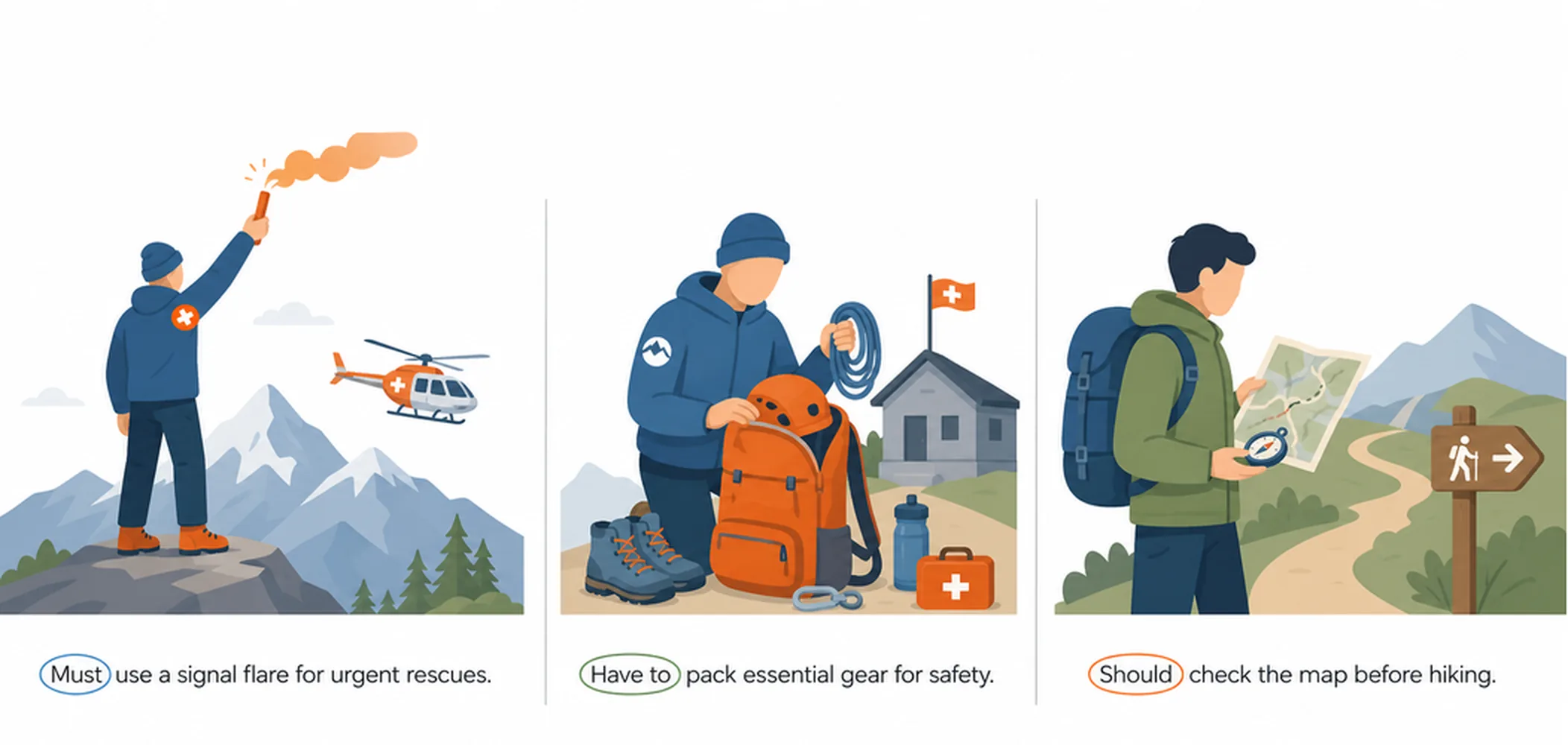
What are modal verbs for obligation?
Modal verbs are special verbs that show how certain or necessary something is. When we talk about obligation, we use modal verbs to show that someone must do something, should do something, or has to do something. The three most common modal verbs for obligation are must, should, and have to. Each one has a slightly different meaning and strength.
Must vs. should vs. have to
Must is the strongest form of obligation. It means something is absolutely necessary or required. You use must when there is no choice. Have to is very similar to must and means the same thing in most situations, but it is often used when an external rule or person forces you to do something. Should is weaker than must and have to. It means something is a good idea or the right thing to do, but it is not absolutely required.
Key differences in everyday use
In modern English, have to and must are very close in meaning. However, must often sounds more formal and strong, while have to is used more in spoken English and with external rules or situations. Should is used for advice, recommendations, and what you think is the right choice. Remember: must = very strong obligation, have to = strong obligation (often external), should = advice or recommendation.
Must vs. Should vs. Have To: Side-by-Side Comparison
| Category | MUST | SHOULD | HAVE TO |
|---|---|---|---|
| Strength of Obligation | Very strong — near absolute obligation or necessity | Moderate — advice, recommendation, or moral duty | Strong — external rule or requirement imposed by others |
| Source of Obligation | Internal — comes from the speaker's own authority or strong belief | Internal — the speaker's opinion, advice, or conscience | External — comes from rules, laws, institutions, or other people |
| Formality Level | Formal and written contexts; rules, signs, official instructions | Neutral — suitable for both spoken and written English | Neutral to informal — very common in everyday spoken English |
| Typical Context | Laws, regulations, strong personal conviction, logical deduction | Advice, suggestions, expectations, best practice | Rules set by employers, schools, governments, or circumstances |
| Form | Modal verb — no conjugation: must + bare infinitive. No past tense form. | Modal verb — no conjugation: should + bare infinitive. Past: should have + past participle. | Semi-modal — conjugates like a regular verb: have/has/had to + bare infinitive. Has full tense range. |
| When to Use | Use when the speaker personally insists something is necessary or when stating a rule with authority | Use to give advice, make recommendations, or express what is generally considered correct or appropriate | Use when an outside force (rule, law, person, situation) makes something necessary |
| Positive Example | You must wear a seatbelt at all times. | You should drink more water every day. | She has to submit the report by Friday. |
| Negative Form | Must not / Mustn't — means it is forbidden or prohibited | Should not / Shouldn't — means it is inadvisable or not recommended | Don't / Doesn't / Didn't have to — means there is no obligation; it is not necessary |
| Negative Example | You mustn't use your phone during the exam. (It is prohibited.) | You shouldn't eat so much sugar. (It is not a good idea.) | You don't have to wear a tie here. (It is not required.) |
| Question Example | Must we bring our own equipment? (Rare in questions; used in formal/written contexts) | Should I apply for the job? (Common for seeking advice) | Do we have to register in advance? (Most common in spoken questions) |
| Past Tense Usage | No direct past tense. Use had to instead: I had to leave early. | Past form with have: You should have told me sooner. (Regret or criticism) | Uses had to naturally: He had to work late last night. |
| Key Signal Words / Phrases | It is essential that…, It is absolutely necessary…, regulations state…, I insist… | It would be a good idea…, I recommend…, in my opinion…, it is advisable… | The rules say…, the law requires…, my boss told me…, I am required to… |
| Common Mistakes | Confusing mustn't (forbidden) with don't have to (not necessary) — they have opposite meanings | Using should when the obligation is strong — it sounds too weak for rules or laws | Forgetting to conjugate: saying "She have to go" instead of "She has to go" |
| 🔑 Key Difference Summary: Must expresses a strong, personal or authority-driven obligation — often a rule or law the speaker enforces. Should is softer, expressing advice, recommendations, or what is considered right — not a strict requirement. Have to expresses obligation imposed by an external source such as a rule, law, or another person — the speaker has no personal control over it. Crucially, mustn't means something is prohibited, while don't have to means something is simply not necessary — these are not interchangeable. | |||
Examples






What to Remember
- Must shows absolute necessity with no choice; it's the strongest form of obligation.
- Have to expresses obligation from external rules or circumstances rather than personal requirement.
- Should suggests advice or recommendation, not strict necessity, making it the weakest form.
- Must and have to are similar but must sounds more formal or authoritative.
- Modal verbs for obligation don't take -s in third person singular (he must go, not "he musts go").