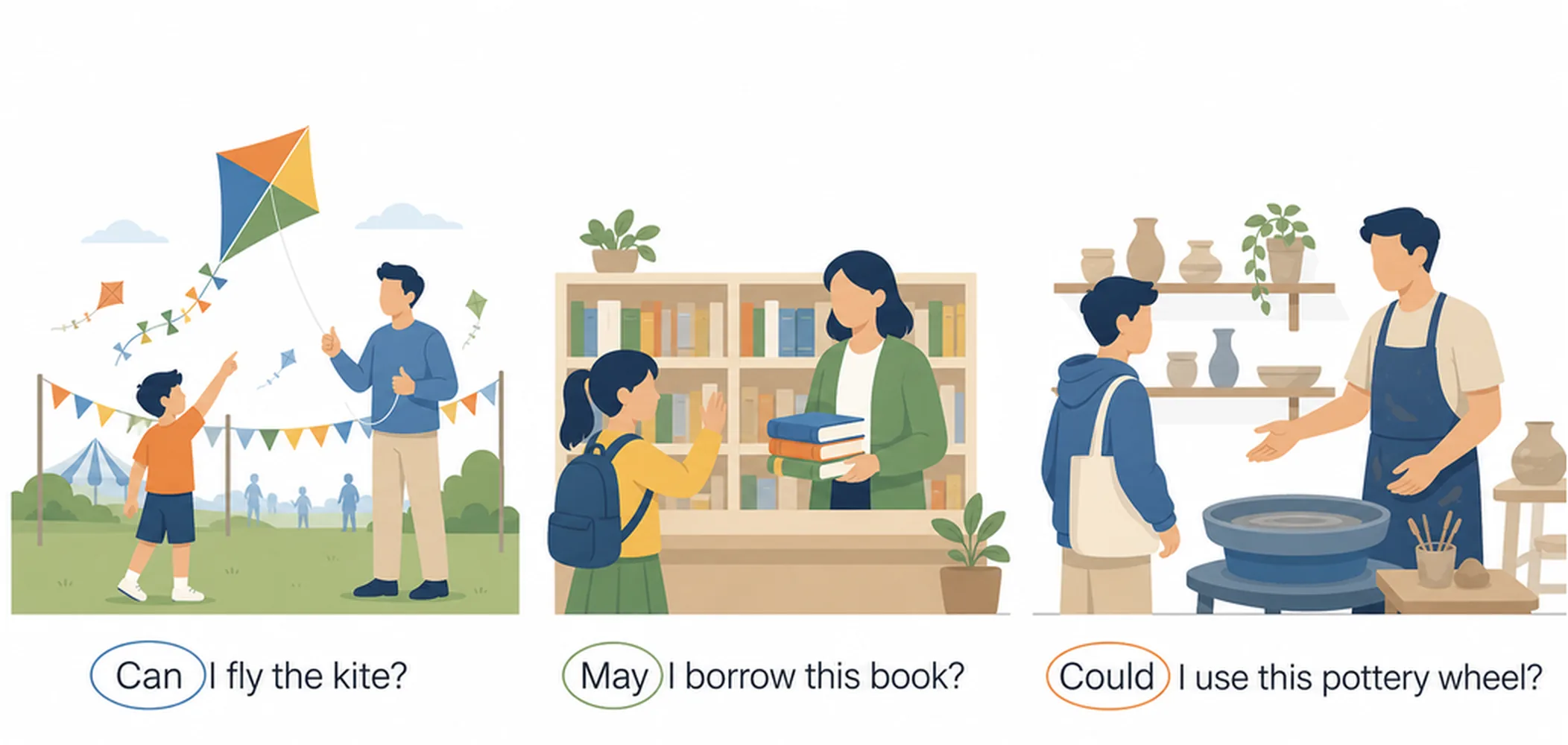
Understanding Modal Verbs for Permission
Modal verbs are special verbs that show ability, possibility, or permission. When we want to ask for permission or give permission, we use can, may, and could. These verbs have different levels of formality and politeness. Can is the most common in everyday situations, may is more formal and polite, and could is also polite but slightly softer than may. All three verbs are followed by the base form of the main verb (the infinitive without 'to').
Can vs. May vs. Could
| Modal Verb | Formality Level | Usage Context | Example |
|---|---|---|---|
| Can | Informal | Casual situations with friends and family | "Can I have a coffee?" |
| May | Formal | Professional settings or with people you don't know well | "May I ask you a question?" |
| Could | Polite | Situations requiring gentleness and consideration; sounds less direct and more cautious | "Could I borrow your pen?" |
In terms of permission being granted, all three modal verbs are equally valid. The difference lies only in formality and politeness levels.
Negative Forms and Responses
To refuse permission, use cannot (can't), may not, or could not (couldn't). Each form carries a different tone and level of formality. The table below shows how these forms compare:
| Form | Tone / Formality | Usage Context |
|---|---|---|
| Cannot / Can't | Direct and strong | Clear refusals; common in professional and informal settings. Implies the action is not permitted. |
| May not | Formal | Official rules, policies, or polite refusals in formal contexts. Often used in rules or regulations. |
| Could not / Couldn't | Softer, less direct | Suggests something is not possible rather than forbidden. Used in gentler refusals or when circumstances prevent an action. |
Example negative responses to permission requests:
Example positive responses to permission requests:
Can, May, and Could: Side-by-Side Comparison
| Dimension | CAN | MAY | COULD |
|---|---|---|---|
| Form | Subject + can + base verb | Subject + may + base verb | Subject + could + base verb |
| Formality Level | Informal / Neutral — suitable for everyday conversations, friends, family, and casual workplaces | Formal — used in professional, academic, official, or written contexts | Polite / Tentative — more indirect than can; appropriate in formal and semi-formal situations |
| Politeness Degree | ⭐ (Least polite of the three) | ⭐⭐⭐ (Most formal and deferential) | ⭐⭐ (More polite than can; softer than may) |
| When to Use | Asking for or giving permission in relaxed, everyday situations; also used for ability | Asking for permission formally; granting permission in an official or respectful tone; also used for possibility | Asking for permission politely when you want to sound less direct or more respectful; softer requests |
| Typical Context | Home, school (among peers), casual workplaces, conversations with friends | Offices, formal meetings, legal documents, academic writing, speaking to authority figures | Workplaces, speaking to someone older or senior, polite social situations, service settings |
| Positive Example | "You can leave early today." "I can borrow your pen, right?" |
"You may proceed with the presentation." "Students may use the library after hours." |
"You could sit here if you like." "Guests could check in early upon request." |
| Negative Example | "You can't park here." "She cannot enter without a badge." |
"You may not use your phone during the exam." "Members may not transfer their passes." |
"You couldn't bring outside food, I'm afraid." "Visitors could not access that floor." |
| Question Example | "Can I use your charger?" "Can we go outside now?" |
"May I speak with the manager, please?" "May we review the contract again?" |
"Could I ask you a question?" "Could we reschedule the meeting?" |
| Key Signal Words / Phrases | Sure, OK, go ahead, no problem, allowed to | Certainly, of course, permitted, authorised, officially | Perhaps, possibly, if you don't mind, would it be OK, kindly |
| Granting vs. Requesting | Used equally for both granting and requesting permission | Commonly used for both, but especially natural when an authority figure grants permission | Most natural when requesting permission; rarely used to grant permission |
| 💡 Key Difference: All three modals express permission, but they differ in formality and tone. Can is the most common and informal choice for everyday requests and is also used to express ability. May is the most formal and authoritative — preferred in official, written, or professional settings, and it can also express possibility. Could sits in the middle: it softens a request to sound more polite and tentative than can, without being as stiff as may. A helpful rule of thumb: use can with friends, could with colleagues or strangers, and may in formal or official situations. | |||
Examples






What to Remember
- Can, may, and could ask for or give permission, with different levels of formality.
- Can is informal and direct; may is more formal and polite in requests.
- Could is polite but softer than may, often used for more gentle requests.
- All three modal verbs are followed by the base form of the main verb.
- Do not add 'to' after can, may, or could before the main verb.