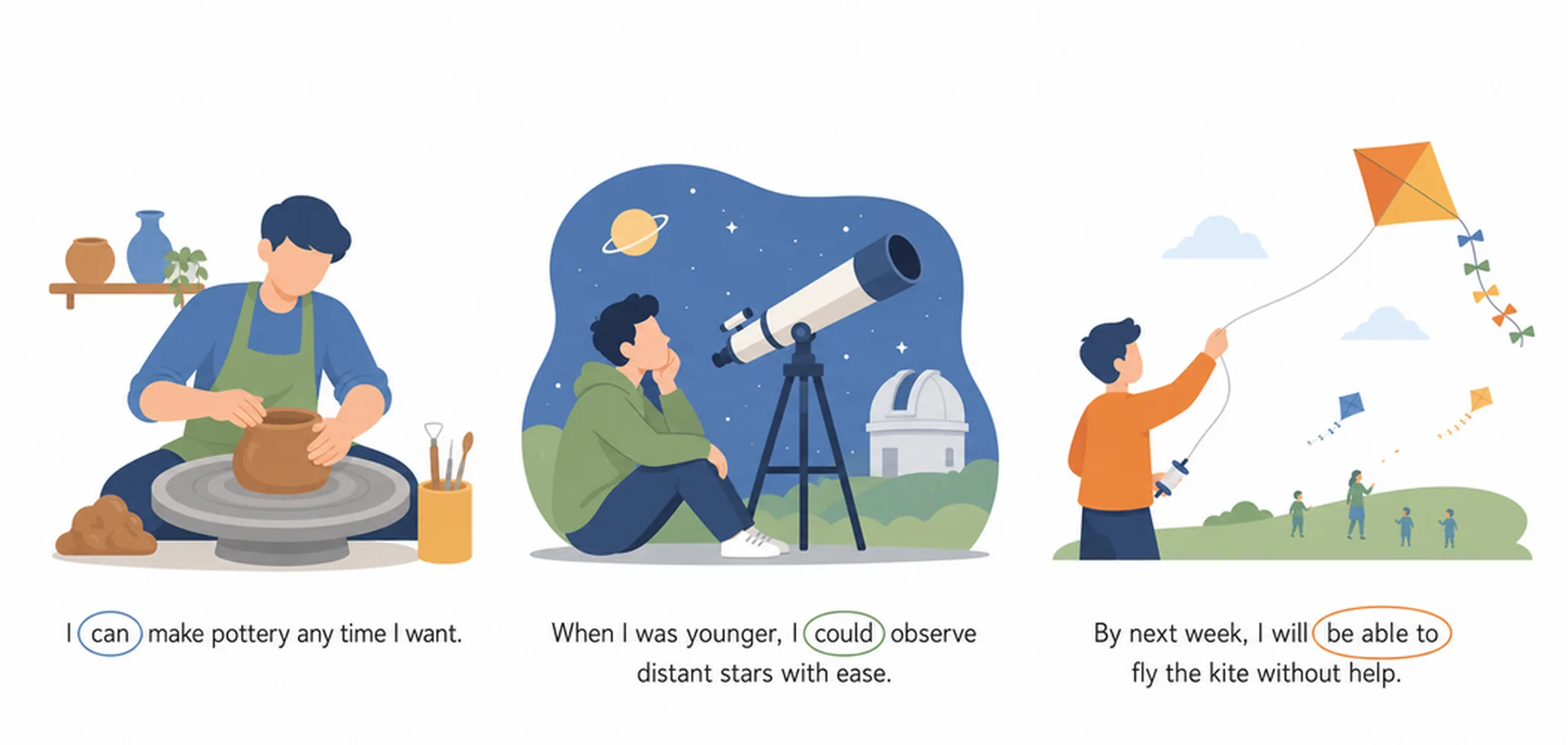
What are modal verbs for ability?
Modal verbs are special auxiliary verbs that show the ability, possibility, or permission to do something. When we talk about ability—what someone can or cannot do—we use three main modal expressions: can, could, and be able to. These verbs help us describe skills, talents, and what is possible or impossible for someone in the present, past, or future.
Can vs. Could vs. Be able to
Can, could, and be able to all express ability, but they are used in different contexts and time frames. Understanding when to use each form is essential for accurate communication.
| Form | Use | Example |
|---|---|---|
| Can | Present ability, general skills, or possibility. Simple and direct. | I can speak French. |
| Could | General or habitual ability in the past (not a specific completed action). Also used in conditional situations. | She could swim when she was young. If I had more time, I could help. |
| Was/were able to | Completed action in the past where the person succeeded despite difficulty. Required instead of "could" when describing a specific achievement. | He was able to finish the project on time. I was able to solve the problem. |
| Be able to | Formal and flexible alternative to can or could. Works in all tenses. Often used in future or perfect forms. | I will be able to help tomorrow. She has been able to improve her skills. |
Key distinction: Could describes general ability or possibility in the past, while was/were able to emphasizes actual accomplishment of a specific past action. For example: "I could swim" (general ability growing up), but "I was able to swim across the river" (I actually succeeded in this difficult task).
Key differences and usage
| Modal Verb | Primary Use | Negation |
|---|---|---|
| can | Present situations and general facts. Expresses current ability or possibility. | cannot / can't — expresses lack of ability in the present |
| could | Past ability or hypothetical situations. In the context of ability, it refers to past or conditional situations (e.g., I could help if you asked). | could not / couldn't — expresses lack of ability in the past |
| be able to | Use when you need different tenses or when emphasizing successfully managing a difficult task. Offers greater flexibility across time frames. | not be able to — expresses lack of ability with the same flexibility as affirmative forms |
Important note: Could can also express a polite request or possibility in other contexts, but when discussing ability specifically, it refers to past or conditional situations.
Can vs. Could vs. Be Able To: Side-by-Side Comparison
| Category | CAN (Present ability) |
COULD (Past ability / polite) |
BE ABLE TO (All tenses / formal) |
|---|---|---|---|
| Form | can + base verb No conjugation needed; same for all subjects |
could + base verb No conjugation needed; same for all subjects |
am/is/are/was/were/will be + able to + base verb Fully conjugated; works in all tenses |
| Tense | Present only | Past (general ability) or polite/conditional present | Present, past, future, perfect — all tenses |
| Formality | Informal / neutral Common in everyday speech and writing |
Neutral / slightly polite More tentative or polite than can |
Formal / neutral Preferred in academic, professional, and written contexts |
| When to use |
• Current skills or abilities • General truths about what someone is capable of • Informal requests |
• General past ability (repeated or habitual) • Polite requests • Hypothetical or conditional situations ⚠️ Not for one specific completed past achievement |
• Ability in any tense (past, present, future, perfect) • One specific completed achievement in the past • After other modal verbs (e.g. might be able to) • Formal writing |
| Positive example | "She can speak three languages." | "When I was young, I could run very fast." | "He was able to finish the exam on time." "They will be able to join us tomorrow." |
| Negative example | "I can't drive a truck." | "He couldn't swim when he was a child." | "We weren't able to contact her in time." "I haven't been able to sleep well lately." |
| Question example | "Can you play the piano?" | "Could you help me with this, please?" | "Were you able to solve the problem?" "Will she be able to attend the meeting?" |
| Key signal words / time expressions | now, today, at the moment, generally, always | when I was…, as a child, in those days, back then, used to, please (polite request) | yesterday, last year, eventually, finally, yet, so far, tomorrow, next week, soon, after (with perfect tenses) |
| 🔑 Key Difference: Use can for present ability in everyday situations. Use could for past general or habitual ability and for polite requests — but avoid it when describing a single specific success in the past (e.g. ✅ "I was able to pass the test" / ❌ "I could pass the test" — the latter implies general ability, not a one-time achievement). Use be able to when you need any tense other than simple present, when following another modal verb (e.g. might be able to, should be able to), or when writing formally. Be able to is the most flexible of the three. | |||
Examples






What to Remember
- Use "can" for present ability and general possibility in affirmative and negative sentences.
- Use "could" for past ability or to express present possibility in a more formal tone.
- "Be able to" works for all tenses and is the only option for future ability with will.
- "Can" cannot be used with will or other modals; use "be able to" instead for future.
- In negatives, "cannot" or "can't" is more common than "am not able to" in everyday speech.