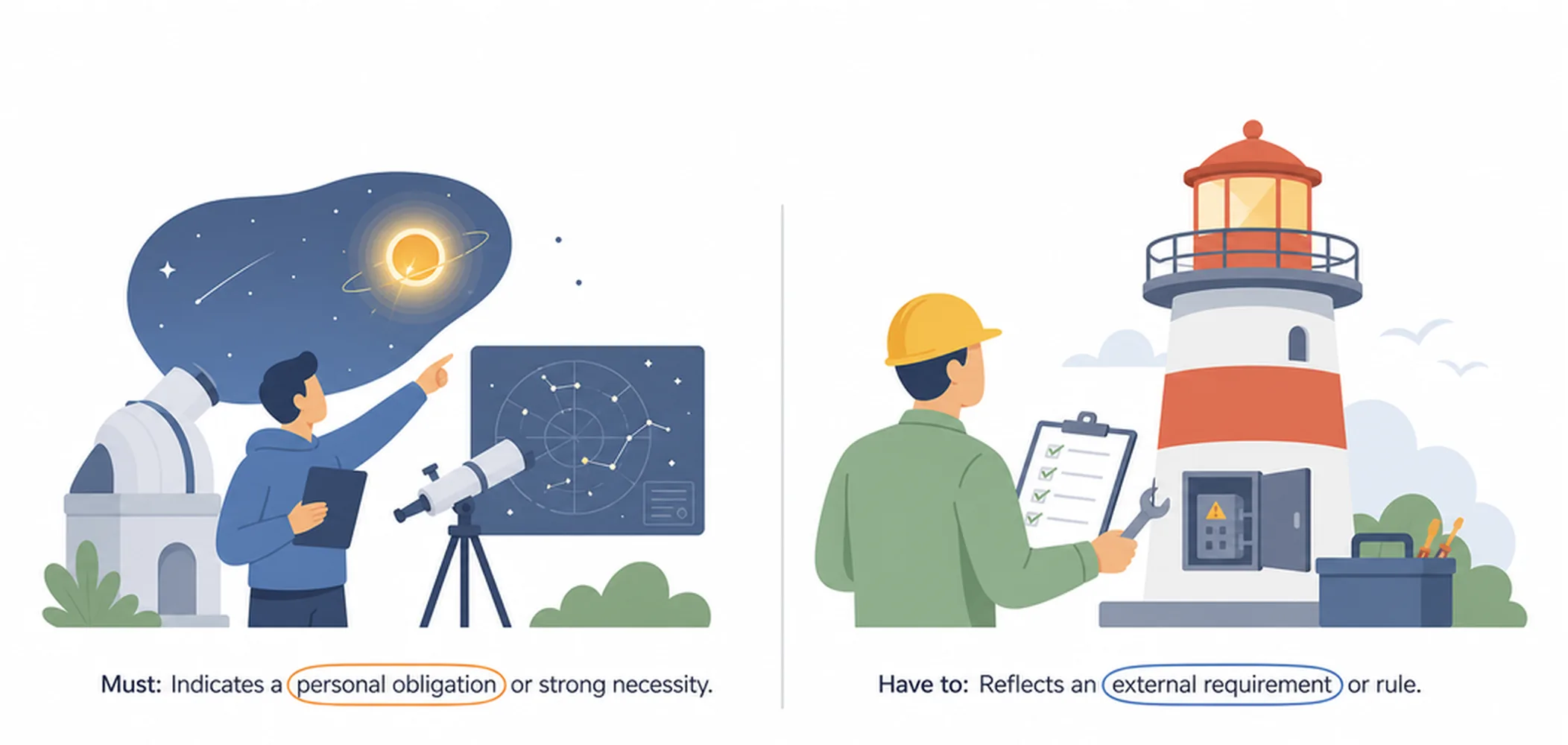
Key Difference Between Must and Have To
Both 'must' and 'have to' express obligation and necessity, but they come from different sources. 'Must' shows a personal obligation or something you believe is necessary. 'Have to' shows an external obligation—a rule, law, or someone else requires it. In British English, 'must' is more formal and personal, while in American English, 'have to' is much more common in everyday speech.
When to Use Each Form
Use 'must' when you personally feel something is important or necessary, or when making a strong rule. Use 'have to' for external requirements like laws, workplace rules, or instructions from someone else. In negative sentences, the difference is important: 'must not' means 'do not do this,' while 'don't have to' means 'it is not necessary.'
Pro Tip: Negatives Are Different
Remember the negative forms have opposite meanings. 'You must not tell anyone' = prohibition (don't do it). 'You don't have to tell anyone' = it's optional (you can choose). This is one of the most important differences between these two modals.
Must vs Have To: Side-by-Side Comparison
| Dimension | Must | Have To |
|---|---|---|
| Form | Modal verb; no conjugation — same for all subjects (I/you/he/she/we/they must). No infinitive, past, or future form on its own. | Semi-modal verb; conjugates fully — have to / has to (present), had to (past), will have to (future). Follows normal verb rules. |
| Source of Obligation | Internal or personal obligation — the speaker imposes the rule or feels strongly that something is necessary. The authority comes from within. | External obligation — the rule or requirement comes from an outside authority such as a law, employer, school, or another person. |
| Formality | More formal and emphatic. Common in written rules, notices, instructions, and official documents. | More neutral and widely used in everyday spoken and written English across both formal and informal contexts. |
| When to Use | Use when you personally believe something is essential, when giving strong advice, or when writing formal rules and regulations. Also used for logical deduction (e.g., "It must be true"). | Use when referring to obligations imposed by external rules, circumstances, or other people. Preferred when talking about the past or future, since "must" has no past/future form for obligation. |
| Positive Example | "You must try this restaurant — the food is incredible." "Passengers must wear seat belts at all times." |
"I have to submit the report by Friday — my boss said so." "She has to wear a uniform at work." |
| Negative Example | "You must not (mustn't) park here." Meaning: It is prohibited / forbidden — you are not allowed to do it. |
"You don't have to come if you're tired." Meaning: It is not necessary — there is no obligation, but you can if you want. |
| Negative Meaning | Prohibition — "must not" means it is strictly forbidden or strongly advised against. The action should not happen. | No obligation / Lack of necessity — "don't have to" means the action is optional; there is no requirement to do it. |
| Question Example | "Must I bring my passport?" Grammatically correct but sounds formal or old-fashioned; rarely used in modern spoken English. |
"Do I have to bring my passport?" The natural and preferred question form in everyday English speech and writing. |
| Tenses Available | Present only (for obligation). No past or future form for obligation — use "had to" or "will have to" instead when needed. | All tenses: have/has to (present), had to (past), will have to (future), having to (gerund). |
| Key Signal Words / Contexts | Signs and notices ("Visitors must sign in"), strong personal recommendations, formal written instructions, logical deduction ("It must be him"). | References to rules set by others ("The law says…", "My doctor told me…"), workplace requirements, school policies, past or future obligations. |
| Typical Usage Context | Formal writing, official signs, strong advice given by the speaker, expressing personal conviction or urgency. | Everyday conversation, describing rules imposed by others, talking about obligations in the past or future. |
| 🔑 Key Difference: The core distinction is the source of obligation. Must expresses an internal obligation — the speaker personally believes the action is essential or is imposing the rule themselves. Have to expresses an external obligation — the requirement comes from an outside authority, rule, or circumstance. Crucially, their negatives are opposites in meaning: must not = prohibition (you cannot do it), while don't have to = no obligation (you don't need to do it, but you may). When referring to the past or future, always use have to, since "must" has no equivalent obligatory past or future form. | ||
Examples






What to Remember
- Both 'must' and 'have to' show obligation, but 'must' is personal while 'have to' is external.
- 'Must' expresses something you believe is necessary; 'have to' expresses rules or requirements from others.
- In British English, 'must' is formal and common; in American English, 'have to' is preferred.
- Use 'must' for personal decisions and 'have to' for external rules, laws, or requirements.
- In negative forms, 'mustn't' (prohibition) and 'don't have to' (no obligation) have completely different meanings.