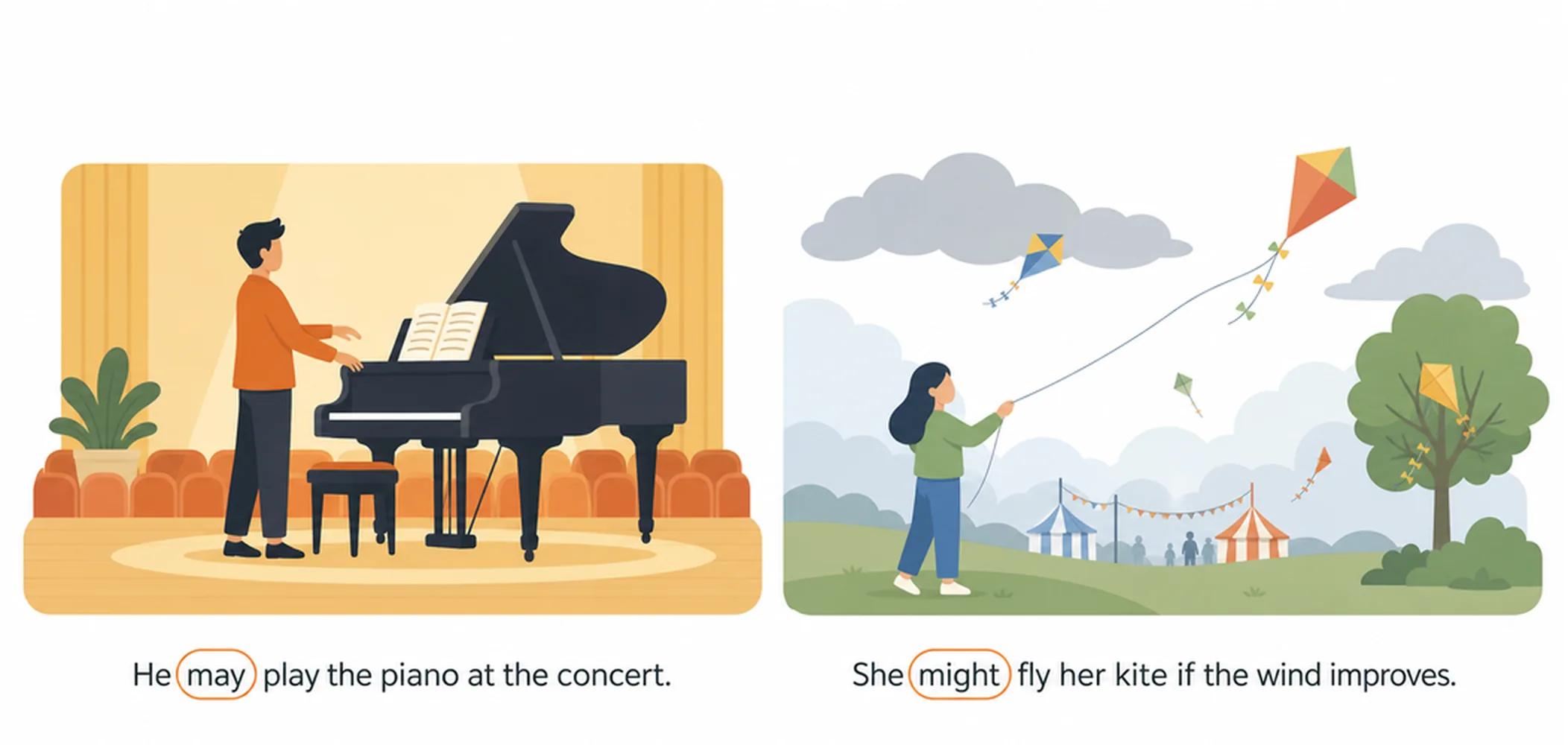
Understanding May vs Might
Both 'may' and 'might' are modal verbs, but they have different primary uses. 'May' is mainly used to ask for permission or express possibility with confidence. 'Might' suggests more uncertainty or doubt about something happening. In modern English, the difference is becoming less strict, and many speakers use them interchangeably, but understanding the traditional distinction helps you communicate more precisely.
Key Differences at a Glance
MAY is used for: (1) Asking or giving permission — 'May I leave early?' (2) Expressing possibility with reasonable confidence — 'It may rain tomorrow.' (3) Formal, polite expressions — 'You may proceed.' // MIGHT is used for: (1) Expressing greater uncertainty or doubt — 'They might come, but I'm not sure.' (2) Discussing hypothetical situations — 'If you studied harder, you might pass.' (3) Making polite suggestions — 'You might want to call ahead.'
May vs Might: Side-by-Side Comparison
| Category | May | Might |
|---|---|---|
| Form | Modal verb; base form of the main verb follows (e.g., may go, may be). No conjugation for person or number. | Modal verb; base form of the main verb follows (e.g., might go, might be). No conjugation for person or number. Historically the past tense of may. |
| Level of Certainty | Higher likelihood; suggests a real, fairly probable possibility (roughly 50 % or more chance). | Lower likelihood; suggests a more remote, tentative, or uncertain possibility (roughly less than 50 % chance). |
| When to Use | Use for present or future possibilities that are reasonably likely; also used to grant or seek formal permission. | Use for less likely or purely hypothetical possibilities; for polite/tentative requests; in conditionals and reported speech. |
| Permission | Commonly used to ask for or grant permission in both formal and everyday contexts. (May I leave early?) | Rarely used for permission in modern English; when used, it sounds very tentative or old-fashioned. (Might I borrow this?) |
| Hypothetical / Conditional Use | Less common in hypothetical or unreal conditions; used when the scenario is treated as genuinely possible. | Preferred in hypothetical, unreal, or past conditional sentences. (If I had studied harder, I might have passed.) |
| Formality | Neutral to formal; appropriate in both spoken and written English, and especially for formal permission requests. | Can sound slightly more tentative or polite; also appears in formal writing for hedged statements and academic language. |
| Positive Example | She may arrive before noon — the weather looks fine. | She might arrive before noon, but I wouldn't count on it. |
| Negative Example | He may not attend the meeting — he has a conflicting appointment. | He might not attend — it's really quite uncertain at this point. |
| Question Example | May I use your phone, please? (polite permission request) | Might I suggest a different approach? (very tentative, formal suggestion) |
| Key Signal Words / Contexts | perhaps, possibly, it is likely that; real present/future situations; formal permission contexts. | if, even if, although, just possibly; hypothetical scenarios; reported speech; past conditionals. |
| 🔑 Key Difference: The core distinction is one of degree of certainty. May implies a stronger, more realistic possibility and is the standard choice for granting or requesting permission. Might implies a weaker, more doubtful possibility and is preferred in hypothetical, conditional, or reported-speech contexts. In everyday informal speech the two are often interchangeable, but in formal or precise writing, choosing correctly signals the intended level of probability. | ||
Examples






What to Remember
- Use 'may' to ask permission or express possibility with greater confidence in the outcome.
- Use 'might' to suggest uncertainty, doubt, or lower probability that something will happen.
- 'May' and 'might' are increasingly used interchangeably in modern English, though traditional distinctions still matter.
- Both modal verbs require the base form of the verb without 'to' after them.
- In formal contexts, maintaining the traditional distinction between 'may' and 'might' demonstrates more precise communication.