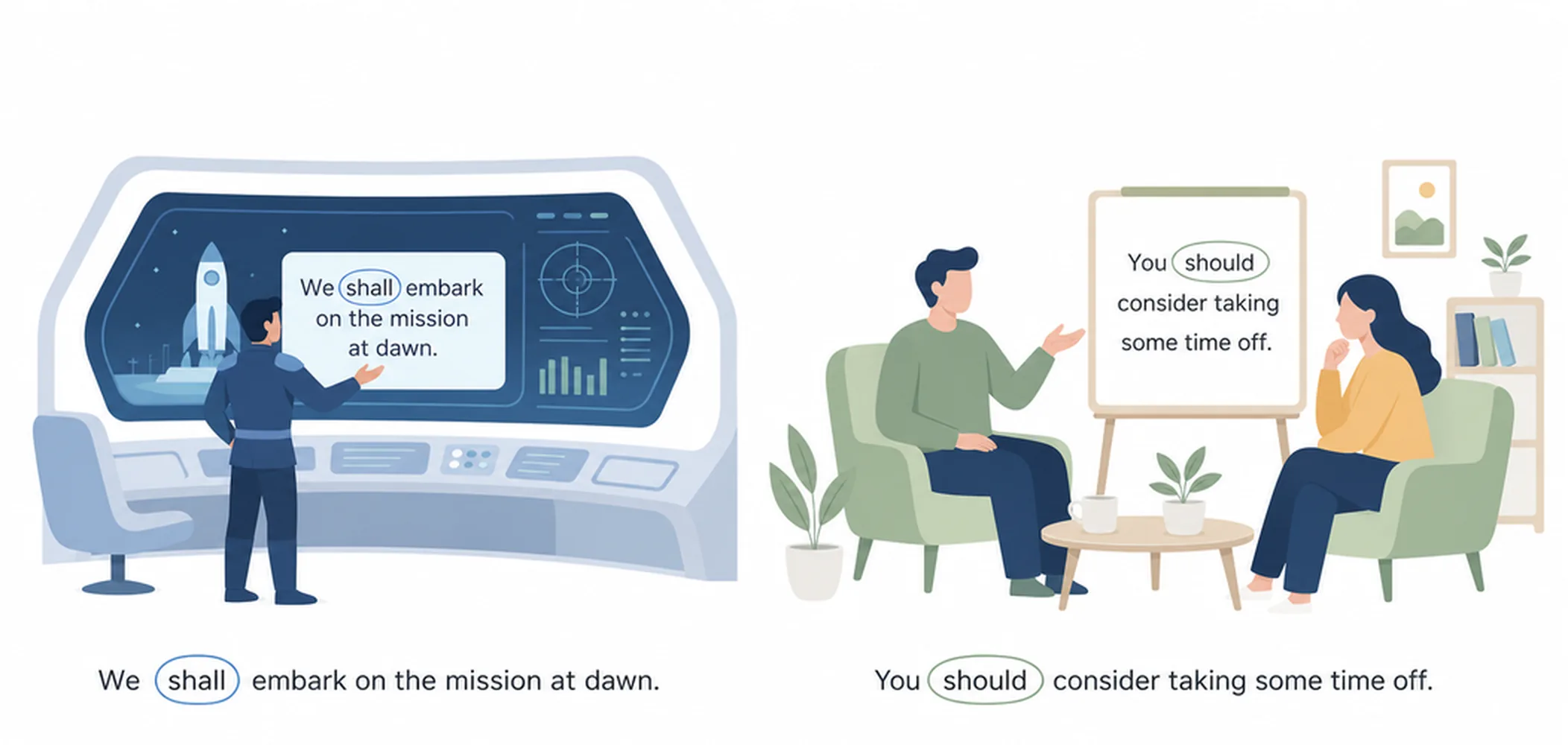
Shall vs Should: Key Difference
Shall and should are both modal verbs, but they have different uses. Shall is formal and expresses offers, suggestions, or future plans—especially in British English. Should is more common and expresses advice, recommendations, obligations, and expectations. Understanding when to use each one will help you sound more natural and appropriate in different situations.
Shall vs Should: Side-by-Side Comparison
| Dimension | Shall | Should |
|---|---|---|
| Form | Modal auxiliary verb; present/future tense form. Used primarily with first-person subjects (I, we) in traditional usage. | Modal auxiliary verb; past tense form of "shall," but functions as an independent modal in modern English with all subjects (I, you, he, she, they, we). |
| Core Meaning | Expresses strong intention, obligation, or a definite future event. In legal/formal contexts, it signals a mandatory requirement or command. | Expresses advice, recommendation, moral duty, expectation, or mild obligation. The action is desirable but not strictly mandatory. |
| Formality Level | High formality. Common in legal documents, official rules, contracts, and formal literary prose. Increasingly rare in everyday conversation. | Moderate formality. Suitable for both formal writing and everyday speech. Widely used in advice-giving, suggestions, and polite instructions. |
| When to Use |
|
|
| Strength of Obligation | Strong / Mandatory — non-compliance is typically not an option, especially in legal contexts. Closer in force to "must." | Moderate / Advisory — non-compliance is possible but inadvisable. Softer than "must" and closer to "ought to." |
| Positive Example | "All employees shall comply with the company's safety regulations." "We shall overcome these challenges together." |
"You should drink plenty of water every day." "She should arrive at the airport at least two hours early." |
| Negative Example | "No party shall disclose confidential information to third parties." "The contractor shall not subcontract work without prior approval." |
"You shouldn't eat so much sugar before bed." "He should not have left without saying goodbye." |
| Question Example | "Shall we begin the meeting?" (formal offer/suggestion) "Shall I carry that for you?" (polite offer, British English) |
"Should I call the doctor?" (seeking advice) "Should we reschedule the appointment?" (seeking recommendation) |
| Key Signal Words / Contexts | Legal clauses, contracts, bylaws, regulations, formal declarations, "shall not," mandatory provisions, formal British offers ("Shall we…?") | "ought to," advice columns, health recommendations, moral discussions, "should have" (past regret), conditional sentences ("If… then you should…") |
| Regional Preference | British English: Still used in formal speech and legal writing, and for polite offers ("Shall I…?"). American English: Largely replaced by "will" in everyday use; retained mainly in legal and formal documents. |
British English: Common in all registers for advice and obligation. American English: Equally common; preferred over "shall" for advice and recommendations in both formal and informal contexts. |
| Common Mistakes | Using "shall" in casual conversation (sounds overly stiff). Confusing its mandatory legal sense with a mere future intention in formal writing. | Using "should" in legal documents where "shall" is required to indicate binding obligation. Overusing it where stronger modals ("must," "have to") are more appropriate. |
| Key Difference: The essential distinction between shall and should comes down to obligation versus advice. Shall — especially in legal and formal writing — imposes a mandatory, binding obligation with little room for interpretation, functioning much like "must." Should, by contrast, conveys a recommendation, moral expectation, or advisable course of action, leaving the subject with a degree of choice. In everyday modern English (particularly American English), shall has largely fallen out of conversational use and been replaced by will, while should remains the versatile, go-to modal for advice and guidance across all registers and regions. | ||
Formula
✔ Positive
Subject
+
shall
+
base verb
I shall return tomorrow.
? Question
Shall
+
subject
+
base verb
Shall I help you?
✖ Negative
Subject
+
shouldn't
+
base verb
They shouldn't be late for work.
Examples

Shall I open the window for you?
Formal offer · Polite question

We shall meet again next week.
Future plan · Formal/Literary

Shall we dance?
Polite suggestion · Social situation

You should study harder if you want to pass.
Advice · Common usage

She should arrive by 6 p.m.
Expected outcome · Probability

You shouldn't eat too much sugar.
Negative advice · Recommendation
When to use it
Giving Advice
Use should when you want to recommend or suggest something to someone. This is the most common use of should in daily English.
"You should wear a coat. It's very cold outside."
Making Formal Offers
Use shall in formal or polite situations to offer help or suggest something together. Common in British English.
"Shall I call a taxi for you?"
Stating Expected Results
Use should to express what you think will probably happen or what is expected in a situation.
"The package should arrive by Friday."
Expressing Duty or Obligation
Use should to say what someone must do or what is their responsibility or duty.
"Parents should help their children with homework."
Signal words
I think
probably
expected
duty
obligation
responsibility
polite request
formal offer
suggestion
Common Mistakes
✕
Wrong
Shall I going to the party?
✓
Correct
Shall I go to the party?
Modal verbs use base form, not -ing form. Use the infinitive after shall.
✕
Wrong
I should to finish my homework.
✓
Correct
I should finish my homework.
Don't use 'to' after modal verbs like should. Use the base form directly.
✕
Wrong
He will shall come tomorrow.
✓
Correct
He shall come tomorrow.
Don't combine two modal verbs. Use either 'will' or 'shall', not both.
KEY TAKEAWAYS
What to Remember
- Use shall for offers, suggestions, and future plans, especially in British English.
- Use should for advice, recommendations, obligations, and expressing what is expected.
- Should is more common in everyday English than shall in modern usage.
- Shall is formal and less frequent in American English compared to British English.
- Don't confuse shall with should—they express different meanings despite both being modal verbs.