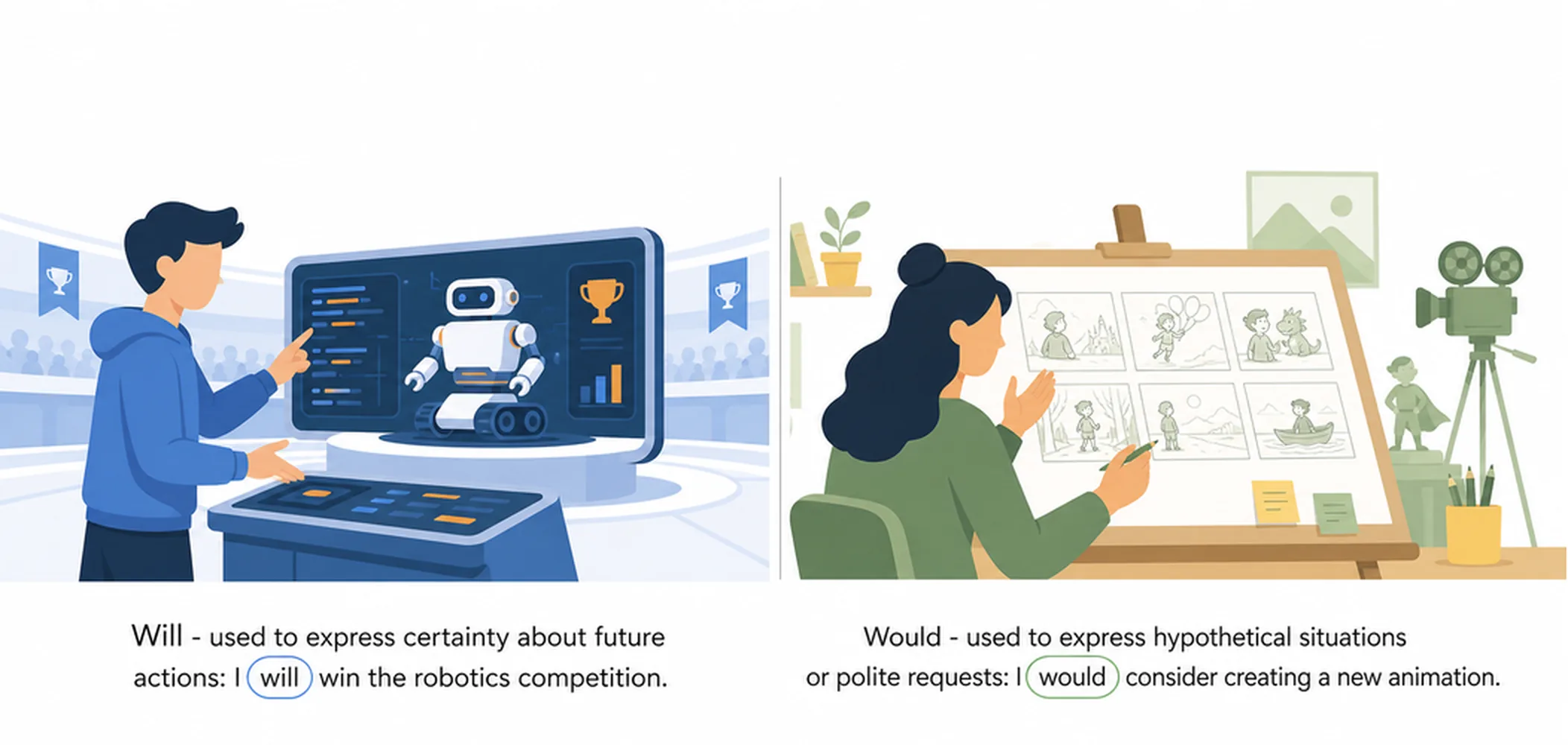
The Key Difference Between Will and Would
Will and would are both modal verbs, but they have different uses. Will is used to express future actions, predictions, and promises. Would is used for hypothetical situations, polite requests, past habits, and conditional statements. Understanding when to use each one is essential for B1 learners. The main rule: use will for real future events, and would for imaginary, polite, or conditional situations.
Will vs Would: Direct Comparison
Will refers to the future and expresses intention, certainty, or spontaneous decisions. Would refers to hypothetical or unlikely situations, and also appears in polite questions and past conditional sentences. Think of will as confident and real, while would as uncertain or imaginary. In conditional sentences (if-clauses), would is used in the main clause when the condition is unlikely or impossible.
Will vs Would: Side-by-Side Comparison
| Category | Will | Would |
|---|---|---|
| Form | will + base verb (e.g. will go, will eat, will be) |
would + base verb (e.g. would go, would eat, would be) |
| When to use |
• Real future plans or predictions • Spontaneous decisions made at the moment of speaking • Promises, offers, and requests • General truths about the future • Certain or highly likely outcomes |
• Hypothetical or imaginary situations • Conditional sentences (second and third conditionals) • Polite requests and offers • Past habits or repeated actions • Reported speech (future in the past) |
| Time reference | Present → Future (real timeline) | Imaginary present/future, or past reported speech |
| Certainty level | High certainty — the speaker treats the event as real or very likely | Lower certainty — the event is conditional, hypothetical, or softened for politeness |
| Positive example | "She will call you tomorrow." "I will help you with that." |
"She would call if she had time." "I would love to visit Paris someday." |
| Negative example | "He won't attend the meeting." "They will not be late." |
"He wouldn't attend unless invited." "They would not agree to that deal." |
| Question example | "Will you be at the party?" "Will it rain this afternoon?" |
"Would you like some coffee?" "Would you help me if I asked?" |
| Key signal words / phrases | tomorrow, next week, soon, definitely, certainly, I promise, I think … will, probably | if, unless, wish, imagine, in an ideal world, used to (past habit), could you / would you (polite) |
| Formality / Politeness | More direct; can sound blunt or commanding in requests "Will you close the door?" (direct) |
More polite and tentative; preferred in formal or courteous contexts "Would you close the door?" (polite) |
| 🔑 Key Difference: Will is used for real, certain, or decided future events — the speaker sees the situation as part of actual reality. Would is used for hypothetical, conditional, or imagined situations, polite requests, past habits, and reported speech — the speaker distances the statement from direct reality. A simple test: if you can replace the modal with a real, definite plan, use will; if the situation depends on a condition, is imaginary, or needs softening out of politeness, use would. | ||
Examples






What to Remember
- Use will for future actions, predictions, and promises about real events.
- Use would for hypothetical situations, imaginary scenarios, and conditional statements.
- Would is more polite than will in requests and offers.
- Use would to describe past habits and repeated actions in past.
- Don't confuse will (future) with would (hypothetical/conditional); they serve different purposes.