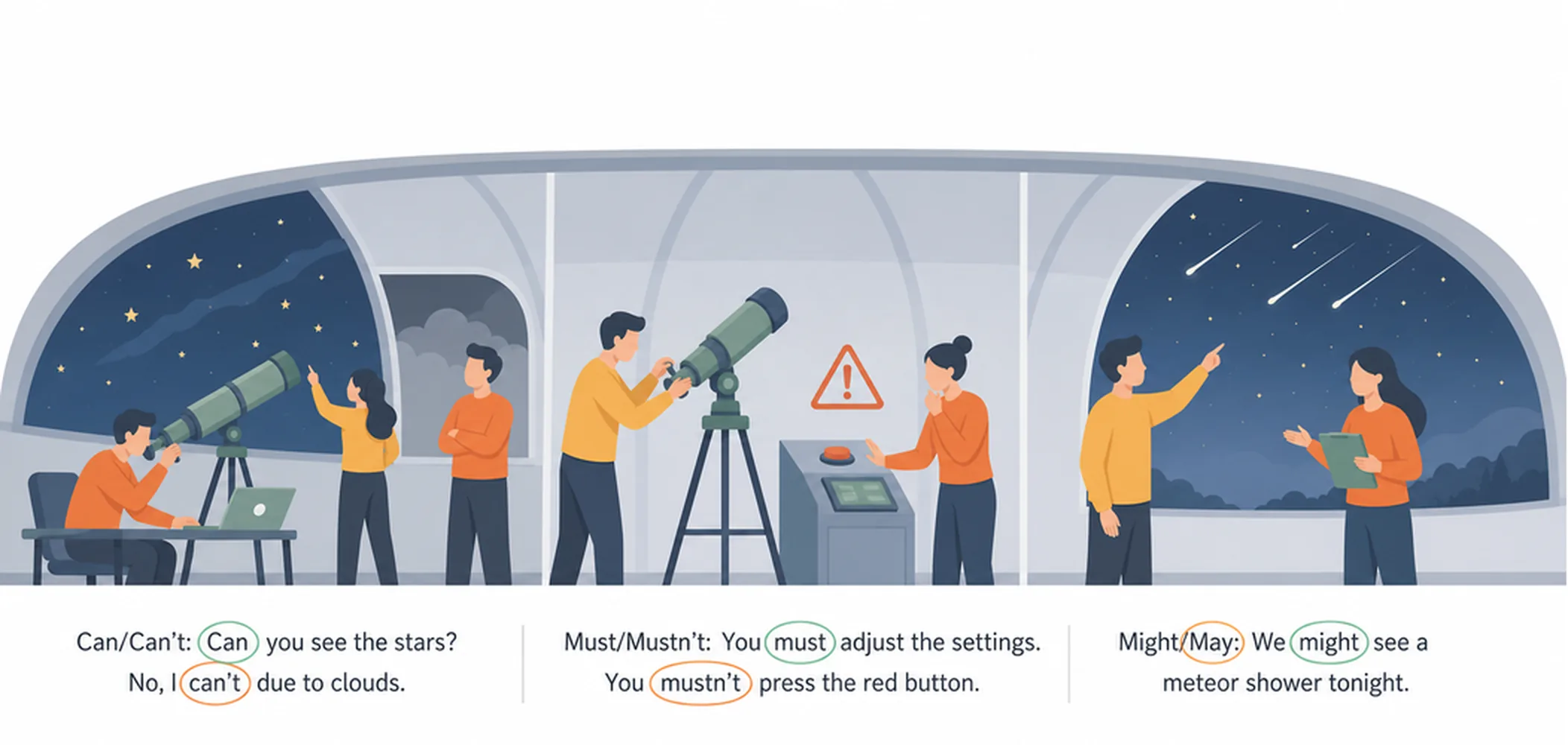
What are modal verbs?
Modal verbs are special auxiliary verbs that show ability, permission, obligation, probability, or possibility. They are not used alone—they always come before a main verb in the base form (infinitive without 'to'). Common modal verbs include can, could, may, might, must, should, would, and will. Modal verbs do not change form based on the subject (no -s ending in the third person), and they do not use 'do' in questions or negatives.
Ability and possibility
Use 'can' to express present ability or possibility, and 'could' for past ability or polite present possibility. 'May' and 'might' show permission or present/future possibility, with 'might' being slightly more uncertain. These modals help you talk about what is or was possible in different situations.
Obligation and advice
Obligation and advice modal verbs are used to express rules, responsibilities, and recommendations. The three main verbs in this category—must, should, and have to—each have distinct uses and levels of strength.
| Modal Verb | Usage | Strength |
|---|---|---|
| Must | Shows strong obligation, certainty, or rules. Often used in statements, laws, and formal requirements. | Very strong; no flexibility |
| Should | Gives advice or expresses what is expected or recommended. Allows the listener to choose. | Weak to moderate; flexible |
| Have to | Expresses necessity or obligation. Not a true modal verb, but functions similarly to must in informal contexts. | Strong; external obligation |
Must: You must arrive on time for the meeting.
Should: You should study the material before the exam.
Have to: I have to pick up my daughter at 3 p.m.
Why modal verbs matter
Modal verbs let you express nuance in English. Without them, you can only state facts. With them, you can show degrees of certainty, politeness, requirement, and freedom. Mastering modal verbs will make your English more natural, flexible, and appropriate for different social contexts.
Complete List of Modal Verbs
| Modal Verb | Primary Meaning | Form | Example | Note |
|---|---|---|---|---|
| can | Ability; informal permission; possibility | can + base verb | She can swim. / Can I go? | Present tense only; no infinitive form |
| could | Past ability; polite permission; possibility; polite request | could + base verb | He could run fast. / Could you help me? | Past form of can; also used for hypothetical situations |
| may | Formal permission; possibility | may + base verb | You may leave early. / It may rain. | More formal than can for permission; approximately 50% possibility |
| might | Weaker possibility; tentative suggestion | might + base verb | She might come tonight. | Past form of may; implies less certainty than may |
| will | Future certainty; willingness; instant decisions | will + base verb | I will call you. / Will you help? | Contracted to 'll; negative is won't |
| would | Conditional; polite request; past habit | would + base verb | Would you like tea? / I would go if I could. | Past form of will; key in conditional sentences |
| shall | Formal future (I/we); offers; suggestions | shall + base verb | Shall we dance? / I shall return. | Mainly used with I / we; more common in British English |
| should | Advice; recommendation; weak obligation; expectation | should + base verb | You should see a doctor. / He should be here by now. | Past form of shall; weaker than must |
| must | Strong obligation; logical deduction / certainty | must + base verb | You must wear a seatbelt. / She must be tired. | No past tense form; use had to for past obligation |
| must not (mustn't) | Prohibition; strong negative obligation | must not + base verb | You mustn't smoke here. | Opposite of must; not the same as don't have to (which means no obligation) |
| have to | External obligation; necessity | have to + base verb | I have to finish this report. | Semi-modal; inflects for tense (had to, will have to) |
| don't have to | Absence of obligation; no necessity | don't/doesn't have to + base verb | You don't have to come. | Not the same as mustn't; the action is simply optional |
| ought to | Moral obligation; advice; expectation | ought to + base verb | You ought to apologise. | Similar to should; slightly more formal; always followed by to |
| need (to) | Necessity; (negative) no need | need (to) + base verb | You need to finish this. / Need you go? | Semi-modal; functions as both modal (negative/question) and regular verb; negative: don't need (to) |
Examples






What to Remember
- Modal verbs are auxiliary verbs that express ability, permission, obligation, probability, or possibility.
- Modal verbs always come before a main verb in base form without 'to'.
- Modal verbs don't change form for any subject; never add -s in third person.
- Modal verbs form questions and negatives without using 'do', 'does', or 'did'.
- Use 'can' for present ability, 'could' for past ability or polite requests.