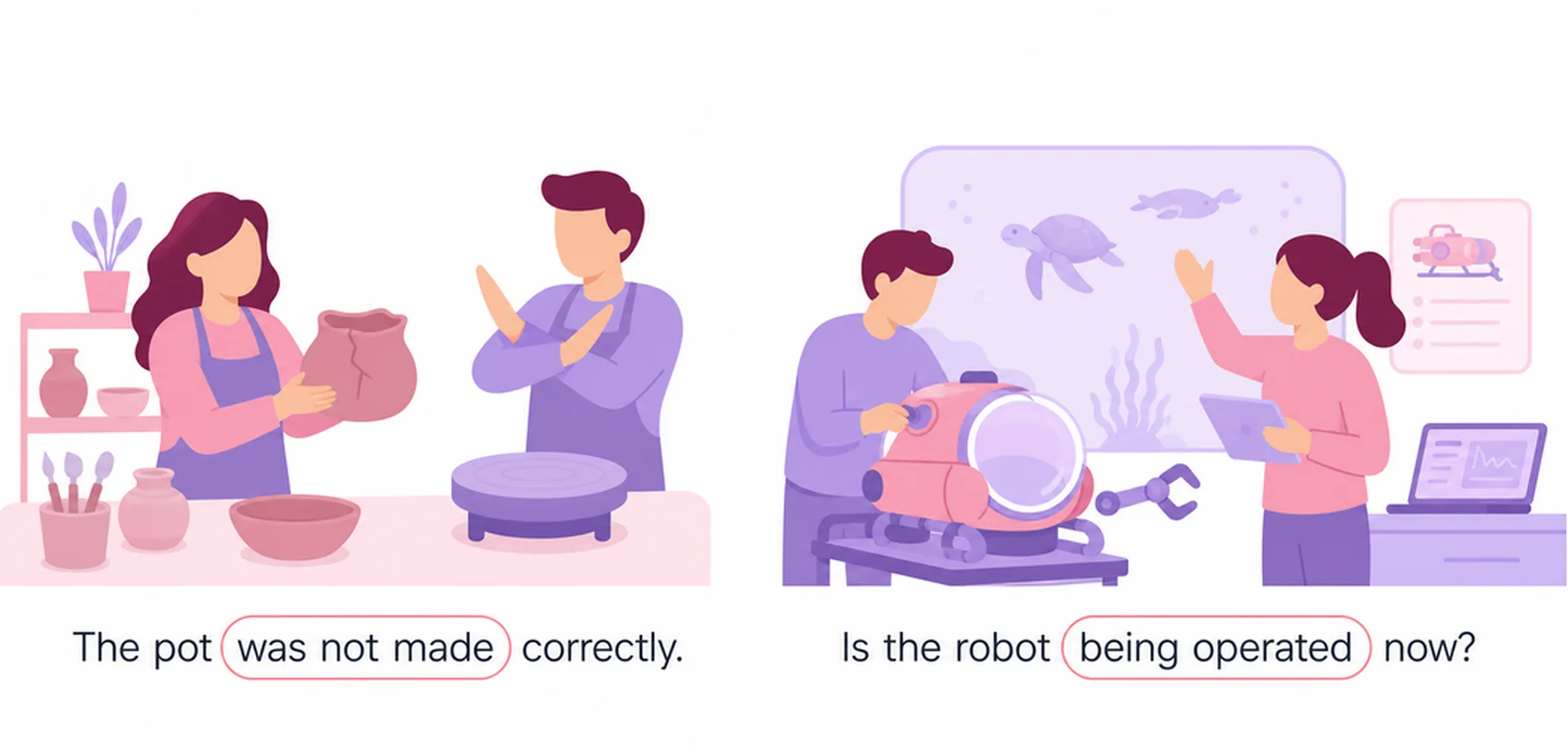
Passive Voice: Negatives and Questions
At B1 level, you need to master not just the passive voice, but also how to make it negative and ask questions. The key is understanding where to place the negation and question words in passive structures. In this lesson, we'll practice both forms so you can use the passive confidently in all situations.
Negative Sentences vs. Questions: Side-by-Side
| Tense | Negative Form | Question Form | Example |
|---|---|---|---|
| Present Simple Passive | Subject + am/is/are + not + past participle | Am/Is/Are + subject + past participle? |
Negative: The report is not written every week.
not inserted after auxiliary
Question: Is the report written every week?
auxiliary moves before subject
|
| Past Simple Passive | Subject + was/were + not + past participle | Was/Were + subject + past participle? |
Negative: The letter was not signed yesterday.
not inserted after was/were
Question: Was the letter signed yesterday?
auxiliary moves before subject
|
| Present Perfect Passive | Subject + has/have + not + been + past participle | Has/Have + subject + been + past participle? |
Negative: The invoice has not been sent.
not inserted after has/have
Question: Has the invoice been sent?
has/have moves before subject
|
| Future Simple Passive | Subject + will + not + be + past participle | Will + subject + be + past participle? |
Negative: The bridge will not be opened next year.
not inserted after will
Question: Will the bridge be opened next year?
will moves before subject
|
| Past Continuous Passive | Subject + was/were + not + being + past participle | Was/Were + subject + being + past participle? |
Negative: The road was not being repaired that day.
not inserted after was/were
Question: Was the road being repaired that day?
was/were moves before subject
|
In passive negative sentences, the word order remains the same as in the positive form — the subject stays first — and not is inserted immediately after the first auxiliary verb (e.g., is not, was not, has not, will not). The subject never moves.
In passive questions, the structure is fundamentally different: the first auxiliary verb is inverted and moved to the front of the sentence, before the subject. This inversion is the primary grammatical signal that a sentence is a question. No extra auxiliary (like do/does/did) is needed in passive voice because the passive already contains an auxiliary verb (is, was, has, will, etc.) that can be fronted directly.
In short: Negatives keep the subject first and add not; questions move the auxiliary before the subject. When forming a negative question, the auxiliary moves to the front and not follows it (e.g., Wasn't it signed?).
Examples






What to Remember
- In passive negation, place 'not' after the auxiliary verb, never before the main verb.
- Form passive questions by inverting the auxiliary verb and subject at the sentence start.
- Use 'by' to show who performs the action in negative and question passive sentences.
- The main verb always stays in past participle form in all passive structures.
- Question words like 'what' or 'who' come before the inverted auxiliary in passive questions.