What is Passive Voice?
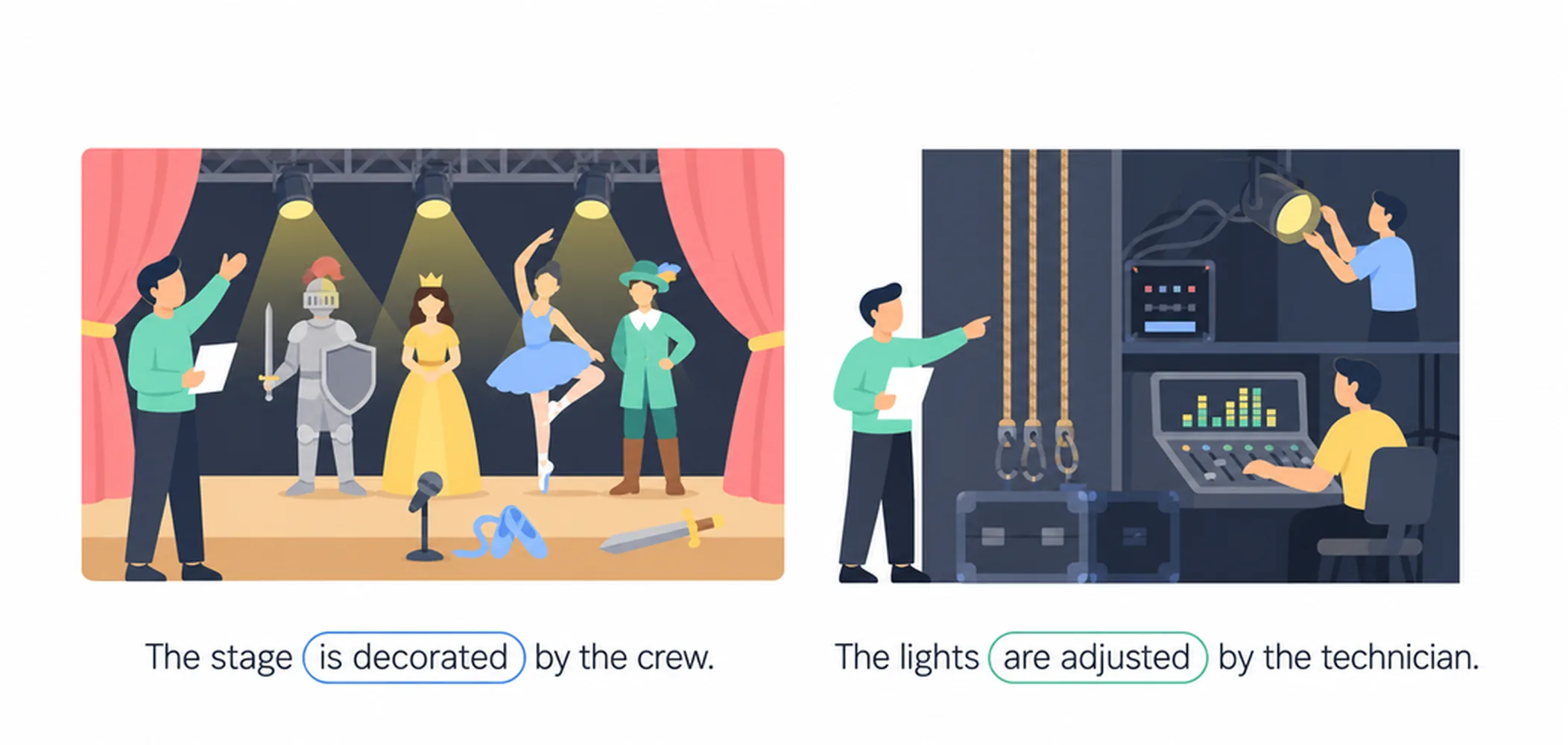
Passive voice shifts focus from the person doing an action to the action itself or the person receiving it. In active voice, the subject performs the action. In passive voice, the subject receives the action. Compare: Active: 'The chef prepares the meal.' Passive: 'The meal is prepared by the chef.' Both sentences mean the same thing, but passive voice emphasizes the meal, not the chef. At B1 level, you'll use passive voice to sound more formal, to focus on results, or when the 'doer' is unknown or unimportant.
Forming Present Passive Voice
To form passive voice in present tenses, use the present tense of 'be' + past participle. For present simple: am/is/are + past participle. Example: 'The letter is sent every morning.' For present continuous: am/is/are being + past participle. Example: 'The house is being painted right now.' For present perfect: have/has been + past participle. Example: 'The work has been completed.' The past participle stays the same for all three tenses—only the 'be' verb changes to show the time.
When to Use Present Passive Voice
Use passive voice when you want to emphasize the action or result rather than who did it, when the doer is unknown or obvious, or in formal writing like reports and instructions. In everyday conversation, active voice is more natural and direct. However, passive voice is essential in academic writing, professional communication, and when describing processes. For example, in a recipe: 'The ingredients are mixed together' (not important who mixes). Or in news: 'Two people were injured in the accident' (the injured person is the focus, not the cause).
Present Passive Voice: Full Conjugation by Subject
| Subject | Affirmative | Negative | Question |
|---|---|---|---|
| I | I am invited |
I am not invited |
Am I invited? |
| you (singular) | you are invited |
you are not invited |
Are you invited? |
| he / she / it | he is invited |
he is not invited |
Is he invited? |
| we | we are invited |
we are not invited |
Are we invited? |
| you (plural) | you are invited |
you are not invited |
Are you invited? |
| they | they are invited |
they are not invited |
Are they invited? |
| Subject | Affirmative | Negative | Question |
|---|---|---|---|
| I | I am being watched |
I am not being watched |
Am I being watched? |
| you (singular) | you are being watched |
you are not being watched |
Are you being watched? |
| he / she / it | she is being watched |
she is not being watched |
Is she being watched? |
| we | we are being watched |
we are not being watched |
Are we being watched? |
| you (plural) | you are being watched |
you are not being watched |
Are you being watched? |
| they | they are being watched |
they are not being watched |
Are they being watched? |
| Subject | Affirmative | Negative | Question |
|---|---|---|---|
| I | I have been chosen |
I have not been chosen |
Have I been chosen? |
| you (singular) | you have been chosen |
you have not been chosen |
Have you been chosen? |
| he / she / it | it has been chosen |
it has not been chosen |
Has it been chosen? |
| we | we have been chosen |
we have not been chosen |
Have we been chosen? |
| you (plural) | you have been chosen |
you have not been chosen |
Have you been chosen? |
| they | they have been chosen |
they have not been chosen |
Have they been chosen? |
1. Auxiliary agreement: Use am only with I; use is with he / she / it; use are with you, we, they.
2. has vs. have: In the present perfect passive, use has been with he / she / it and have been with all other persons.
3. Irregular past participles: Many common verbs have irregular forms used in the passive — for example, write → written, break → broken, choose → chosen, see → seen, do → done, make → made, take → taken, give → given, know → known, bring → brought.
4. Contractions: In informal speech, negatives are often contracted — isn't, aren't, hasn't, haven't. Note that amn't is non-standard; use I'm not instead.
5. Present continuous passive limitation: Stative verbs (for example, know, like, contain) are not normally used in the continuous passive form.
6. By-agent: The agent (doer) can optionally be added with by — for example, The letter is being written by her.
Examples






What to Remember
- Passive voice shifts focus from the doer to the action or receiver of the action.
- In present simple passive, use is/are + past participle: 'The meal is prepared.'
- In present continuous passive, use is/are + being + past participle: 'The meal is being prepared.'
- Use passive voice to sound formal, emphasize results, or when the doer is unknown.
- Both active and passive sentences convey the same meaning but with different emphasis.