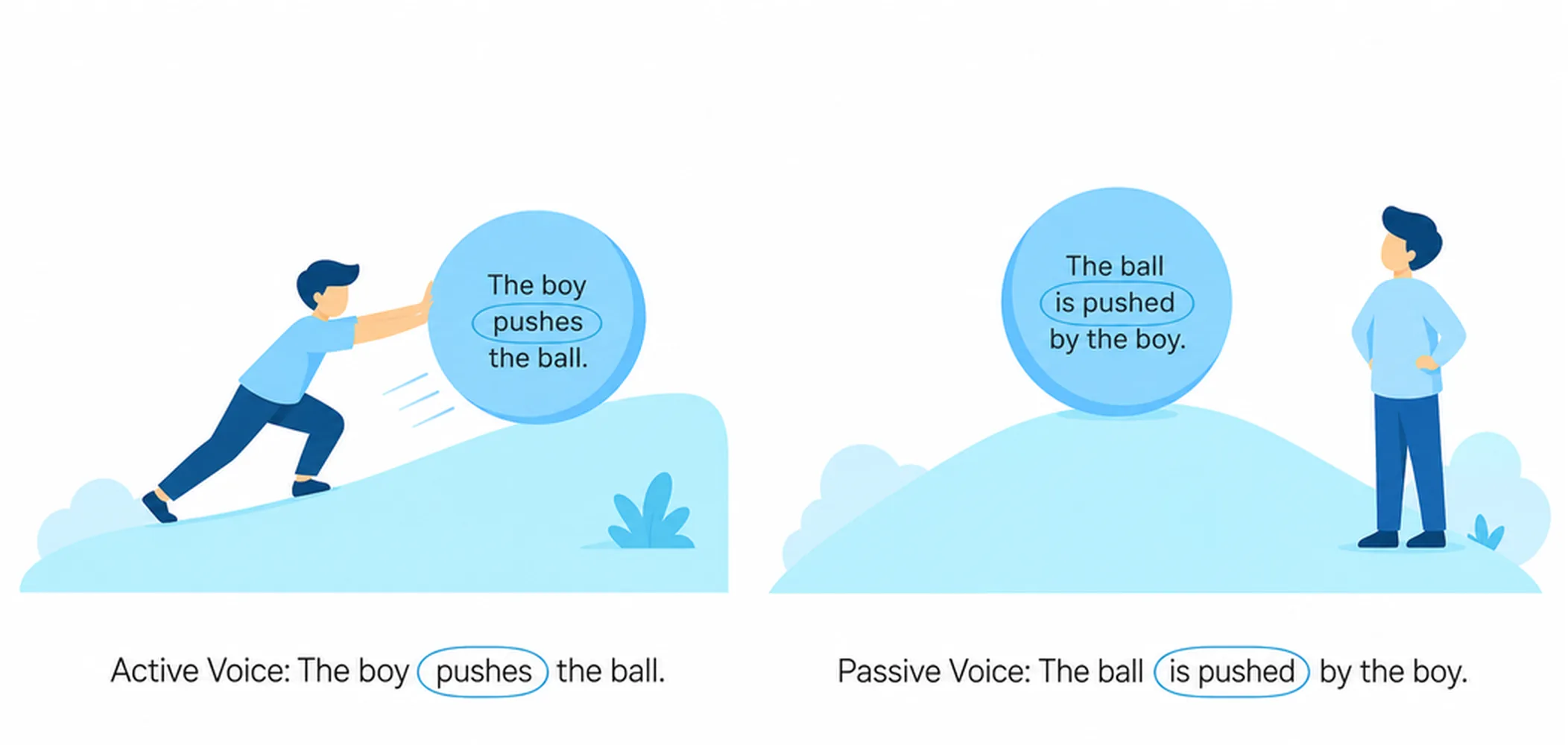
What is the Passive Voice?
The passive voice is a grammatical structure where the focus shifts from the person or thing doing the action (the subject) to the person or thing receiving the action (the object). In other words, the object of an active sentence becomes the subject of a passive sentence. Instead of saying "The chef cooked the meal," you say "The meal was cooked by the chef." The passive voice is formed using the auxiliary verb "be" in the appropriate tense, followed by the past participle of the main verb.
Active Voice vs. Passive Voice
In the active voice, the subject performs the action: "The teacher explained the lesson." In the passive voice, the subject receives the action: "The lesson was explained by the teacher." The passive voice is particularly useful when you don't know who performed the action, when the action is more important than the doer, or when you want to be more formal or objective. Notice that the "by" phrase (called the agent) is often omitted in passive sentences, especially when the doer is unknown or unimportant: "The lesson was explained."
Active Voice vs. Passive Voice: Side-by-Side Comparison
| Category | Active Voice | Passive Voice |
|---|---|---|
| Form | Subject + Verb + Object e.g. The chef [subject] cooked [verb] the meal [object]. |
Subject + to be + Past Participle (+ by + Agent) e.g. The meal [subject] was cooked [verb phrase] by the chef [agent]. |
| When to Use | When the doer of the action is known, important, or the focus of the sentence. Preferred in everyday conversation and direct writing. | When the action or the receiver is more important than the doer, the doer is unknown, or you want to avoid naming the doer. Common in formal, scientific, and journalistic writing. |
| Positive Example (Simple Present) |
The teacher explains the lesson. Subject: The teacher | Verb: explains | Object: the lesson |
The lesson is explained by the teacher. Subject: The lesson | Verb: is explained | Agent: by the teacher |
| Positive Example (Simple Past) |
Scientists discovered a new planet. Subject: Scientists | Verb: discovered | Object: a new planet |
A new planet was discovered (by scientists). Subject: A new planet | Verb: was discovered | Agent: optional |
| Positive Example (Present Perfect) |
Someone has stolen my bike. Subject: Someone | Verb: has stolen | Object: my bike |
My bike has been stolen. Subject: My bike | Verb: has been stolen | Agent: unknown/omitted |
| Positive Example (Future Simple) |
The company will launch the product next month. Subject: The company | Verb: will launch | Object: the product |
The product will be launched next month. Subject: The product | Verb: will be launched | Agent: omitted |
| Negative Example | The manager did not approve the request. | The request was not approved by the manager. |
| Question Example | Did the police arrest the suspect? | Was the suspect arrested (by the police)? |
| Key Signal Words | Action verbs in their direct form; the subject is always the person or thing performing the action. e.g. writes, built, will send, has finished |
"by" (to introduce the agent); forms of to be + past participle. e.g. is written, was built, will be sent, has been finished |
| Subject Role | The subject performs the action (the agent). e.g. Maria wrote the report. |
The subject receives the action (the patient). e.g. The report was written by Maria. |
| Object Role | The object receives the action and comes after the verb. e.g. Maria wrote the report. |
The original object becomes the new subject; the original subject can be dropped or introduced with "by". e.g. The report was written. |
| Key Difference: In the active voice, the subject acts upon the object — the focus is on who does the action. In the passive voice, the object of the active sentence becomes the subject, shifting the focus to what was done or who received the action. The passive is formed with the correct tense of to be + the past participle, and the original agent may be included with "by" or omitted entirely when it is unknown, unimportant, or obvious from context. | ||
Examples






What to Remember
- The passive voice shifts focus from the action-doer to the action-receiver.
- Form passive voice using the auxiliary verb "be" plus the past participle.
- The auxiliary verb "be" must match the tense of the original active sentence.
- The agent (person doing the action) can be omitted or introduced with "by."
- Passive voice emphasizes what happens rather than who does the action.