What Are Regular Verbs?
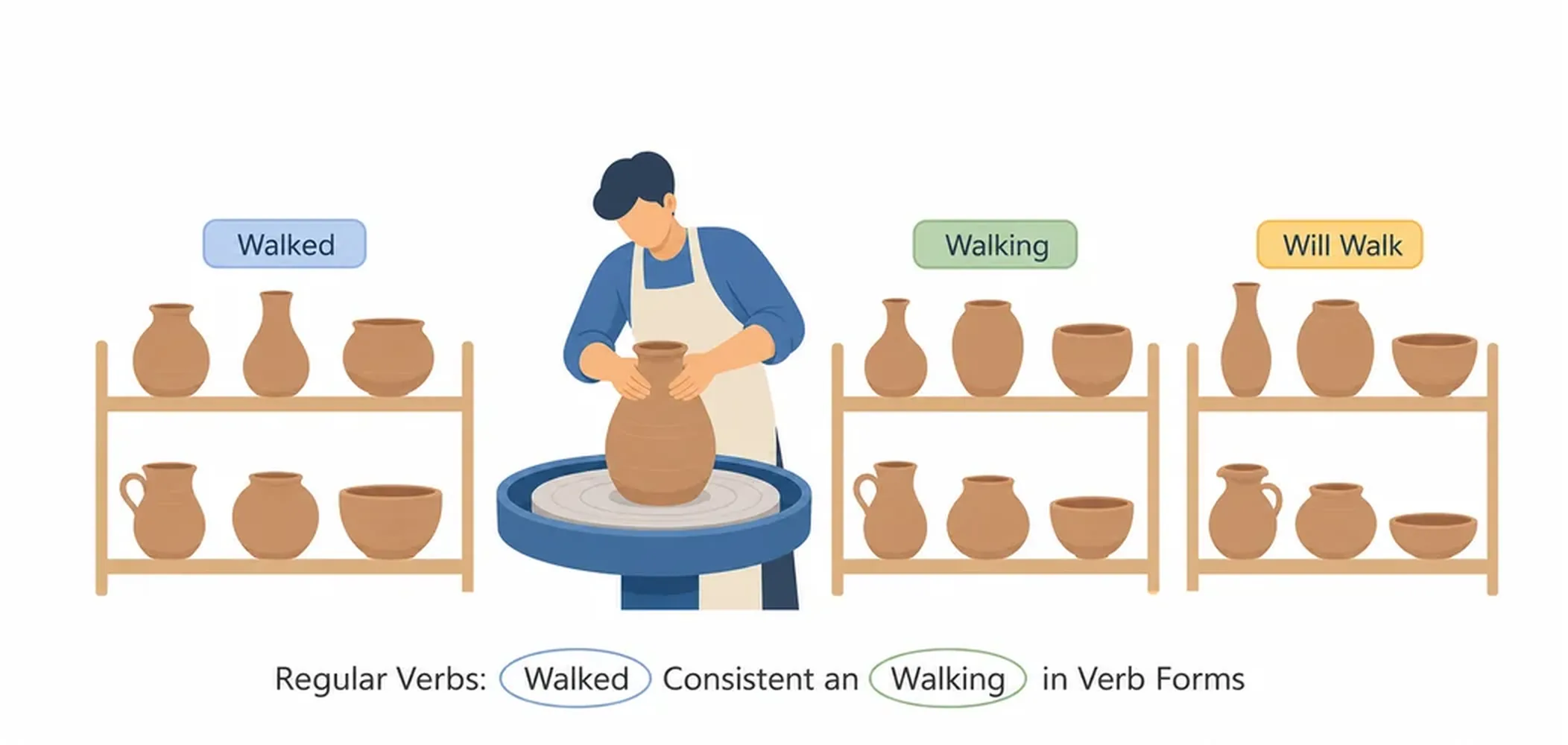
Regular verbs are verbs that follow a simple, predictable pattern when you change their tense. The pattern is the same for almost all regular verbs in English. This makes them easier to learn than irregular verbs, which change in unpredictable ways. Most English verbs are regular, so learning this pattern is very useful.
How to Form Regular Verbs
To form the past tense of regular verbs, you add -ed to the base form. For example: walk → walked, play → played, watch → watched. The -ed ending sounds different depending on the final sound of the verb, but the spelling rule is the same. This simple rule works for most regular verbs in English.
Regular Verbs in Sentences
Regular verbs follow the same pattern in positive and negative sentences. In negative sentences, you use 'did not' (or 'didn't') with the base form of the verb, not the -ed form. In questions, you also use the base form: Did you play yesterday? This pattern is consistent across all regular verbs.
Regular Verbs vs Irregular Verbs
| Regular Verbs | Irregular Verbs | |
|---|---|---|
| Form | Base verb + -ed (or -d if the verb already ends in e) for both simple past and past participle. The same form is used in all cases. Examples: walk → walked, love → loved, play → played, jump → jumped |
No fixed rule. Each verb has its own unique past simple and past participle forms that must be memorised individually. Forms can change vowels, endings, or the entire word. Examples: go → went / gone, buy → bought / bought, run → ran / run, be → was/were / been |
| When to use | Used in simple past tense, present perfect, past perfect, and passive constructions — wherever a past form is needed. The -ed ending applies consistently across all of these contexts without exception. | Used in exactly the same grammatical contexts as regular verbs — simple past, present perfect, past perfect, and passives — but the specific form required must be looked up or learned, as no pattern can be applied. |
| Positive example |
She walked to school this morning. They have finished the project. He cleaned the entire house yesterday. |
She went to school this morning. They have done the project. He broke the window yesterday. |
| Negative example |
She did not walk to school. They have not finished the project. He did not clean the house. Note: The base form is used after "did not" — the -ed ending is not doubled here. |
She did not go to school. They have not done the project. He did not break the window. Note: The base form is also used after "did not" for irregular verbs, same as regular verbs. |
| Question example |
Did she walk to school? Have they finished the project? Did he clean the house? |
Did she go to school? Have they done the project? Did he break the window? |
| Key signal words |
Yesterday, last week, ago, already, just, ever, never, since, for, recently, by the time, when. These signal words trigger the need for a past form — and with regular verbs, simply add -ed. |
Yesterday, last week, ago, already, just, ever, never, since, for, recently, by the time, when. The same signal words apply — but they do not help you predict the form. You must know the correct irregular form in advance. |
| Key Difference: The defining feature of a regular verb is its complete predictability — add -ed (or -d) to the base form and you have both the simple past and past participle, every single time, with no exceptions. Irregular verbs, by contrast, follow no single rule; their past forms are unpredictable and unique to each verb, making them necessary to memorise. This one consistent -ed pattern is precisely what earns a verb the label "regular." | ||
Examples






What to Remember
- Regular verbs follow a predictable pattern when changing tense, making them easier to learn than irregular verbs.
- Add -ed to the base form of regular verbs to create the past tense.
- Most English verbs are regular, so learning the -ed pattern is very useful and practical.
- The -ed ending sounds different depending on the final sound of the base verb.
- Remember: irregular verbs do not follow the -ed pattern and must be learned separately.