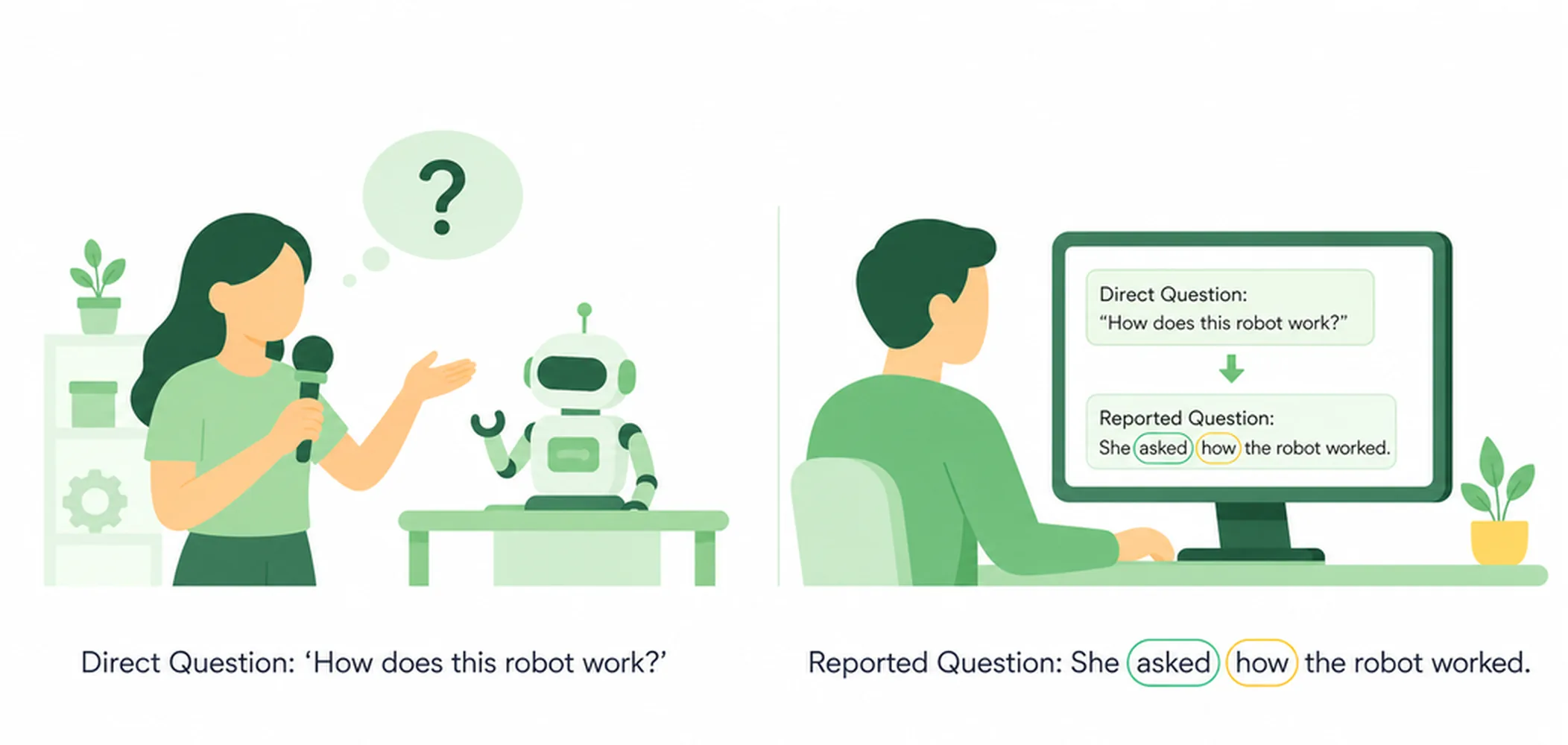
What are reported questions?
Reported questions allow us to tell someone what another person asked without using their exact words. When we report a question, we change it from direct speech (the original question) into reported speech (what we tell someone else about it). This requires changes to word order, pronouns, and sometimes tenses. Reported questions are essential for accurate communication in both spoken and written English, especially in professional and academic contexts.
Key differences: yes/no questions vs. wh-questions
There are two main types of reported questions. Yes/no questions (questions with 'do', 'does', 'did', 'can', 'will', etc.) are reported using 'if' or 'whether'. Wh-questions (those starting with 'what', 'where', 'when', 'why', 'who', 'how') keep their question word in reported speech. In both cases, the word order changes to statement word order (not question word order), and we use a reporting verb like 'ask', 'want to know', or 'wonder'.
Tense shifts in reported questions
When reporting questions, we typically shift tenses back one level, just as we do with reported statements. A present tense question becomes past tense in reported speech, and a past tense question becomes past perfect. However, if the reporting verb is in the present tense ('She asks'), or if the information is still true or relevant, we can keep the original tense. This flexibility makes reported questions more natural and context-dependent than they might initially seem.
How to Report a Question — Step-by-Step
To report a question, follow these four essential steps. Each step transforms the original question into reported speech. After learning the steps, use the tense selector below to identify which verb tense works best for your context.
Introduce the Reported Question
Begin with a reporting verb such as asked, wondered, inquired, or wanted to know. The reporting verb indicates that the original words were a question.
Direct: "Where are you going?"
Reported: She asked where I was going.
Change Pronouns and Perspective
Update pronouns to match the new perspective. The speaker becomes the person reporting, and listeners become third persons or objects. Adjust possessives and reflexive pronouns accordingly.
Direct: "What did you do yesterday?"
Reported: He asked what I had done the day before.
Adjust Word Order
Change question word order to statement word order. Remove the auxiliary verb from the front and place it after the subject. For yes/no questions, add if or whether and use statement word order.
Direct: "When will they arrive?"
Reported: I asked when they would arrive.
Direct: "Do you speak French?"
Reported: She asked if I spoke French.
Adjust the Verb Tense
Change the verb tense based on the time frame of the original question and the reporting situation. Use the selector below to determine which tense is appropriate.
Use these tenses when reporting a question asked in the past:
Use for simple past actions or habitual past events.
Use for actions in progress at a specific past moment, or actions interrupted by another event.
Use for actions completed before another past event.
Use for actions that were ongoing up to or before another past event.
Use these tenses when reporting a question in the present (immediate or habitual):
Use for general facts, habitual actions, or actions not tied to a specific time.
Use for actions happening right now or temporary situations.
Use for past experience with present relevance, or actions completed recently.
Examples






What to Remember
- Use statement word order (subject + verb) in reported questions, not question word order.
- Change pronouns and tenses in reported questions to match the reporting context and perspective.
- Use "if" or "whether" for yes/no questions; keep question words for wh- questions.
- Reported questions end with periods, not question marks, since they are statements.
- Avoid inverting the auxiliary verb in reported questions; maintain standard declarative sentence structure throughout.