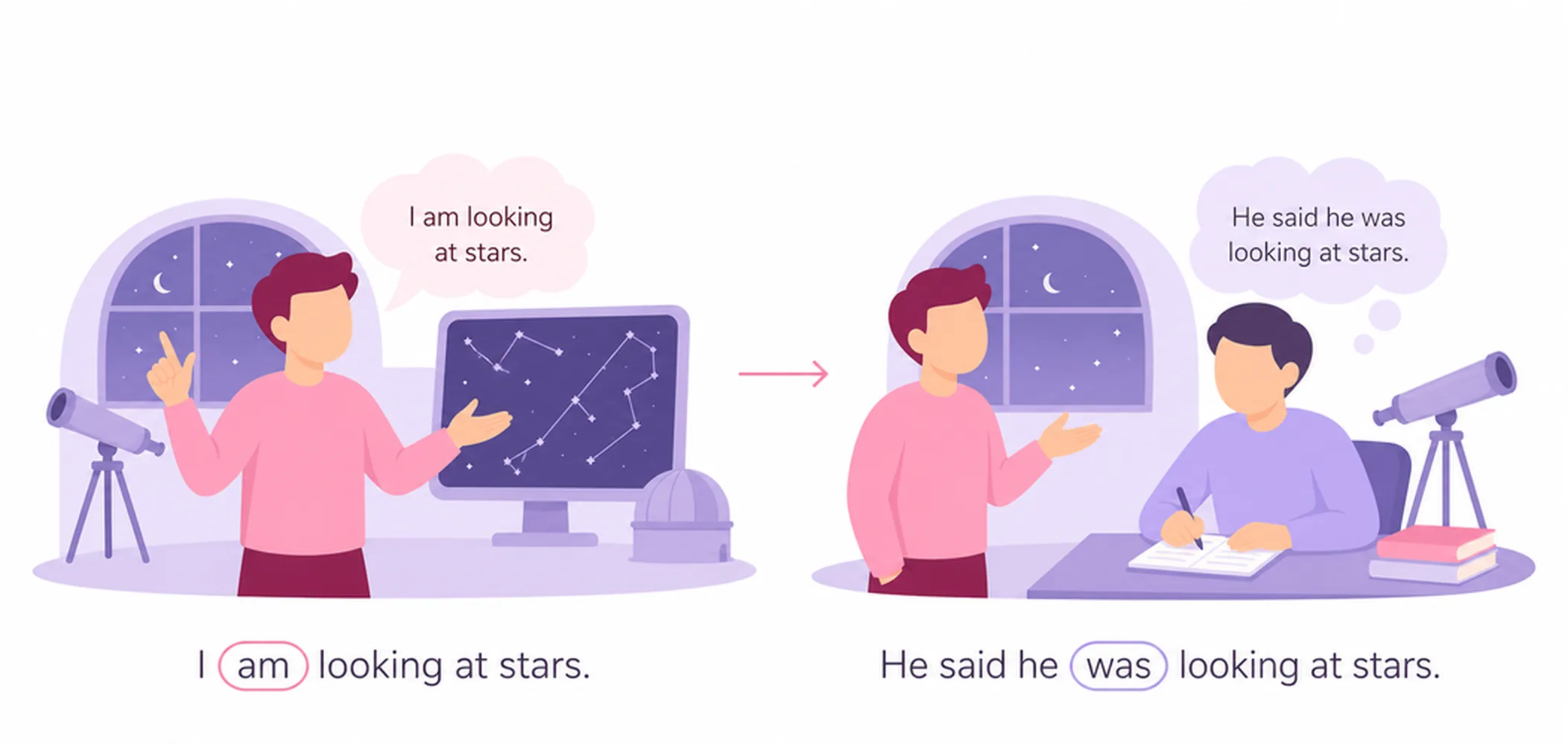
What is Reported Speech?
Reported speech (also called indirect speech) allows you to tell someone what another person said without using their exact words. Instead of quoting directly, you paraphrase and report the information. When you use reported speech, you typically move back one tense: present becomes past, past becomes past perfect, and so on. This shift happens because you are reporting something that was said in the past, even if only moments ago.
Key Changes in Reported Speech
When converting direct speech to reported speech, several elements change. Tenses shift backwards (present simple becomes past simple, present perfect becomes past perfect). Pronouns change to reflect the new speaker's perspective: 'I' becomes 'he/she,' 'you' becomes 'me/him/her,' and 'we' may become 'they.' Time expressions also adjust: 'today' becomes 'that day,' 'tomorrow' becomes 'the next day,' and 'here' becomes 'there.' The reporting verb (said, told, asked, explained, etc.) introduces the reported clause and varies depending on context.
Reported Statements, Questions, and Commands
Reported speech covers three main structures: statements (using 'said' or 'told'), questions (using 'asked,' 'wanted to know,' or 'inquired'), and commands (using 'told,' 'asked,' or 'ordered'). For statements, the tense shifts and the structure becomes subject + reporting verb + that-clause. For questions, question word order changes to statement order (no inversion). Commands use the infinitive form with 'to' after the reporting verb. Understanding these distinctions helps you choose the appropriate reporting structure for different situations.
Direct Speech vs Reported Speech — Side-by-Side
| Category | Direct Speech | Reported (Indirect) Speech |
|---|---|---|
| Form | Subject + said / asked: “exact words” | Subject + said (that) / asked + reported clause (tense shift applied) |
| When to use | Quoting someone's exact words, shown inside quotation marks; common in dialogue, journalism, and fiction | Retelling or summarising what someone said without quotation marks; common in academic writing, news reporting, and conversation |
| Positive example | “I am tired,” she said. “I work here,” he said. “She has finished the report,” Tom said. “I will help you,” Ana said. |
She said (that) she was tired. He said (that) he worked there. Tom said (that) she had finished the report. Ana said (that) she would help me. |
| Negative example | “I don't know the answer,” he said. “She hasn't called me,” Lucy said. “We won't be late,” they said. |
He said (that) he didn't know the answer. Lucy said (that) she hadn't called her. They said (that) they wouldn't be late. |
| Question example | “Are you ready?” he asked. “Where do you live?” she asked. “Can you help me?” they asked. |
He asked if / whether I was ready. She asked where I lived. They asked if / whether I could help them. |
| Tense shift rules | Present Simple → Present Continuous → Present Perfect → Past Simple → Past Continuous → will → can → may → |
→ Past Simple → Past Continuous → Past Perfect → Past Perfect → Past Perfect Continuous → would → could → might |
| Pronoun changes | “I love my job,” she said. “We need your help,” they said. “You should trust yourself,” he told me. |
She said (that) she loved her job. They said (that) they needed my help. He told me (that) I should trust myself. |
| Key signal words | now → today → yesterday → tomorrow → here → this → these → last week → next week → ago → |
→ then / at that moment → that day → the day before / the previous day → the next day / the following day → there → that → those → the week before / the previous week → the following week → before |
| Reporting verbs | Only said and asked are commonly shown, matching the exact spoken words | said, told, asked, explained, admitted, promised, warned, suggested, insisted, claimed, complained, denied, announced, reminded, advised, urged — chosen to reflect the speaker's intention or attitude |
| When tense shift is NOT needed | “The Earth orbits the Sun,” the teacher said. “Water boils at 100 °C,” she said. |
The teacher said the Earth orbits the Sun. ✔ (General truth — tense unchanged) She said water boils at 100 °C. ✔ (Scientific fact — tense unchanged) |
| 🔑 Key Difference: Direct speech reproduces a speaker's exact words inside quotation marks and preserves the original tense, pronouns, and time expressions. Reported (indirect) speech removes the quotation marks and adapts the sentence by (1) shifting the verb tense one step back into the past, (2) changing pronouns to match the new speaker's perspective, (3) updating time and place expressions to reflect the reporting context, and (4) choosing a precise reporting verb that captures the speaker's intention. The optional word that may be omitted in informal English. Tense backshift is unnecessary when reporting general truths, scientific facts, or statements that are still true at the time of reporting. | ||
Examples






What to Remember
- Use reported speech to paraphrase what someone said without quoting their exact words.
- Move back one tense when reporting: present becomes past, past becomes past perfect.
- Change pronouns and references to fit the reporter's perspective, not the speaker's.
- Use reporting verbs like said, told, asked, and explained to introduce reported statements.
- Modal verbs shift back too: can becomes could, will becomes would, must becomes had to.