What is Reported Speech?
Reported speech (also called indirect speech) is when you tell someone what another person said without using their exact words. When we report speech, we often need to change the tense of the original statement. This shift in tense is called "backshift" because we move the verb into a past form. The main rule is: if the reporting verb is in the past tense (said, told, asked), the tense in the reported clause usually moves one step backward in time.
The Backshift Pattern
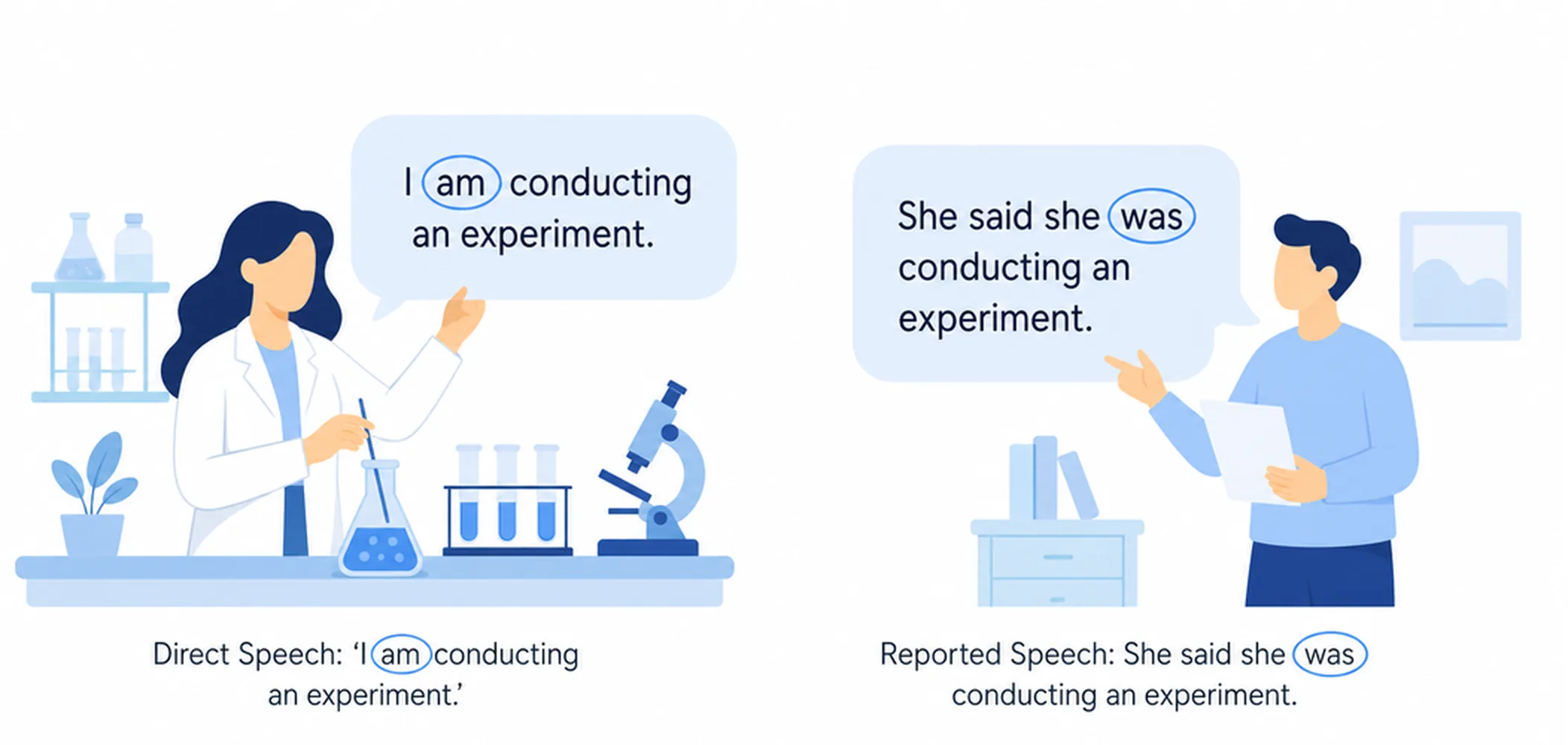
Understanding tense backshift is essential for accurate reported speech. Direct speech uses the speaker's original tense, while reported speech adjusts it based on when the reporting verb occurred. For example, if someone says 'I am working on a project' and you report this later, you change it to 'She said she was working on a project.' The present tense 'am' becomes past tense 'was' because the reporting verb 'said' is in the past. This creates distance between the original statement and your report of it.
When Backshift Doesn't Apply
Not all reported speech requires tense changes. If the reporting verb is in the present tense (says, tells, asks), no backshift occurs—the tenses remain the same. Additionally, if the reported information is still true or generally true, backshift is optional. For instance, 'She said that water boils at 100 degrees' may keep the present tense because this is a universal fact. Context and relevance determine whether strict backshift is necessary. As you advance in English, you'll learn when flexibility in tense usage is acceptable.
Tense Changes at a Glance
| Direct Speech Tense | Reported Speech (Backshifted) Tense |
|---|---|
|
Present Simple
e.g. "I work here."
|
Past Simple
e.g. He said he worked there.
|
|
Present Continuous
e.g. "I am reading a book."
|
Past Continuous
e.g. She said she was reading a book.
|
|
Present Perfect Simple
e.g. "I have finished the report."
|
Past Perfect Simple
e.g. He said he had finished the report.
|
|
Present Perfect Continuous
e.g. "I have been waiting for an hour."
|
Past Perfect Continuous
e.g. She said she had been waiting for an hour.
|
|
Past Simple
e.g. "I visited Paris last year."
|
Past Perfect Simple
e.g. He said he had visited Paris the previous year.
|
|
Past Continuous
e.g. "I was sleeping when you called."
|
Past Perfect Continuous
e.g. She said she had been sleeping when I called.
|
|
Past Perfect Simple
e.g. "I had already eaten."
|
Past Perfect Simple (no change)
e.g. He said he had already eaten.
|
|
Past Perfect Continuous
e.g. "I had been working all day."
|
Past Perfect Continuous (no change)
e.g. She said she had been working all day.
|
|
Future Simple (will)
e.g. "I will call you tomorrow."
|
Conditional (would)
e.g. He said he would call me the next day.
|
|
Future Continuous (will be + -ing)
e.g. "I will be travelling next week."
|
Conditional Continuous (would be + -ing)
e.g. She said she would be travelling the following week.
|
|
Future Perfect (will have + past participle)
e.g. "I will have finished by Monday."
|
Conditional Perfect (would have + past participle)
e.g. He said he would have finished by Monday.
|
|
Modals: can / may / shall / must / need
e.g. "I can help you." / "You must leave."
|
could / might / should / had to / needed to
e.g. He said he could help me. / She said I had to leave.
|
|
Modals: could / would / might / should / ought to
e.g. "I could swim faster then."
|
No change — already past modal forms
e.g. He said he could swim faster then.
|
When reporting what someone said in the past using a past reporting verb (e.g. said, told, asked), the verb tense in the reported clause is typically shifted one step back into the past — a rule called backshifting. Present simple becomes past simple, past simple becomes past perfect, will becomes would, and so on. However, backshifting is not mandatory when the reported information is still true or current at the time of reporting (She said the Earth orbits the Sun), or when using a present reporting verb (He says he is tired). Additionally, tenses that are already in the past perfect cannot shift further back and therefore remain unchanged.
Examples






What to Remember
- Use reported speech to tell what someone said without quoting their exact words.
- When the reporting verb is past tense, shift the reported clause verb one tense back.
- Present simple becomes past simple, and present perfect becomes past perfect in reported speech.
- If the reporting verb is present tense, the reported clause tense usually doesn't change.
- Backshift doesn't apply to past perfect, modal verbs like "would," or universal truths.