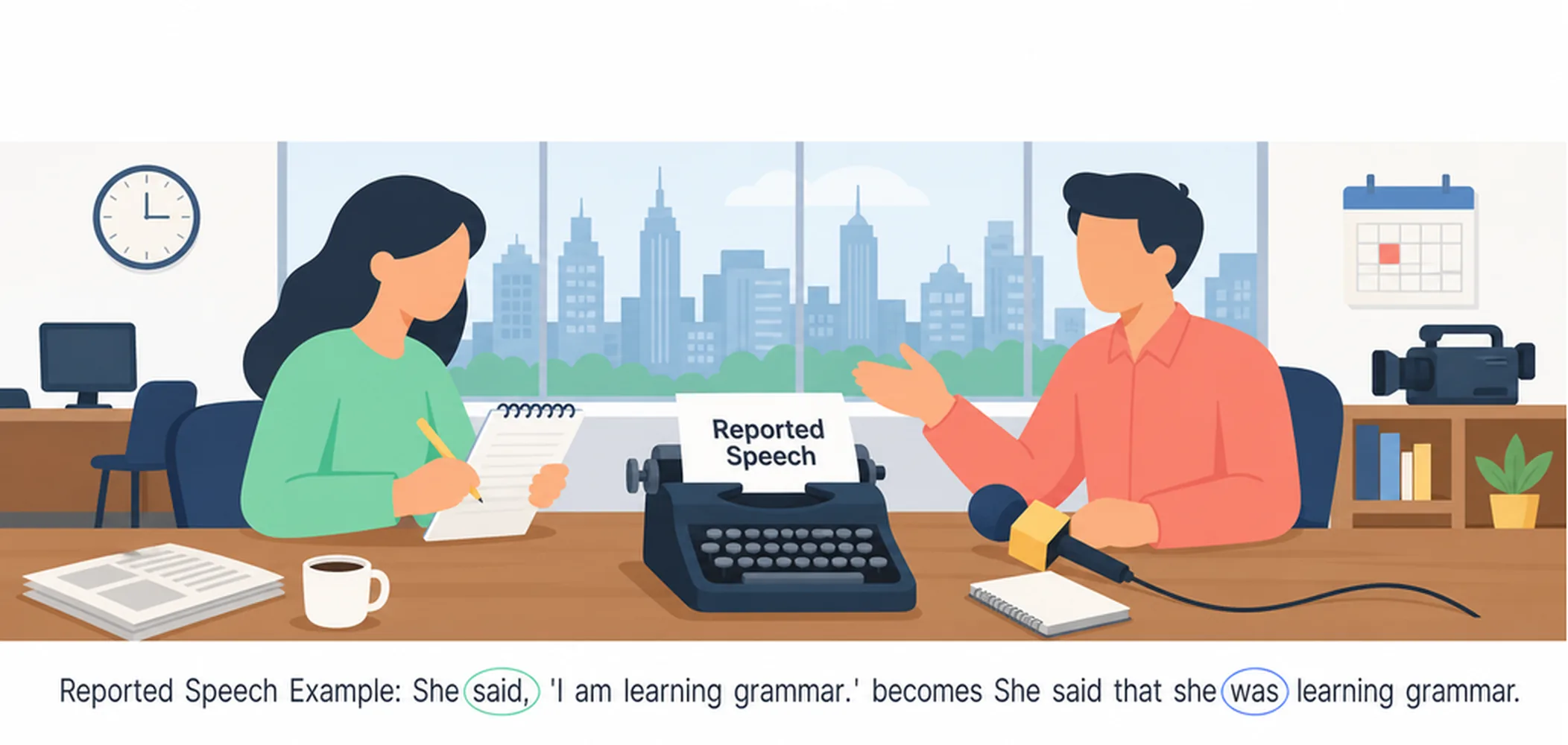
What is Reported Speech?
Reported speech, also called indirect speech, is a way of communicating what someone said without quoting their exact words. Instead of using quotation marks and repeating the speaker's original words, you report the content of their message by restructuring it grammatically. This is particularly useful in formal writing, storytelling, and everyday conversation when you want to share information without direct quotation. The main feature of reported speech is that it requires systematic changes to tense, pronouns, time expressions, and sometimes word order compared to the original direct speech.
Key Changes in Reported Speech
When converting direct speech to reported speech, several grammatical transformations typically occur. The verb tense usually shifts backward in time—present becomes past, past becomes past perfect, and future becomes conditional. Pronouns change to reflect the new perspective ("I" becomes "he/she"), and time expressions are adjusted accordingly ("tomorrow" becomes "the next day," "now" becomes "then"). Additionally, when reporting statements, the word order follows the declarative pattern with the reporting verb (said, told, explained) introducing the reported clause. Questions require inversion changes, and imperatives are converted into infinitive constructions. These changes maintain the meaning while adapting the language to fit a narrative context.
Direct Speech vs. Reported Speech
| Category | Direct Speech | Reported Speech |
|---|---|---|
| Form | The speaker's exact words are quoted, placed inside quotation marks, and introduced by a reporting verb (e.g. say, tell, ask). | The speaker's words are paraphrased without quotation marks. Tense, pronouns, and time expressions shift to reflect the reporting context. |
| When to Use | Use when quoting someone's words exactly as they were spoken — common in dialogue, journalism, and fiction. | Use when relaying what someone said without quoting them word-for-word — common in conversation, essays, and news reporting. |
| Positive Example | "I am very tired today," she said. | She said that she was very tired that day. Note: present simple → past simple; "today" → "that day" |
| Negative Example | "I haven't finished my homework yet," he said. | He said that he hadn't finished his homework yet. Note: present perfect → past perfect; "my" → "his" |
| Question Example | "Where are you going?" she asked. | She asked where I was going. Note: question word order → statement word order; tense shifts back; question mark removed |
| Tense Shifts | Tenses remain as spoken: • Present Simple • Present Continuous • Present Perfect • Past Simple • Will / Can |
Tenses shift one step back: • → Past Simple • → Past Continuous • → Past Perfect • → Past Perfect • → Would / Could |
| Pronoun Shifts | Pronouns reflect the original speaker's point of view: "I love my job," said Tom. |
Pronouns shift to reflect the reporter's point of view: Tom said that he loved his job. |
| Key Signal Words | Time/place expressions as spoken: • now • today • yesterday • tomorrow • here • this • last night • next week |
Time/place expressions shift to: • then • that day • the day before • the following day • there • that • the night before • the following week |
| Key Difference: Direct speech reproduces a speaker's exact words within quotation marks, keeping all original tenses, pronouns, and time references intact. Reported (indirect) speech paraphrases what was said, requiring a systematic backshift of tenses (e.g. present → past), adjustment of pronouns to match the reporting perspective (e.g. "I" → "he/she"), and replacement of time and place expressions to suit the moment of reporting (e.g. "today" → "that day"). Additionally, questions in reported speech abandon inverted word order and question marks, adopting normal statement structure instead. | ||
Examples





What to Remember
- Reported speech conveys someone's message without using their exact words or quotation marks.
- Shift tenses back one level: present becomes past, past becomes past perfect, etc.
- Change pronouns and references to match the reporter's perspective, not the original speaker's.
- Use reporting verbs like said, told, asked, and insisted to introduce reported clauses.
- Modal verbs like can, will, and may shift to could, would, and might in reported speech.