What Are Time and Place Word Changes?
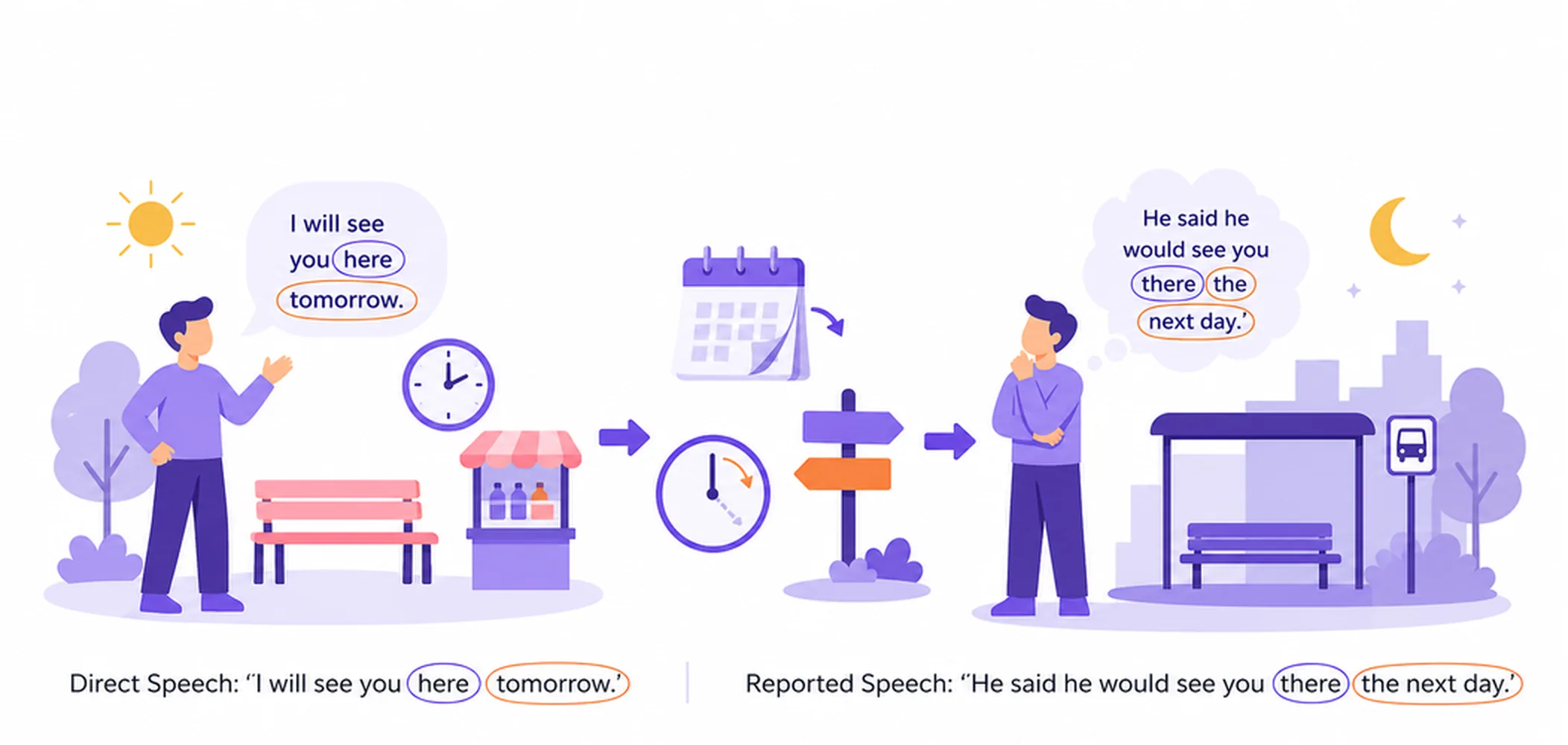
When we report what someone said, we often need to change certain words that depend on the speaker's perspective. Time words like 'today', 'tomorrow', and 'here' make sense when the speaker says them, but they need to change when we report the speech later or from a different location. These changes happen automatically because the context has shifted. The reported speaker is no longer present, and we're speaking from a different point in time or space.
Common Time and Place Word Changes
The most important rule is to shift time words backwards. If the original speaker said 'today', we report it as 'that day'. If they said 'tomorrow', we say 'the next day' or 'the following day'. Place words also change based on our perspective. 'Here' becomes 'there', and 'this place' becomes 'that place'. However, if we report speech immediately after it happens, or if the situation is still relevant, you can sometimes keep the original words. Always consider whether the reported information is still current when deciding whether to change these words.
When Do We NOT Change Time and Place Words?
You don't need to change time and place words if the reported speech is still accurate at the moment of reporting. For example, if someone says 'I'm busy today' and you report it five minutes later, you can say 'He said he's busy today' because today is still happening. Similarly, if you're reporting from the same location, 'here' can remain. This flexibility is especially common in direct, informal reporting. The key principle is: change words only when they would be misleading or confusing without the change.
Time and Place Word Changes at a Glance
| Direct Speech | Reported Speech | Example (Direct → Reported) |
|---|---|---|
| now | then / at that moment | "I am busy now." → She said she was busy then. |
| today | that day | "I'll call you today." → He said he would call me that day. |
| yesterday | the day before / the previous day | "I saw her yesterday." → He said he had seen her the day before. |
| tomorrow | the next day / the following day | "I'll leave tomorrow." → She said she would leave the next day. |
| this week | that week | "I'm travelling this week." → He said he was travelling that week. |
| last week | the week before / the previous week | "I finished it last week." → She said she had finished it the week before. |
| next week | the following week / the week after | "We meet next week." → He said they would meet the following week. |
| this month / year | that month / that year | "Sales are up this year." → She said sales were up that year. |
| ago | before | "I met her two years ago." → He said he had met her two years before. |
| here | there | "I work here." → She said she worked there. |
| this | that | "This is my bag." → He said that was his bag. |
| these | those | "These are my keys." → She said those were her keys. |
Examples






What to Remember
- When reporting speech, shift time words backward: 'today' becomes 'that day', 'tomorrow' becomes 'the next day'.
- Change place words based on the new speaker's perspective: 'here' becomes 'there', 'this place' becomes 'that place'.
- Shift personal references when reporting: 'I' and 'you' change based on who is speaking and listening now.
- If the reported statement is still true or timeless, time word changes may be optional in some contexts.
- Apply shifts consistently whenever the speaker, time, or location differs between direct and reported speech.