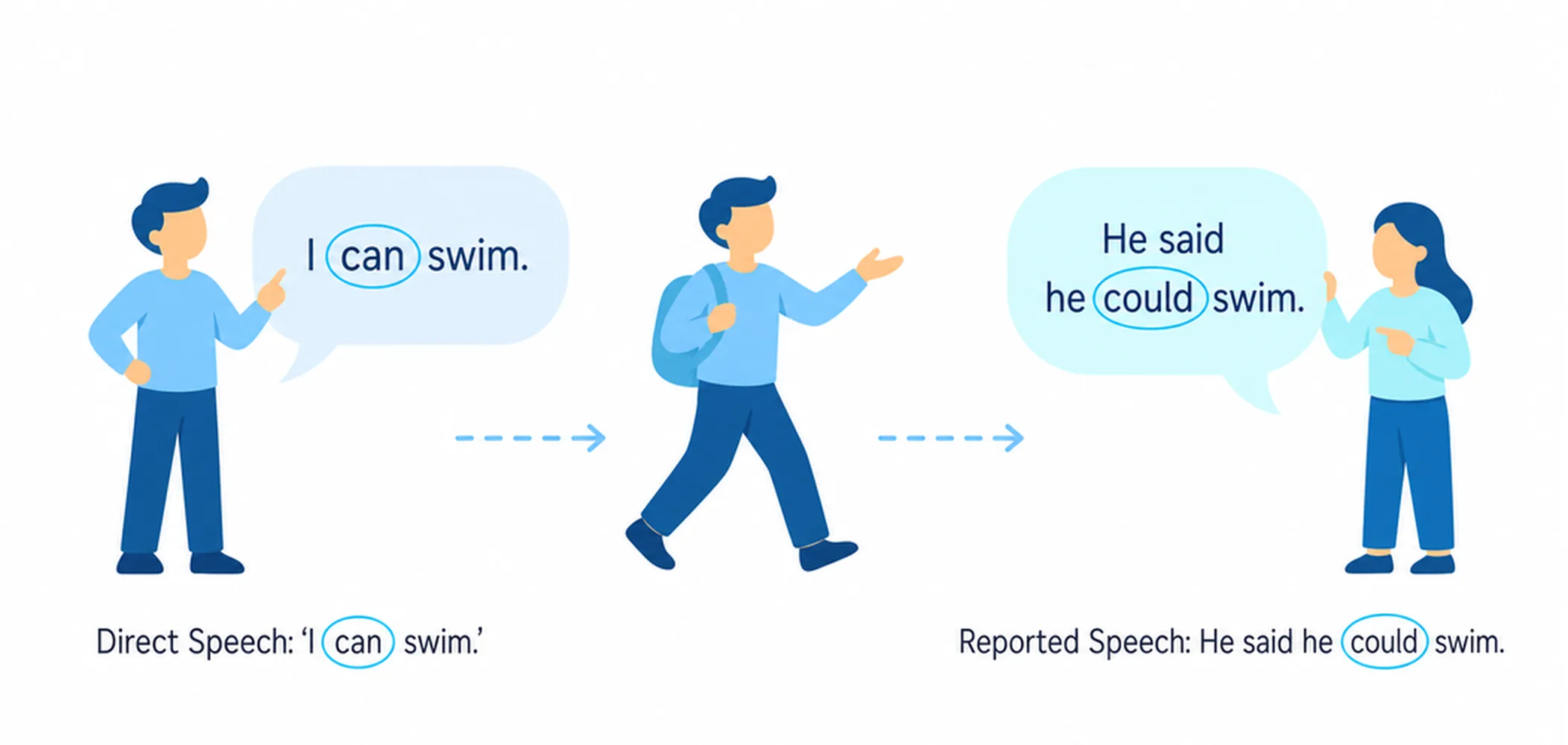
Understanding Modal Verbs in Reported Speech
When we report what someone said using reported speech, modal verbs often change to maintain the correct tense relationship. The key principle is backshifting: we move the modal verb back one tense level to show that the original statement was made in the past. Some modals change, while others remain the same. Understanding these transformations helps you report speech accurately and naturally.
Modal Verbs That Change
The most common modal verbs shift backward: 'can' becomes 'could', 'will' becomes 'would', 'may' becomes 'might', and 'must' becomes 'had to'. These changes reflect the past perspective of reported speech. However, 'should', 'could', 'might', 'ought to', and 'would' typically don't change because they already have a past or conditional quality. The context and the reporting verb you choose (said, told, mentioned) remain the same.
Special Cases and Practical Notes
When the reported speech refers to something that is still true or a permanent fact, you can choose not to backshift the modal: 'She said that water boils at 100 degrees' works just as well as backshifting. Additionally, if the reporting clause uses present tense (such as 'He says that...'), the modal in the reported clause doesn't change. Pay attention to the reporting situation to decide whether backshifting is necessary or sounds more natural.
Modal Verb Changes in Reported Speech
| Direct Speech Modal Verb | Reported Speech Equivalent |
|---|---|
|
can
"I can help you."
|
could
She said she could help me.
|
|
will
"I will call you tomorrow."
|
would
He said he would call me the next day.
|
|
may
"She may arrive late."
|
might
He said she might arrive late.
|
|
must
"You must finish this today."
|
had to (obligation) / must (logical deduction)
She said I had to finish it that day. / He said it must be true.
|
|
shall
"I shall return."
|
would
He said he would return.
|
|
should
"You should see a doctor."
|
should (no change)
She said I should see a doctor.
|
|
could
"I could swim when I was young."
|
could (no change)
She said she could swim when she was young.
|
|
might
"It might rain later."
|
might (no change)
He said it might rain later.
|
|
would
"I would love to come."
|
would (no change)
She said she would love to come.
|
|
ought to
"You ought to apologise."
|
ought to (no change)
He said I ought to apologise.
|
Examples






What to Remember
- Use backshifting to move modal verbs back one tense level in reported speech.
- Can becomes could, will becomes would, and may becomes might when reporting past statements.
- Some modals like must, should, and ought to often remain unchanged in reported speech.
- Modal verbs shift to maintain correct tense relationship between the reported clause and reporting verb.
- Always consider the original speaker's intention when choosing whether to backshift certain modal verbs.