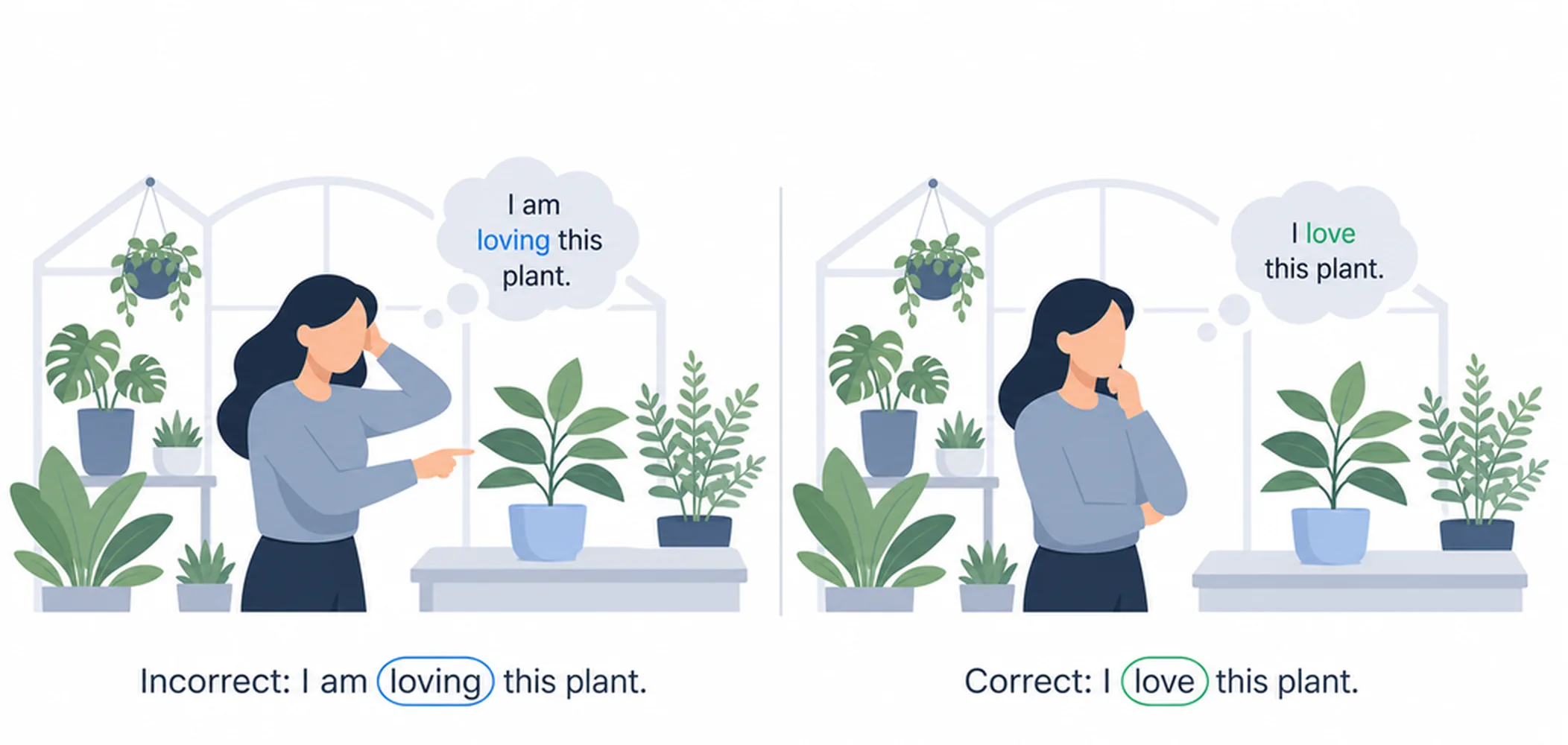
Why Stative Verbs Are Tricky
Stative verbs describe states, feelings, or conditions—not actions. Many learners make mistakes because they treat stative verbs like dynamic verbs, using continuous tenses incorrectly. The main problem is using the present continuous (is -ing) with verbs that should only use simple tenses. Understanding when a verb is stative will help you speak and write more naturally.
7 Errors to Avoid
Below are the most frequent mistakes B1 learners make with stative verbs. Study each pair carefully and notice the difference.
Stative vs Dynamic: Side-by-Side Comparison
| Verb | Incorrect (Continuous) | Correct (Simple) | Example |
|---|---|---|---|
|
Mental States
|
|||
| know | am/is/are + knowing | know / knows | I am knowing the answer. → I know the answer. |
| believe | am/is/are + believing | believe / believes | He is believing in ghosts. → He believes in ghosts. |
| understand | am/is/are + understanding | understand / understands | I am understanding the lesson now. → I understand the lesson now. |
|
Emotions & Feelings
|
|||
| love | am/is/are + loving | love / loves | She is loving chocolate ice cream. → She loves chocolate ice cream. |
| hate | am/is/are + hating | hate / hates | He is hating Mondays. → He hates Mondays. |
| prefer | am/is/are + preferring | prefer / prefers | I am preferring tea over coffee. → I prefer tea over coffee. |
|
Possession
|
|||
| have (own) | am/is/are + having | have / has | I am having a car. → I have a car. |
Examples

I understand your concern, but I think everything will be fine.
Stative verb · Knowledge/comprehension

Do you like pizza, or do you prefer pasta?
Stative verbs · Preferences

She owns a small bookshop in the city center.
Stative verb · Possession

I believe the project will succeed because the team is very motivated.
Stative verb · Opinion/belief
When to use it
Expressing opinions
Use simple present with stative verbs like think, believe, and suppose when giving your view on something.
I think this film is excellent.
Describing feelings
Emotions and preferences (like, love, hate, want) are stative. Never add -ing to these verbs.
She loves chocolate, but he hates it.
Sensory perception
When describing what you perceive through your senses (see, hear, taste, smell), use simple tenses.
This perfume smells wonderful.
Knowledge and understanding
Verbs like know, understand, and recognize describe mental states, not actions.
Do you know his phone number?
Signal words
understand
like
love
hate
want
need
know
believe
think
suppose
own
possess
seem
appear
taste
smell
sound
look
feel
see
hear
Common Mistakes
✕
Wrong
I am understanding the grammar now.
✓
Correct
I understand the grammar now.
Understand is stative. Use simple present, not continuous. The action doesn't happen 'right now'—it describes your current state of knowledge.
✕
Wrong
She is liking the new restaurant very much.
✓
Correct
She likes the new restaurant very much.
Like (preference) is stative. You don't 'do' liking—you have a feeling. Use simple present only.
✕
Wrong
They are knowing the answer to the question.
✓
Correct
They know the answer to the question.
Know is stative. Knowledge is a state, not an action. Never use continuous forms with 'know'.
✕
Wrong
He is owning three cars.
✓
Correct
He owns three cars.
Own is stative. Possession is a state, not something you actively 'do'. Use simple present.
✕
Wrong
I am believing that she is honest.
✓
Correct
I believe that she is honest.
Believe (opinion) is stative. This is about your mental state, not an action. Use simple present.
✕
Wrong
Are you seeing the problem with this plan?
✓
Correct
Do you see the problem with this plan?
See (understand/perceive) is stative when it means 'understand'. Use simple present, not continuous.
✕
Wrong
The coffee is tasting bitter to me.
✓
Correct
The coffee tastes bitter to me.
Taste (sensory perception) is stative. It describes how something is, not an action you're doing. Use simple present.
KEY TAKEAWAYS
What to Remember
- Stative verbs describe states or conditions, never use continuous tenses with them.
- Common stative verbs include: be, have, like, want, know, understand, believe, seem.
- Never say "I am understanding" or "she is wanting"—use simple present instead.
- Some verbs can be stative or dynamic depending on meaning; check context carefully.
- Use simple tenses (present, past, perfect) with stative verbs, not continuous forms.